Technological Readiness Levels (TRL) scoring and methodology serve as pivotal frameworks in Research and Development (R&D) that guide project management and company planning across various sectors, including aerospace, healthcare, and manufacturing. Originating from NASA in the 1970s, TRLs provide a structured approach to assessing the maturity of technologies, with a nine-level scale that ranges from basic principles (TRL 1) to fully operational systems (TRL 9).
النقاط الرئيسية
- Originated by NASA, adopted globally for R&D.
- Nine levels ranging from basic principles to proven systems.
- Facilitates risk management and informed funding choices.
- Evaluation based on key criteria for each TRL level.
- Aligns with various phases of project development.
- Consider context and potential misuse of TRL framework.
According to a report by the European Commission, effective application of TRLs has been shown to improve the likelihood of successful project completion by up to 70%, highlighting their importance in risk management and decision-making processes for funding and technology transition.
Definition of Technological Readiness Levels TRLs
Technological Readiness Levels (TRLs) serve as a metrics framework designed to evaluate the maturity of technologies. Originally conceived by NASA in the late 1970s as part of the Space Shuttle program, the purpose was to enable a structured way to assess the readiness of emergent technologies for inclusion in space missions. TRL assessments help in identifying technological gaps and in making informed decisions about project funding, planning, and risk management.
The TRL scale consists of nine distinct levels, each representing a phase of development. Level 1 denotes the basic principles observed, while Level 9 signifies that the technology has been proven in an operational environment:
| Level | Description & details (ملاحظة: الأمثلة خيالية، للتوضيح فقط) |
| TRL 1 | Basic principles observed: scientific research begins to translate into applied research and development. Activities might include paper studies of a technology’s basic properties.
|
| TRL 2 | Technology concept formulated: invention begins. Once basic principles are observed, practical applications can be invented. Activities are limited to analytic studies.
|
| TRL 3 | Analytical and experimental proof of concept: active research and development begin, including both analytical studies and laboratory experiments to validate that the theoretical predictions are correct.
|
| TRL 4 | Technology validated in lab environment: تechnology validated through designed investigation. Examples might include analysis of the technology parameter operating range. The results provide evidence that envisioned application performance requirements might be attainable.
|
| TRL 5 | Technology validated in relevant environment: reliability of technology significantly increases. Examples could involve validation of a semi-integrated system/model of technological and supporting elements in a simulated environment.
|
| TRL 6 | Technology demonstrated in relevant environment: prototype system verified. Examples might include a prototype system/model being produced and demonstrated in a simulated environment.
|
| TRL 7 | System prototype demonstration in operational environment: a major step increase in technological maturity. Examples could include a prototype model/system being verified in an operational environment.
|
| TRL 8 | Actual system completed and qualified through test and demonstration: system/model produced and qualified. An example might include the knowledge generated from TRL 7 being used to manufacture an actual system/model, which is subsequently qualified in an operational environment.
|
| TRL 9 | Actual system proven in operational environment: system/model proven and ready for full commercial deployment. An example includes the actual system/model being successfully deployed for multiple missions by end users.
|
This linear progression creates a clear map from conceptualization to mature deployment, facilitating communication among stakeholders across various phases of product development and innovation.
TRLs in R&D Project Management
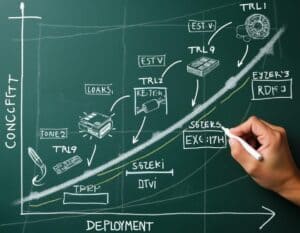
This structured approach allows project managers to objectively analyze where their projects stand within the development cycle. With clear delineations of stages, stakeholders can make informed decisions based on the TRL designation, leading to more precise budget allocations and resource planning.
Various organizations have adapted the TRL methodology to fit their specific requirements while still maintaining the core premise of measuring technological advancement along a linear spectrum.
TRL evaluation: the participation of multidisciplinary teams enhances reliability in assessing TRLs. Collaboration with experts from fields such as manufacturing, environmental science, and economics can provide diverse perspectives on potential risks and benefits. Engaging stakeholders early in the evaluation process also ensures broader input and promotes accountability, helping the understanding of the technology’s readiness.
For instance, a new drug development project might utilize TRLs to benchmark its progress from laboratory testing (TRL 1) to clinical trials (TRL 5) swiftly and without unnecessary delays.
Project Tips:
- Incorporate regular TRL assessments at key project milestones to maintain alignment on development goals and adjust project trajectories effectively. This iterative process not only helps track progress but also enables rapid adaptation to unforeseen challenges. Regular reviews can further enhance the clarity of the project’s readiness status throughout its lifecycle.
- Utilize a TRL-based checklist during project meetings to continually assess technology maturity and keep the momentum of discussions focused on actionable objectives.
- The TRL assessment process is often achievable through a combination of qualitative and quantitative methods: teams may employ a scoring matrix to objectively evaluate various facets, including technical performance, operational maturity, and integration potential.

TLRs & Company Management

Aligning Technology Readiness Levels with strategic road-mapping: iدمج مستويات الجاهزية التكنولوجية في technology roadmap يقدم هذا النهج طريقة منهجية لمواءمة التطورات التكنولوجية مع أهداف الأعمال، وبالتالي تحسين استراتيجيات الاستثمار.
This alignment allows investors to evaluate risk and potential returns more effectively, as technologies with higher TRLs generally carry less uncertainty and provide a clearer market pathway. من ناحية أخرى، التكنولوجيا المنظمة جيداً خريطة الطريق يمكن أن يوجه هذا النهج الاستخدام الفعال لمستويات جاهزية التكنولوجيا (TRLs) من خلال توفير سياق لكل مرحلة من مراحل التطوير. يُمكّن هذا السياق الشركات من وضع توقعات قابلة للتحقيق لنمو التكنولوجيا وتحديد الاستثمارات المطلوبة في كل مستوى من مستويات جاهزية التكنولوجيا.
This synergy between TRLs and the technology roadmap guarantees that investments are strategically connected to the company’s innovation path.

Limitations and Considerations When Using the TRL Framework
While Technological Readiness Levels offer a systematic framework for gauging technology maturity, certain limitations must be considered. One major concern is the inherent lack of quantitative metrics for the transition between levels. For example, moving from TRL 4 to TRL 5 may require extensive testing and validation, but the criteria for determining readiness are often qualitative. This could lead to inconsistencies in assessments across different projects or organizations.
Another challenge is that the TRL framework primarily addresses technological readiness but does not encapsulate other critical factors such as market viability or regulatory compliance.
Many innovations may achieve high TRLs yet still fail to enter the market due to insufficient understanding of customer needs or legal barriers.
To Wrap-Up
Technological Readiness Levels (TRLs) offer a structured methodology that not only facilitates assessment during the R&D phases but also significantly enhances project management effectiveness across various sectors. By systematically categorizing technology maturity from conceptual stages to operational deployment, TRLs can serve as an indispensable tool for engineers and project managers alike. The nine-level scale, rooted in historical precedent, establishes a common language that streamlines communication within teams and stakeholders, pushing to collaboration and informed decision-making.
التعليمات
What are the Technological Readiness Levels (TRLs)?
توفر مستويات الجاهزية التكنولوجية (TRLs) إطارًا لتقييم نضج التكنولوجيا. وقد اكتسب هذا المقياس، الذي طورته وكالة ناسا، رواجًا واسعًا في مختلف القطاعات لتحسين تقييم التكنولوجيا وإدارة المشاريع. يتألف مقياس TRL من تسعة مستويات متميزة، يصف كل منها مرحلة من مراحل نضج التكنولوجيا. بدءًا من المستوى الأول (TRL 1)، الذي يركز على المبادئ الأساسية، وصولًا إلى المستوى التاسع (TRL 9)، حيث تم تطبيق التكنولوجيا بنجاح في بيئات تشغيلية، يقدم كل مستوى صورة واضحة للتطور التكنولوجي.
What are the purposes and benefits of using TRLs in project management?
TRLs provide a standardized method for evaluating technology, which fosters alignment among team members and stakeholders regarding project status. This clarity enhances risk management strategies and informs critical funding and project transition decisions.
What methodology is used for assessing TRLs in R&D projects?
To assess TRLs, a structured methodology is employed that involves analyzing project components and addressing specific evaluation questions. This process ensures the assigned TRL accurately reflects the technology’s current state and readiness for the next developmental phase.
How are TRLs applied in different R&D project management phases?
في إدارة مشاريع البحث والتطوير، تُعدّ مستويات جاهزية التكنولوجيا بمثابة نقاط مرجعية تُحدد مراحل التطوير المختلفة. يوفر كل مستوى إرشادات حول المهام والأهداف اللازمة لنقل التكنولوجيا من مرحلة الفكرة إلى مرحلة التشغيل، مما يُعزز التقدم المنهجي. تُعتبر مستويات جاهزية التكنولوجيا أداةً مفيدة، ولكن لها حدود يجب إدراكها. ينبغي على المستخدمين فهم أن إطار عمل مستويات جاهزية التكنولوجيا قد لا ينطبق عالميًا على جميع التقنيات، وعليهم مراعاة السياق والاستخدام المقصود بعناية عند الاعتماد على هذا النظام.
How do TRLs influence government and agency funding allocation for research initiatives?
TRLs significantly impact funding allocation decisions, as they provide a common framework for evaluating how mature a technology is. By assessing TRL levels, funding bodies can focus their resources on projects that demonstrate a promising likelihood of success and relevance.
How do TRLs support corporate strategy and new product development planning?
Companies can leverage TRLs to inform their strategic planning and new product development efforts. By understanding the readiness of technologies, organizations can make more informed investment decisions and optimize resource allocation to enhance the likelihood of successful product launches.
قراءات ذات صلة
- Integration of TRLs with Agile Methodology: assessing how TRLs can complement agile practices for iterative development.
- Linking TRLs to Stage-Gate Processes: understanding the relationship between TRLs and stage-gate project management frameworks.
- TRLs in دورة حياة المنتج Management: utilizing TRLs to inform decision-making throughout a product’s lifecycle stages.
- Use of TRLs in تقييم المخاطر Models: discussing how TRLs can be factored into technology risk evaluation methods.
- Cross-Industry TRLs Application: investigating how TRLs can be applied across diverse sectors beyond their original intent.
- Technological Forecasting and TRLs: connecting TRLs with methods of predicting future technological trends and readiness.
مسرد المصطلحات المستخدمة
Network-attached storage (NAS): جهاز تخزين متصل بشبكة، يتيح الوصول إلى البيانات ومشاركتها بين عدة مستخدمين وأجهزة، ويوفر عادةً تخزينًا مركزيًا للملفات، ونسخًا احتياطيًا، وإدارتها. يعمل بشكل مستقل عن جهاز الكمبيوتر، ويمكن الوصول إليه عبر بروتوكولات الشبكة القياسية.
New Product Development (NPD): عملية منهجية تتضمن إنشاء وتصميم وتقديم سلع أو خدمات جديدة إلى السوق، وتشمل مراحل مثل توليد الفكرة وتطوير المفهوم والنماذج الأولية والاختبار والتسويق لتلبية احتياجات المستهلكين وتحقيق أهداف العمل.
Product Lifecycle Management (PLM): نهج منهجي لإدارة دورة حياة المنتج من البداية، من خلال التصميم الهندسي والتصنيع، إلى الخدمة والتخلص منها، ودمج الأشخاص والعمليات والبيانات والتكنولوجيا لتحسين جودة المنتج وتقليل الوقت المستغرق لطرح المنتج في السوق وتعزيز التعاون بين أصحاب المصلحة.
Proof of Concept (PoC): عرض أولي للتحقق من جدوى أو وظيفة أو إمكانات فكرة أو منتج أو تقنية، وغالبًا ما يستخدم لتقييم الجدوى قبل التطوير أو التنفيذ على نطاق كامل.
Technological Readiness Levels (TRL): مقياس يستخدم لتقييم نضج التكنولوجيا، ويتراوح من البحث والتطوير الأساسي إلى النشر الكامل، ويصنف عادة من 1 (المفهوم) إلى 9 (الاستخدام التشغيلي)، مما يسهل التقييم واتخاذ القرار في عمليات تطوير التكنولوجيا.