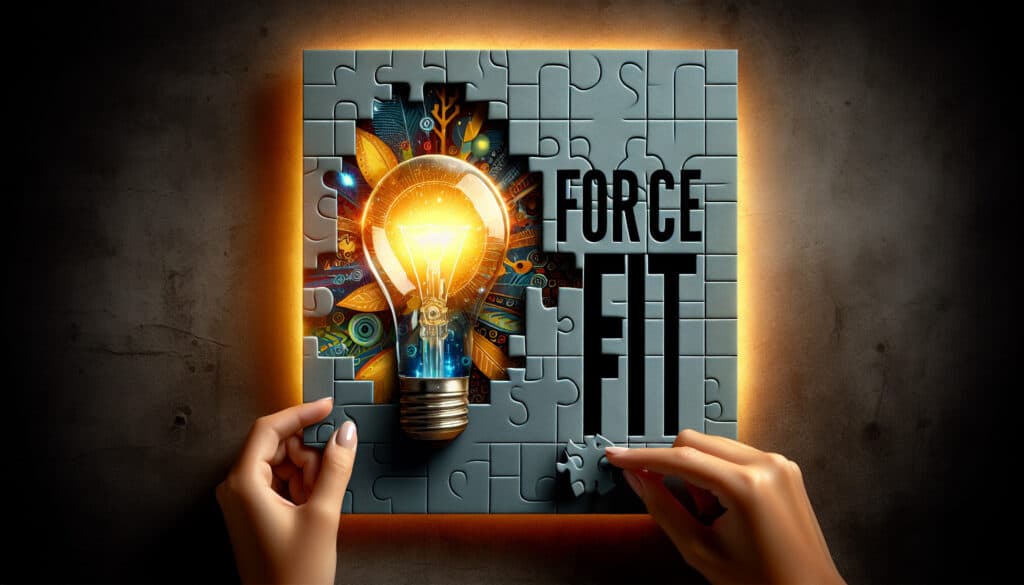
Force-Fit methodology, leveraging the juxtaposition of unrelated concepts, is particularly useful in diverse contexts ranging from consumer electronics to healthcare product development. In industries such as automotive design, where enhancing user experience and safety features is a constant challenge, teams may apply Force-Fit by juxtaposing a concept from nature, like biomimicry seen in vehicle aerodynamics, or an element from technology, like smartphone interfaces, to inspire innovative solutions for dashboard design or control systems. Within the early phases of product development, especially during brainstorming sessions, multidisciplinary teams comprising designers, engineers, and market analysts can participate to broaden the scope of ideas generated, creating a rich reservoir of potential solutions. This methodology is effective in tackling traditionally stubborn problems, such as improving resource efficiency in manufacturing by drawing inspiration from unrelated fields like agriculture or architecture, potentially leading to breakthrough innovations. The randomized element of combining disparate ideas can dislodge typical biases and preconceived notions, leading to unique product features or services, such as integrating augmented reality into retail environments to enhance customer interaction. Moreover, the versatility of Force-Fit allows teams to apply this technique anywhere from initial ideation workshops to fine-tuning the final design stages, making it a flexible tool in the innovation toolkit. Engaging participants from varied backgrounds ensures a wider array of perspectives and can result in unexpected insights, drastically improving the probability of discovering groundbreaking solutions that stand out in competitive markets.
该方法的关键步骤
找出需要解决的核心问题。
选择一个不相关的对象或概念强行与问题联系起来。
分析所选对象或概念的特征和功能。
集思广益,思考如何利用这个看似无关的物体的特性来解决最初的问题。
鼓励天马行空的想法涌现,不要妄加评判。
筛选出最有前景的研究方向。
将选定的想法提炼并调整为可行的解决方案。
专业提示
参与跨学科研讨会,鼓励多元化的视角,促进不相关领域之间意想不到的联系。
在头脑风暴会议期间,利用来自不相关领域的实物来激发不同的思维模式,促进非常规的联想。
Incorporate random word generators or prompts to stimulate offbeat thinking, challenging participants to connect these words to the design problem at hand.