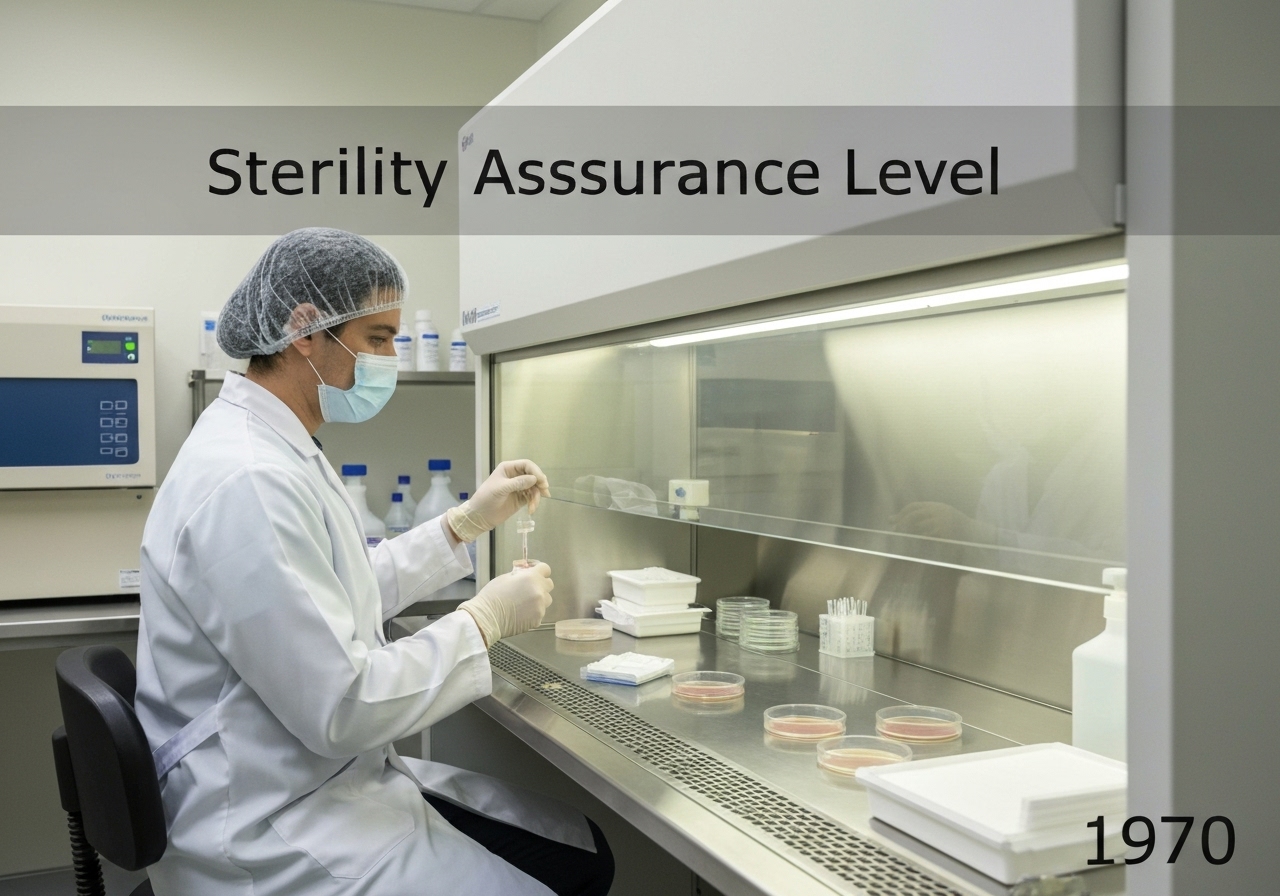
无菌保证水平 (SAL) 是一个定量指标,表示灭菌后单个活微生物在物品上存活的概率。医疗器械常用的 SAL 为 10⁻⁶,这意味着产品不无菌的概率为百万分之一。这种概率方法承认绝对无菌无法被证明,只能通过统计方法从灭菌过程中推断。 验证.
The concept of the Sterility Assurance Level (SAL) is rooted in the understanding that microbial death follows first-order kinetics, meaning it is a probabilistic event. It is impossible to prove that every single microorganism on an object has been killed; one can only calculate the probability of a microbe surviving the process. The SAL is this probability. For instance, an SAL of [latex]10^{-6}[/latex] does not mean one contaminated item exists for every million produced. Instead, it means there is a one-in-a-million chance for any given item to harbor a single viable microorganism after the sterilization process. This statistical approach is fundamental to the validation of sterilization cycles in regulated industries like pharmaceuticals and medical devices. To establish a cycle that achieves a desired SAL, manufacturers perform validation studies. This often involves placing biological indicators (BIs), which are standardized preparations of highly resistant bacterial spores (like Geobacillus stearothermophilus for steam or Bacillus atrophaeus for EtO), in the most challenging locations within a sterilization load. The process parameters (e.g., time, temperature, concentration) are then adjusted and tested until they consistently achieve a complete kill of the BIs. The cycle is then extended for a ‘half-cycle’ or more to provide a safety margin, ensuring the process can deliver the target SAL of [latex]10^{-6}[/latex] or better. The choice of SAL depends on the intended use of the product. Items that will come into contact with compromised tissue, such as surgical implants and injectable drugs, require the most stringent SAL of [latex]10^{-6}[/latex]. For items that contact intact skin, a lower SAL of [latex]10^{-3}[/latex] may be acceptable.