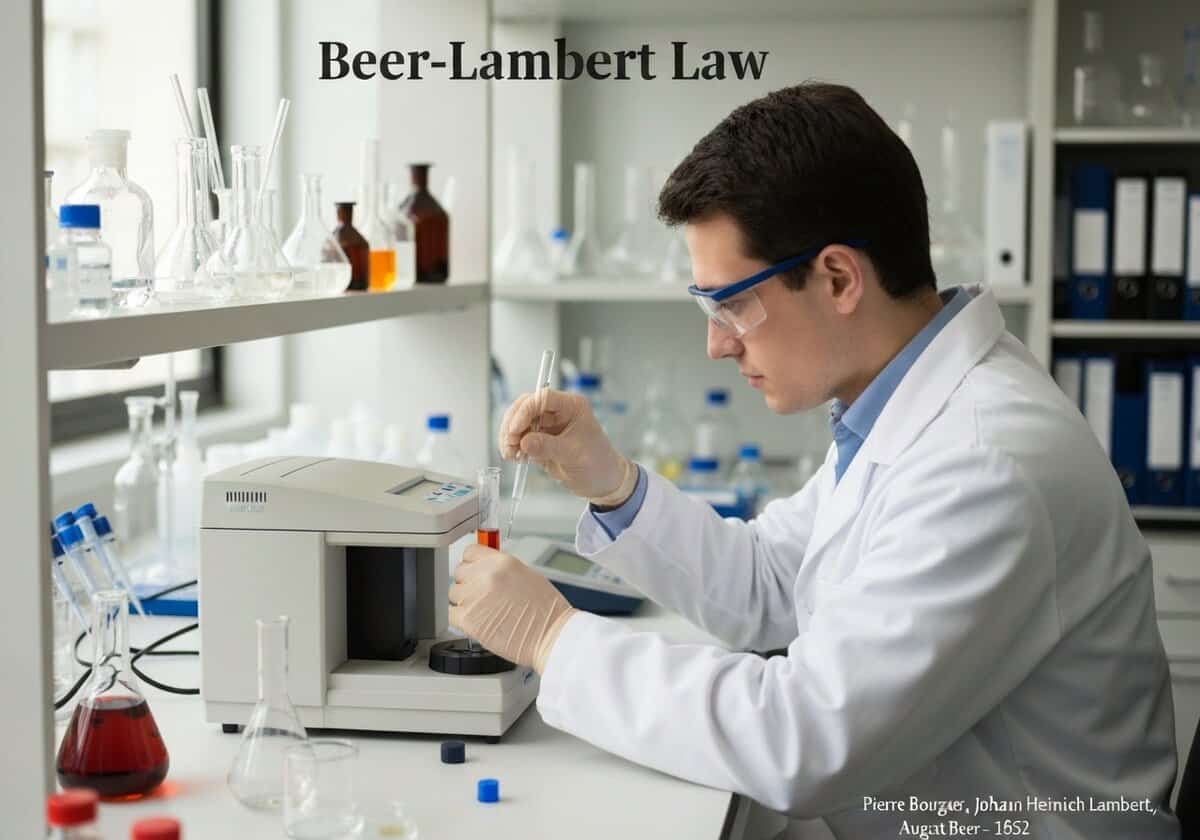
比尔-朗伯定律将光的衰减与光所经过的物质的特性联系起来。它指出,溶液的吸光度([latex]A[/latex])与吸收物种的浓度([latex]c[/latex])和光通过溶液的路径长度([latex]l[/latex])成正比。这种关系表示为 [latex]A = \epsilon c l[/latex],其中 [latex]\epsilon[/latex] 是摩尔吸收率。.


(图片仅供参考)
比尔-朗伯定律将光的衰减与光所经过的物质的特性联系起来。它指出,溶液的吸光度([latex]A[/latex])与吸收物种的浓度([latex]c[/latex])和光通过溶液的路径长度([latex]l[/latex])成正比。这种关系表示为 [latex]A = \epsilon c l[/latex],其中 [latex]\epsilon[/latex] 是摩尔吸收率。.
The Beer-Lambert law, also known as the Beer–Lambert–Bouguer law, is the cornerstone of quantitative absorption spectroscopy. It combines the findings of several scientists over more than a century. Pierre Bouguer (1729) and Johann Lambert (1760) established that the fraction of light absorbed is proportional to the thickness of the absorbing medium. August Beer (1852) then discovered that the absorbance is also proportional to the concentration of the absorbing substance in a solution. The law is typically written as [latex]A = \log_{10}(I_0/I) = \epsilon c l[/latex], where [latex]I_0[/latex] is the intensity of the incident light and [latex]I[/latex] is the intensity of the transmitted light. The molar absorptivity, [latex]\epsilon[/latex], is a constant that is characteristic of the absorbing substance at a specific wavelength. This means that for a given substance and path length, a plot of absorbance versus concentration will be a straight line, allowing for the creation of a calibration curve. By measuring the absorbance of an unknown sample, its concentration can be determined from this curve. The law holds true for monochromatic light and for dilute solutions where interactions between solute molecules are negligible. Deviations can occur at high concentrations due to chemical and instrumental effects.
比尔-兰伯特定律
(如果日期未知或不相关,例如“流体力学”,则提供其显著出现的近似估计)

只有注册会员才能免费获得 100% 的全尺寸图片和下载。.
> 登录 <