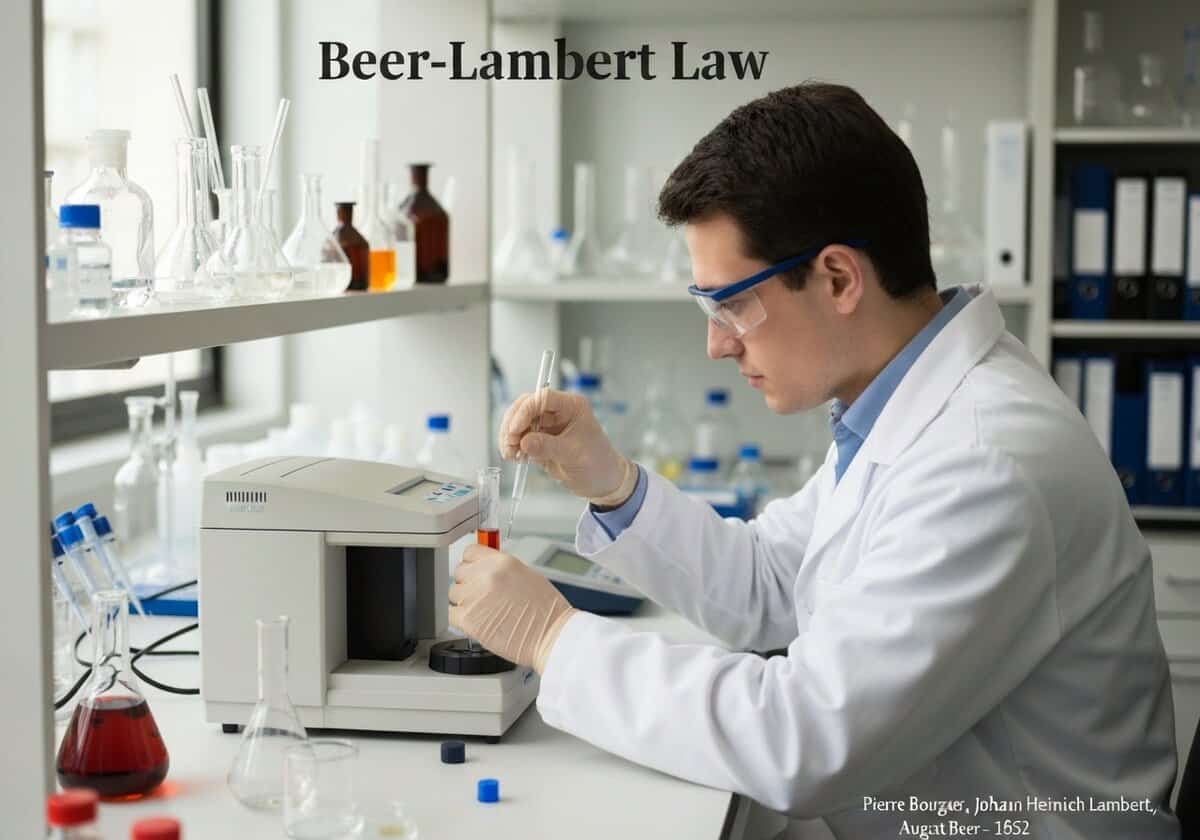
ベール・ランバートの法則は、光の減衰と、光が通過する物質の特性との関係を示しています。この法則によれば、溶液の吸光度([latex]A[/latex])は、吸収物質の濃度([latex]c[/latex])と、溶液中を光が通過する経路長([latex]l[/latex])に正比例します。この関係は、[latex]A = epsilon cl[/latex]と表され、[latex]epsilon[/latex]はモル吸光係数です。

(画像はイメージです)
ベール・ランバートの法則は、光の減衰と、光が通過する物質の特性との関係を示しています。この法則によれば、溶液の吸光度([latex]A[/latex])は、吸収物質の濃度([latex]c[/latex])と、溶液中を光が通過する経路長([latex]l[/latex])に正比例します。この関係は、[latex]A = epsilon cl[/latex]と表され、[latex]epsilon[/latex]はモル吸光係数です。

The Beer-Lambert law, also known as the Beer–Lambert–Bouguer law, is the cornerstone of quantitative absorption spectroscopy. It combines the findings of several scientists over more than a century. Pierre Bouguer (1729) and Johann Lambert (1760) established that the fraction of light absorbed is proportional to the thickness of the absorbing medium. August Beer (1852) then discovered that the absorbance is also proportional to the concentration of the absorbing substance in a solution. The law is typically written as [latex]A = \log_{10}(I_0/I) = \epsilon c l[/latex], where [latex]I_0[/latex] is the intensity of the incident light and [latex]I[/latex] is the intensity of the transmitted light. The molar absorptivity, [latex]\epsilon[/latex], is a constant that is characteristic of the absorbing substance at a specific wavelength. This means that for a given substance and path length, a plot of absorbance versus concentration will be a straight line, allowing for the creation of a calibration curve. By measuring the absorbance of an unknown sample, its concentration can be determined from this curve. The law holds true for monochromatic light and for dilute solutions where interactions between solute molecules are negligible. Deviations can occur at high concentrations due to chemical and instrumental effects.
ボットによるトラフィック(現在1日あたり4万件以上)を排除するため、このコンテンツはコミュニティメンバー限定となっています。
> ログイン < または > 登録 < (100%無料)でこれにアクセスできます。他のすべての制限付きコンテンツとツールも同様です。
ビア・ランバート法則
(日付が不明または関連性がない場合、例えば「流体力学」などでは、その注目すべき出現時期の概算値が提示されます。)

フルサイズの画像とダウンロードは、登録会員のみが100%無料で利用できます。
> ログイン <