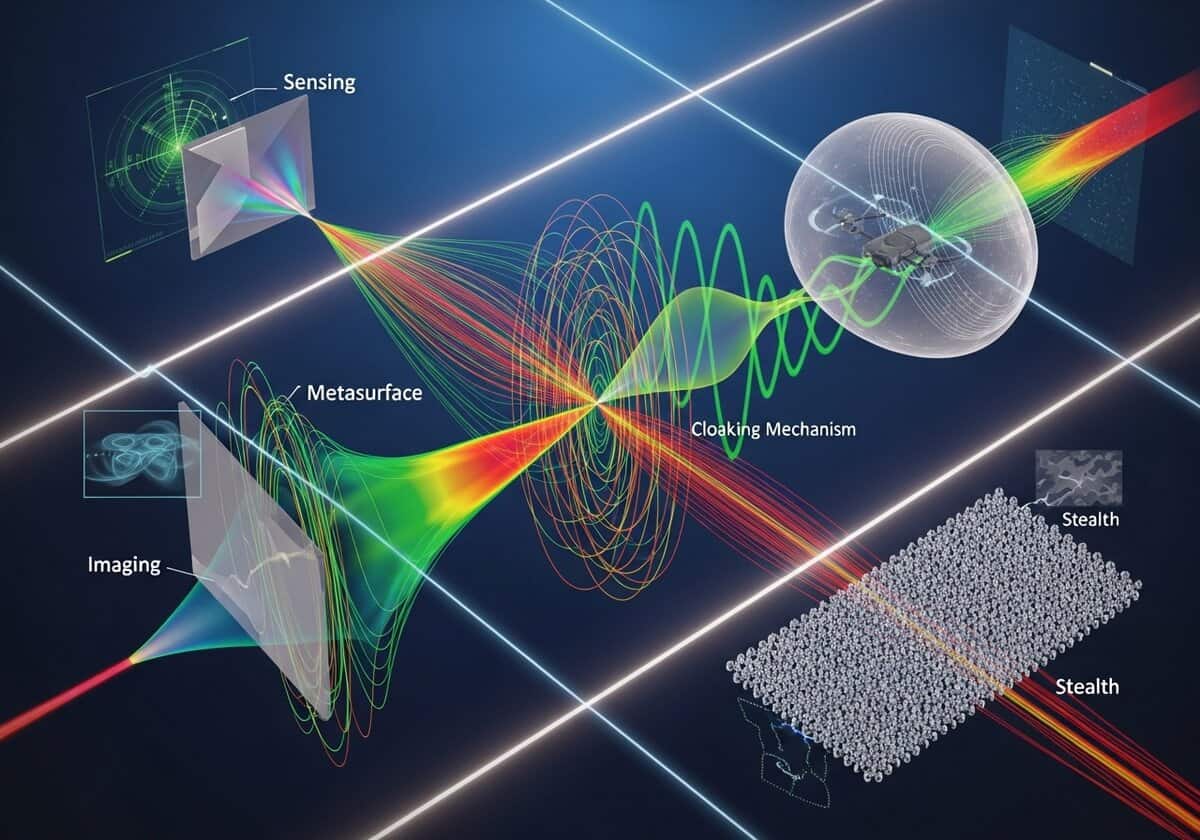

Os metamateriais consistem em estruturas projetadas artificialmente que exibem propriedades eletromagnéticas. acústico, or mechanical properties unattainable in natural materials, achieved through subwavelength patterning and tailored unit cell design. This domain explores negative refractive indices, cloaking, superlensing, tunable responses, and anisotropic behavior across microwave, terahertz, optical, and acoustic regimes. Advances in metasurfaces, plasmonics, chiral configurations, and nonlinear effects enable unprecedented control over wave propagation, polarization, and dispersion. Our continuously updated compilation hereafter presents the latest peer-reviewed research and patented tecnologias addressing fabrication techniques, theoretical modeling, device integration, and application-specific innovations critical for next-generation sensing, imaging, communication, and stealth technologies:
Esta é a nossa mais recente seleção de publicações e patentes mundiais em inglês sobre metamateriais, provenientes de diversos periódicos científicos online, classificadas e focadas em índice de refração negativo, metamateriais eletromagnéticos, metamateriais acústicos, cristais fotônicos, metamateriais plasmônicos, metasuperfícies, metamateriais quirais, metamateriais hiperbólicos, metamateriais sintonizáveis, metamateriais não lineares, absorvedores de metamateriais, antenas de metamateriais, camuflagem de metamateriais, filtros de metamateriais, ressonadores de metamateriais, dispersão de metamateriais, banda proibida de metamateriais, controle de polarização de metamateriais e superlentes de metamateriais.
Compact integrated occupant monitoring camera
Patent published on the 2026-06-04 in WO under Ref WO2026112692 by SEEING MACHINES LTD [AU] (Edwards Timothy [au])
Abstract: Described herein is a vehicle monitoring camera for monitoring an interior of a vehicle. The camera comprises a substrate configured to house electronic components. At least one light source is mounted to the substrate and configured to emit light in the infrared wavelength range onto a scene within the vehicle. An image sensor is mounted to the substrate and comprises a two dimensional array of sensing elements configured to sense light in at least the infrared wavelength range from the scene. [...]
Our summary: The vehicle monitoring camera is designed to observe the interior of a vehicle. It includes an infrared light source and an image sensor with a two-dimensional array. An imaging metasurface enhances the camera s field of view and focuses light for effective image capture.
occupant monitoring, vehicle camera, infrared imaging, imaging metasurface
Patent
Optically transparent reflector metasurface for millimeter wave beamforming
Patent published on the 2026-06-04 in US under Ref US20260155582 by DELL PRODUCTS L P [US] (Hardy David Fernando [ca], Macdonell Keigan [ca], Gupta Shulabh [ca], Singh Tejinder [ca], Khaira Navjot Kaur [ca])
Abstract: The technology described herein is directed towards a reflector metasurface with high optical transparency such as for reflecting beamformed millimeter wave signals. The reflector includes unit cells of reflecting elements (resonator rings) above a virtually optically transparent dielectric substrate, which is above a perforated metal ground plane. The ground plane is perforated to increase optical transparency, unlike a flat metal sheet. In one implementation, the perforated ground plane includ[...]
Our summary: The technology presents a reflector metasurface designed for millimeter wave beamforming with high optical transparency. It features resonator rings on a transparent dielectric substrate above a perforated metal ground plane. The unique geometry allows for a wide phase range and effective directionality of reflected signals.
metasurface, beamforming, optical transparency, millimeter wave
Patent
Reconfigurable huygens' refractors based on material tuning
Patent published on the 2026-06-04 in US under Ref US20260155566 by DELL PRODUCTS L P [US] (Macdonell Keigan [ca], Hardy David Fernando [ca], Gupta Shulabh [ca], Singh Tejinder [ca], Khaira Navjot Kaur [ca])
Abstract: The technology described herein is directed towards reconfigurable Huygens refractors, which when implemented as unit cells of a metasurface that receives incoming millimeter wave signals, results in transmitted millimeter wave beams that can be beamformed via unit cell reconfiguration. A sufficiently large phase range is achieved by varying the refractive index of the dielectric between the resonating elements of a unit cell. The unit cells phases can be individually reconfigured based on exte[...]
Our summary: This technology enables reconfigurable Huygens refractors as unit cells in a metasurface for millimeter wave signal transmission. The refractors achieve a large phase range by adjusting the dielectric s refractive index between resonating elements. Unit cell phases can be dynamically reconfigured using external stimuli to adapt the metasurface s phase profile for optimized beamforming.
Huygens refractors, metasurface, beamforming, phase tuning
Patent
Radio wave reflecting device
Patent published on the 2026-06-04 in US under Ref US20260155583 by JAPAN DISPLAY INC [JP] (Shirasawa Takuya [jp])
Abstract: [0000] A radio wave reflecting device includes a radio wave selective layer containing a photonic crystal for selecting radio waves in a predetermined wavelength band, and an intelligent reflecting surface for reflecting radio waves in the predetermined wavelength band. The radio wave selective layer may be disposed over a radio wave incident surface of the intelligent reflecting surface and selectively transmits radio waves in the predetermined wavelength band.[...]
Our summary: A radio wave reflecting device features a selective layer with a photonic crystal. It reflects radio waves within a specific wavelength band. The selective layer is positioned over the incident surface of the intelligent reflecting surface.
radio wave, photonic crystal, intelligent reflecting surface, wavelength band
Patent
Dissipative engineering of non-hermitian skin effect photonics for non-magnetic chiral optical couplers
Patent published on the 2026-06-04 in US under Ref US20260153672 by REGENTS OF THE UNIV OF MICHIGAN [US] (Lee Chulwon [us], Deng Hui [us])
Abstract: [0000] An optical device is disclosed. The optical device includes a pair of optical waveguide structures forming an optical chiral router. The pair of optical waveguide structures includes a first optical waveguide structure formed of a first set of photonic crystal nanocavities, a second optical waveguide structure formed of a second set of photonic crystal nanocavities, the first optical waveguide structure being offset relative to the second optical waveguide structure to form auxiliary opti[...]
Our summary: The optical device features a pair of optical waveguide structures that create an optical chiral router. It utilizes photonic crystal nanocavities and auxiliary optical cavity modes. The design induces a chiral skin effect through loss-induced coupling and Z2 symmetry breaking.
non-hermitian, chiral optical couplers, photonic crystal, optical waveguide structures
Patent
Construction of near-? multiple chiral exceptional points in momentum space of photonic crystal slabs
Published on 2026-06-03 by Jingyu Zhang, Yang Gao, Tianfu Ma, Wenjia Li, Weimin Ye and Jianlong Liu @IOP SCIENCE
Abstract: Exceptional points (EPs) in optical systems have attracted considerable attention because of their nontrivial topological properties and unusual physical effects. Among them, scattering EPs are particularly appealing for describing chiral response through the scattering matrix. Photonic crystal slabs offer a versatile platform for studying chiral scattering EPs in momentum space, where their topological evolution can be conveniently accessed and engineered. In this work, a convenient approach is[...]
Our summary: This study presents a method to construct multiple chiral exceptional points (EPs) in the momentum space of photonic crystal slabs. The research identifies and analyzes the evolution of these EPs near the Γ point, highlighting their potential for polarization conversion. The findings suggest practical applications for controlling chiral EPs in optical metadevices.
chiral exceptional points, photonic crystal slabs, momentum space, topological properties
Publication
Unpolarized electrochemical structural color pixel
Patent published on the 2026-05-21 in WO under Ref WO2026106366 by UNIV EWHA IND COLLABORATION [KR] (Hyun Jerome Kartham [kr], Kim Min-ji [kr])
Abstract: The present application relates to an unpolarized electrochemical structural color pixel. According to embodiments of the present application, the unpolarized structural color pixel can dynamically express vivid and diverse colors without depending on specific polarization (that is, under non-polarizer conditions) by integration of an electrochemical deposition-dissolution technique of a metal and a nanohole metasurface of a dielectric layer.[...]
Our summary: The application describes an unpolarized electrochemical structural color pixel. It can dynamically display various colors without requiring specific polarization. This is achieved through electrochemical deposition-dissolution and a nanohole metasurface.
electrochemical, structural color, pixel, metasurface
Patent
Topological phase transition induced by modulating unit cells in photonic Lieb lattice
Published on 2026-05-12 by Zhi-Kang Xiong, Y Liu (???), Xiying Fan and Bin Zhou @IOP SCIENCE
Abstract: Topological photonics was embarked from realizing the first-order chiral state in gyromagnetic media, but its higher-order states were mostly studied in dielectric lattice instead. In this paper we theoretically unveil a hierarchy of topological phases under broken time-reversal symmetry, which include the first-order Chern, and the second-order dipole, quadrupole phases. Concretely, by relaxing a certain spatial symmetry of unit cell, versatile topological phases including both edge and corner [...]
Our summary: This study reveals a hierarchy of topological phases in a photonic Lieb lattice under broken time-reversal symmetry. It identifies first-order Chern and second-order dipole and quadrupole phases by modulating unit cell symmetry. The findings may enhance sublattice engineering for robust waveguides and integrated photonic circuits.
Topological phase transition, Photonic Lieb lattice, Time-reversal symmetry, Gyromagnetic photonic crystals
Publication