Product Design, Manufacturing & Innovation Resources
Lar » Variação Secular Geomagnética

Variação Secular Geomagnética

1650
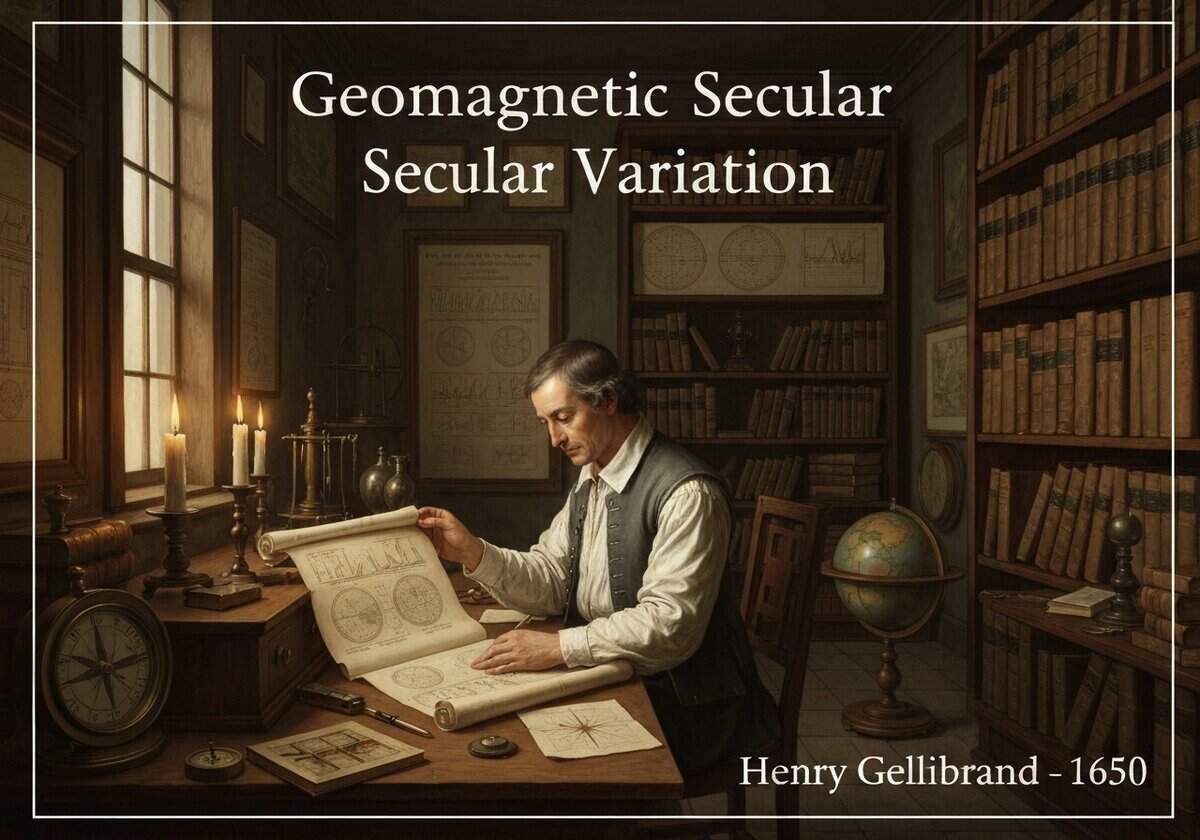
  • Henry Gellibrand
Geofísico do século XVII que estudava dados de variação secular geomagnética.

(Imagem gerada apenas para fins ilustrativos)

Geomagnetic secular variation refers to the slow changes in Earth’s magnetic field on timescales of years to millennia. These changes include shifts in field strength and the direction of the dipole axis, as well as the westward drift of non-dipole features. This variation is caused by the changing flow of molten iron in the outer core, the source of the geodynamo.

Secular variation is observed through continuous monitoring of the magnetic field at observatories and by satellites. The most prominent features include the decay of the main dipolo component and the westward drift. The momento dipolar A intensidade do campo magnético tem diminuído a uma taxa de cerca de 5% por século, o que, se continuar, poderá levar a uma inversão geomagnética em alguns milhares de anos. A deriva para oeste é a tendência de características não dipolares do campo, como áreas de alta ou baixa intensidade, se deslocarem para oeste a aproximadamente 0,2 graus por ano. Acredita-se que isso reflita uma diferença na velocidade de rotação entre o núcleo externo e o manto sobrejacente.

On shorter timescales, scientists have observed ‘geomagnetic jerks,’ which are abrupt changes in the rate of secular variation, occurring over just a year or two. These are unpredictable and are thought to be caused by rapid changes in the fluid flow within the core. Because of secular variation, magnetic maps and models must be regularly updated. The World Magnetic Model (WMM), for instance, is updated every five years and is essential for navigation in applications ranging from military and commercial aviação to the compass in a smartphone.

UNESCO Nomenclature: 2505
Geofísica

Tipo

Fenômeno físico

Interrupção

Substancial

Uso

Uso generalizado

Precursores

  • invenção da bússola magnética
  • Registro sistemático da declinação magnética para navegação
  • O modelo da Terra como um gigante, criado por William Gilbert. ímã

Aplicações

  • Atualização de cartas náuticas e modelos como o Modelo Magnético Mundial (WMM)
  • Arqueomagnetismo para datação de materiais arqueológicos cozidos, como cerâmica ou fornos.
  • providing constraints for geodínamo simulações computacionais
  • Estudando a dinâmica do interior profundo da Terra

Patentes:

NA

Ideias de Inovação Potencial

  • real-time magnetic field mapping using a global network of quantum sensors
  • predictive models for secular variation to create navigation systems that don’t require frequent updates
  • using secular variation data to infer viscosidade and conductivity at the core-mantle boundary
  • deep earth tomography using magnetic field fluctuations as a signal source
  • enhanced archaeomagnetic dating with resolution down to the decade level
  • AI algorithms that can predict geomagnetic jerks months in advance
  • dynamic power grid management systems that adjust to rapid magnetic field changes
  • long-term climate models that incorporate the influence of magnetic field strength on atmospheric chemistry
  • subterranean resource prospecting based on localized secular variation anomalies
  • secure communication channels that use unpredictable geomagnetic fluctuations as a one-time pad
Relacionado a: variação secular, geomagnetismo, deriva para oeste, Modelo Magnético Mundial, arqueomagnetismo, geodínamo, núcleo externo, declinação magnética, momento dipolar, solavanco geomagnético.

Contexto histórico

Variação Secular Geomagnética

1650
1800
1852
1900
1912
1940
1940
1950
1800
1838
1872
1910
1940
1940
1946

(Caso a data seja desconhecida ou irrelevante, por exemplo, "mecânica dos fluidos", é fornecida uma estimativa aproximada de seu surgimento notável)

10º ano aniversário

Imagens em tamanho real e downloads estão disponíveis apenas, 100% gratuitos, para membros registrados.