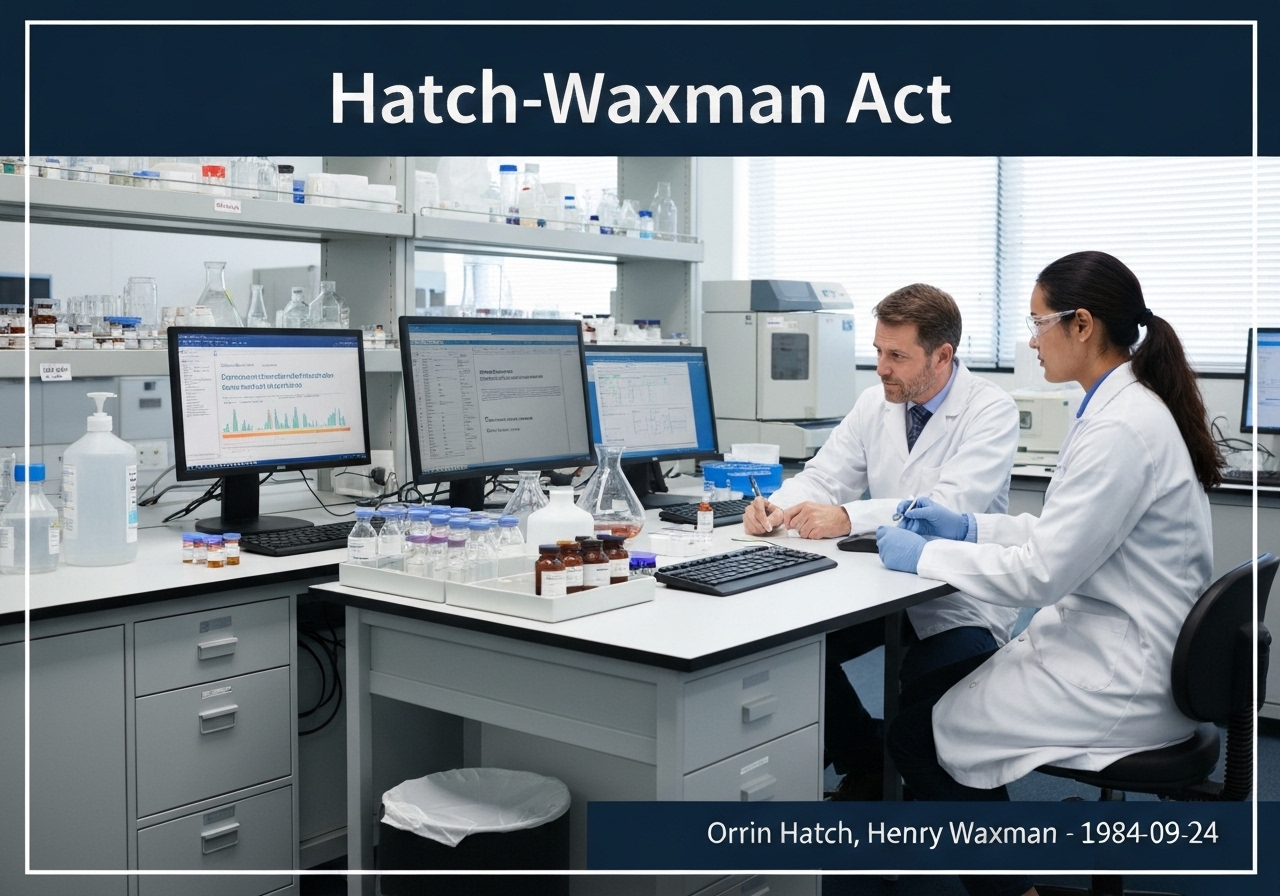
Lei Hatch-Waxman (Lei de Competição de Preços de Medicamentos e Restauração do Prazo de Patentes)
The Hatch-Waxman Act of 1984 is a landmark U.S. law that established the modern framework for generic drug approval. It created the Abbreviated New Drug Application (ANDA) process, allowing generic manufacturers to get approval by demonstrating bioequivalence to the original branded drug, without repeating costly clinical trials. It also granted patente Prorrogação de prazos para empresas inovadoras como forma de compensar o tempo perdido durante a análise regulatória.
The Hatch-Waxman Act sought to strike a delicate balance between two competing interests: encouraging innovation by pharmaceutical companies and increasing access to affordable medicines for consumers. Before the Act, the path to market for generic drugs was arduous, often requiring duplicative and expensive clinical trials. This created a significant barrier to entry, allowing branded drugs to maintain monopoly pricing long after their patents had expired. The Act streamlined this process by creating the ANDA pathway. A generic manufacturer only needs to prove its product has the same active ingredient, dosage form, strength, and route of administration as the reference listed drug (RLD), and that it is bioequivalent—meaning it is absorbed and becomes available at the site of drug action at a similar rate and extent. This significantly reduces the cost and time to bring a generic to market. To incentivize continued innovation, the Act provided two key benefits to innovator companies. First, it allowed for the restoration of a portion of the patent term that was lost while the drug was undergoing FDA review. Second, it granted a period of market exclusivity (typically five years for a new chemical entity) independent of situação da patente. The Act also established a unique system for resolving patent disputes, including a 180-day exclusivity period for the first generic company to challenge a branded drug’s patent, which has spurred a complex landscape of patent litigation.
UNESCO Nomenclature: 5604
Direito administrativo
Interrupção
Revolucionário
Precursores
- As emendas Kefauver-Harris de 1962, que exigiam comprovação de eficácia e criaram a nda process
- Crescente preocupação pública e política com o aumento dos custos dos medicamentos prescritos nas décadas de 1970 e 1980.
- uma série de decisões judiciais que dificultaram a aprovação de medicamentos genéricos
- a necessidade de equilibrar o sistema de patentes com as necessidades de saúde pública
Aplicações
- via de aprovação para quase todos os medicamentos genéricos nos Estados Unidos
- criação da indústria farmacêutica genérica moderna
- Equilibrar os incentivos à inovação com a concorrência de preços dos medicamentos.
- litígios de patentes entre empresas de medicamentos de marca e genéricos
- extensão da vida útil da patente para novos medicamentos
Ideias de Inovação Potencial
- development of ‘supergenerics’ or value-added generics with improved formulations or delivery systems
- creation of the biosimilar approval pathway (bpcIA) modeled on hatch-waxman principles
- complex patent litigation strategies like ‘pay-for-delay’ or ‘reverse payment’ settlements
- authorized generics, where the brand company markets its own generic version
- risk evaluation and mitigation strategies (rems) being used to potentially block generic entry
- citizen petitions filed with the fda to delay generic approvals
- development of complex generic products like inhaled or transdermal drugs
- global harmonization efforts for generic drug approval standards
- use of real-world evidence to support bioequivalence for certain drug classes
- application of the act’s principles to digital therapeutics and software as a medical device
Related to: Hatch-Waxman act, generic drugs, ANDA, bioequivalence, patent term extension, FDA, drug prices, pharmaceutical law,
intellectual property, innovator drugs.