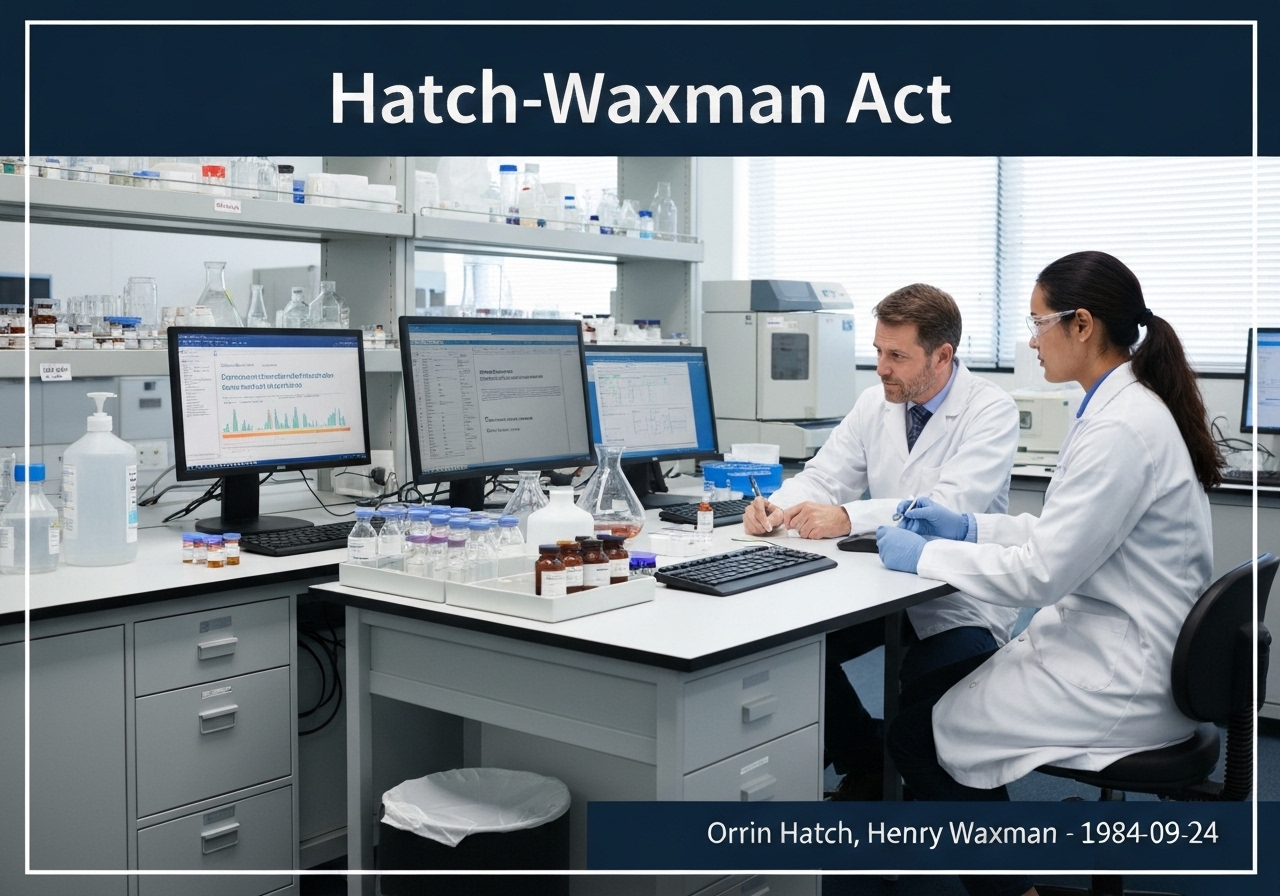
해치-왁스만 법(의약품 가격 경쟁 및 특허 기간 복원법)
The Hatch-Waxman Act of 1984 is a landmark U.S. law that established the modern framework for generic drug approval. It created the Abbreviated New Drug Application (ANDA) process, allowing generic manufacturers to get approval by demonstrating bioequivalence to the original branded drug, without repeating costly clinical trials. It also granted 특허 규제 검토 과정에서 발생한 시간 손실을 보상하기 위해 혁신 기업의 계약 기간을 연장합니다.
The Hatch-Waxman Act sought to strike a delicate balance between two competing interests: encouraging innovation by pharmaceutical companies and increasing access to affordable medicines for consumers. Before the Act, the path to market for generic drugs was arduous, often requiring duplicative and expensive clinical trials. This created a significant barrier to entry, allowing branded drugs to maintain monopoly pricing long after their patents had expired. The Act streamlined this process by creating the ANDA pathway. A generic manufacturer only needs to prove its product has the same active ingredient, dosage form, strength, and route of administration as the reference listed drug (RLD), and that it is bioequivalent—meaning it is absorbed and becomes available at the site of drug action at a similar rate and extent. This significantly reduces the cost and time to bring a generic to market. To incentivize continued innovation, the Act provided two key benefits to innovator companies. First, it allowed for the restoration of a portion of the patent term that was lost while the drug was undergoing FDA review. Second, it granted a period of market exclusivity (typically five years for a new chemical entity) independent of patent status. The Act also established a unique system for resolving patent disputes, including a 180-day exclusivity period for the first generic company to challenge a branded drug’s patent, which has spurred a complex landscape of patent litigation.
UNESCO Nomenclature: 5604
행정법
전구체
- 효능 입증을 요구하고 새로운 규정을 만든 1962년 케포버-해리스 수정안은 nda 프로세스
- 1970년대와 1980년대에 처방약 가격 상승에 대한 대중과 정치권의 우려가 커져갔다.
- 제네릭 의약품 승인을 어렵게 만든 일련의 법원 판결
- 특허 제도와 공중 보건의 필요성 사이의 균형을 맞춰야 할 필요성
응용 프로그램
- 미국에서 거의 모든 제네릭 의약품에 대한 승인 경로
- 현대 제네릭 의약품 산업의 탄생
- 혁신 장려책과 약가 경쟁의 균형 유지
- 브랜드 의약품 회사와 제네릭 의약품 회사 간의 특허 소송
- 신약 특허 기간 연장
잠재적 혁신 아이디어
- development of ‘supergenerics’ or value-added generics with improved formulations or delivery systems
- creation of the biosimilar approval pathway (bpcIA) modeled on hatch-waxman principles
- complex patent litigation strategies like ‘pay-for-delay’ or ‘reverse payment’ settlements
- authorized generics, where the brand company markets its own generic version
- risk evaluation and mitigation strategies (rems) being used to potentially block generic entry
- citizen petitions filed with the fda to delay generic approvals
- development of complex generic products like inhaled or transdermal drugs
- global harmonization efforts for generic drug approval standards
- use of real-world evidence to support bioequivalence for certain drug classes
- application of the act’s principles to digital therapeutics and software as a medical device
Related to: Hatch-Waxman act, generic drugs, ANDA, bioequivalence, patent term extension, FDA, drug prices, pharmaceutical law,
intellectual property, innovator drugs.