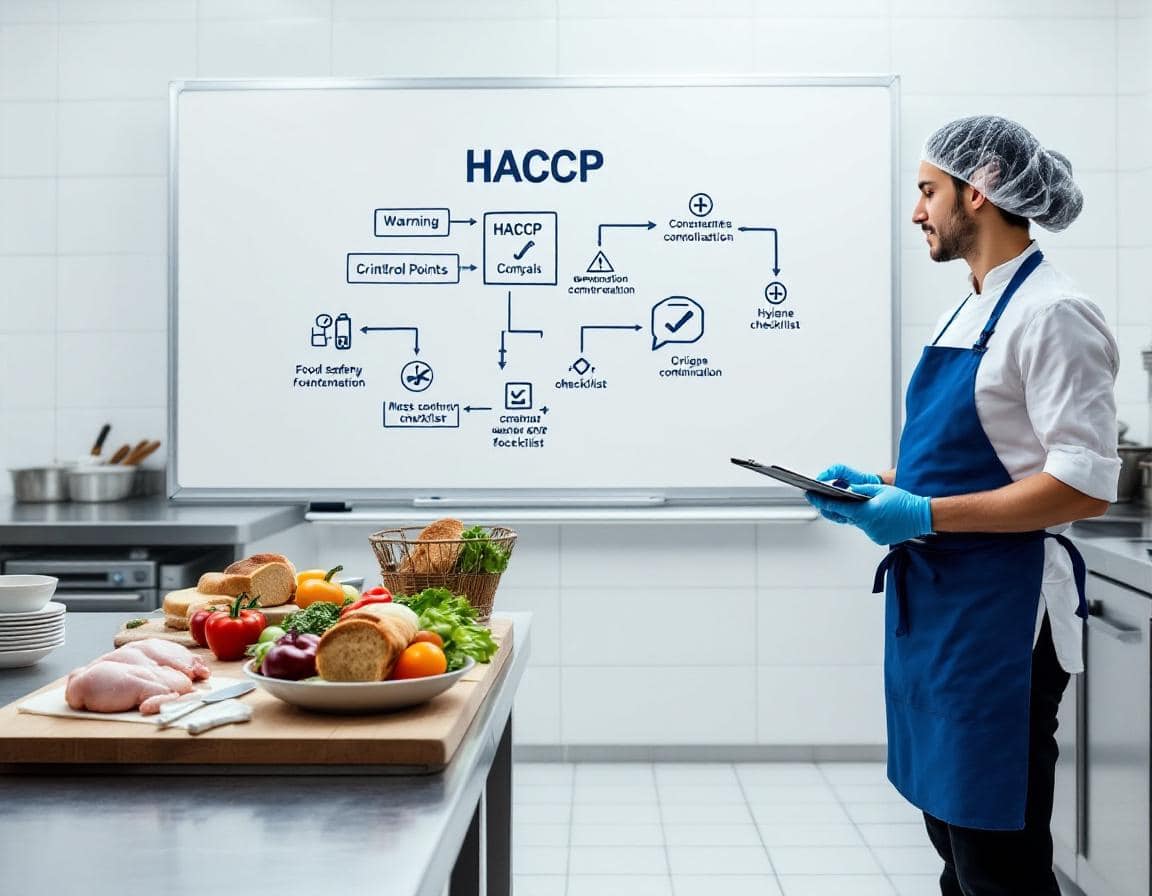
Nos setores de fabricação e processamento de alimentos, a Análise de Perigos e Pontos Críticos de Controle (APPCC) se destaca como uma ferramenta profissional. estrutura para garantir a segurança e a conformidade na indústria alimentícia. Criado na década de 1960 para proteger os alimentos dos astronautas da contaminação, o HACCP se transformou em um padrão globalmente reconhecido que orienta as práticas de segurança alimentar em diversos setores, incluindo restaurantes e serviços de alimentação, e a indústria farmacêutica. Este artigo fornecerá uma visão geral abrangente do HACCP, detalhando sua história, os sete princípios fundamentais, as etapas para desenvolver e implementar um plano HACCP robusto e a identificação de perigos biológicos, químicos e físicos.
Principais conclusões

- O sistema HACCP garante a segurança alimentar através da prevenção sistemática.
- Sete princípios orientam a gestão eficaz de riscos.
- Os CCPs são determinados por meio de estruturas de tomada de decisão.
- A implementação reduz os riscos e facilita a conformidade.
- Os programas de pré-requisitos fortalecem os processos gerais de segurança.
O principal objetivo do HACCP é estabelecer uma estrutura que garanta a segurança alimentar, identificando os pontos críticos de controle no processo de produção onde podem ocorrer perigos. Ao priorizar a prevenção em vez da inspeção, as instalações podem gerenciar proativamente os perigos biológicos, químicos e físicos.
Definição e histórico do HACCP
A Análise de Perigos e Pontos Críticos de Controle (APPCC) é uma abordagem sistemática concebida para identificar, avaliar e controlar os perigos para a segurança alimentar ao longo de todo o processo de produção.

Originado no final da década de 1960, o HACCP foi desenvolvido como uma medida preventiva para garantir a segurança alimentar. O Sistema Nacional de Análise de Perigos e Pontos Críticos de Controle (HACCP) dos EUA é um sistema nacional de saúde. Aeronáutica A Administração Nacional da Força Aérea (NASA) implementou inicialmente a Análise de Perigos e Pontos Críticos de Controle (APPCC) para os alimentos fornecidos aos astronautas, pois era fundamental eliminar quaisquer riscos que pudessem comprometer sua saúde durante as missões. Hoje, os princípios da APPCC foram adotados globalmente em diversos setores da indústria alimentícia.
Estatísticas mostram que a incidência de doenças transmitidas por alimentos causadas por patógenos pode ser significativamente reduzida com a aplicação dos princípios do HACCP, diminuindo as taxas de infecção por salmonela em até 25% em certos tipos de alimentos.
Historicamente, o HACCP ganhou reconhecimento internacional quando o Códice Alimentarius A Comissão adotou-o como norma para sistemas de gestão da segurança alimentar.
A natureza sistemática do HACCP permite sua aplicação não apenas na produção de alimentos, mas também em outros setores, como o farmacêutico e o de cosméticos, onde a segurança é fundamental.
The Seven Principles of HACCP

- Conduct a hazard analysis: identify potential biological, chemical, and physical hazards at each stage of the food production process—from raw material sourcing to final consumption. Assess the risks associated with these hazards and determine appropriate control measures. This includes biological, chemical, and physical hazards that may be present in the manufacturing or processing stage. A systematic approach entails gathering data on previous incidents, conducting risk assessments, and considering inputs from various stakeholders. For instance, analysis from the Centers for Disease Control and Prevention (CDC) shows that approximately 48 million Americans become ill from foodborne illnesses each year, highlighting the importance of hazard identification.
- Determine the Critical Control Points (CCPs) within the process: CCPs are steps where control can be applied to prevent, eliminate, or reduce food safety hazards to acceptable levels. These points are often identified through flow diagrams and expert consultations. For example, in a poultry processing plant, critical control points could include cooking temperatures and cooling times. If these parameters are not met, the risk of pathogen survival increases significantly.
- Establish critical limits: set maximum or minimum values (e.g., temperature, time, pH) for each CCP that must be met to ensure the hazard is controlled. These limits distinguish between safe and unsafe operating conditions. For example, the FDA advises that poultry must be cooked to an internal temperature of 165°F (74°C) to control salmonella and other bacteria, but local criteria or situation can request that to be higher. Compliance with these limits is essential for ensuring food safety and regulatory adherence.
- Establish monitoring procedures: develop and implement procedures to monitor each CCP to ensure they remain within defined limits. Effective monitoring can utilize tools like temperature logs and digital sensing equipment to track compliance. A study conducted among various food manufacturers showed that companies implementing consistent monitoring reduced non-compliance incidents by over 20%.
- Establish Corrective Actions: define actions to be taken when monitoring indicates a deviation from an established critical limit. Corrective actions ensure that no unsafe product reaches the consumer and that the process is brought back under control and does not happen again.
- Establish verificação procedures: carry out actions to ensure that the HACCP system is functioning properly. Verification can involve examining documentation, performing audits, and conducting tests to confirm that the system is delivering the expected results.
- Establish documentation and record-Keeping: maintain accurate and comprehensive records of all HACCP-related activities. Documentation should include hazard analyses, CCP monitoring, corrective actions, and verification procedures to demonstrate compliance and facilitate continuous improvement.
Dica: utilize automated systems where possible to facilitate real-time monitoring and record-keeping, enhancing traceability and compliance with food safety regulamentos.
Identifying Hazards in a Process
Identifying hazards within a production process is critical for food safety and quality assurance. These hazards can be categorized into three main types: biological, chemical, and physical:
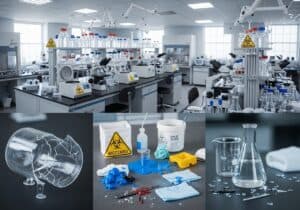
- Biological hazards include harmful microorganisms like bacteria, viruses, and parasites that can contaminate food. For example, Salmonella and Escherichia coli are commonly cited bacteria that can lead to foodborne illnesses, impacting consumer health and industry liability. It is statistically documented that approximately 48 million people get sick each year in the United States due to foodborne pathogens, underscoring the importance of effective hazard identification.
- Chemical hazards encompass harmful substances that may unintentionally enter food products. These can be residues from pesticides, cleaning agents, and additive compounds used during production. To mitigate these risks, it is crucial to monitor and test the presence of these chemicals. For instance, the Environmental Protection Agency (EPA) enforces strict limits on pesticide residues to ensure products remain safe for consumption. A report from the Food and Drug Administration (FDA) noted that approximately 1% of food samples tested exceeded permissible pesticide residue levels.
- Physical hazards, on the other hand, are foreign objects that can contaminate food items, such as glass, metal shards, bone fragments, or stones. The presence of such hazards can cause severe injury to consumers and can threaten brand integrity. Implementing comprehensive inspection measures, especially during critical phases of production and processing lines, is essential. Documented cases have shown that consumer complaints regarding foreign objects can lead to multi-million dollar lawsuits and product recalls, highlighting the need for diligent hazard detection.
The process of identifying potential hazards should include a thorough review of each stage of production. It involves examining the entire supply chain—from raw materials, processing methods, to final product packaging. Utilizing a flowchart can help in visualizing the steps and pinpointing where hazards may arise.
Dica: it’s beneficial to envolver employees across various roles in this review, as they may offer insights into risks that may not be immediately visible to management.
| Type of Hazard | Exemplos | Mitigation Strategies |
|---|---|---|
| Biological | Salmonella, E. coli | Regular microbial testing, employee training on hygiene |
| Chemical | Pesticides, additives, machine lubricants | Supplier certifications, routine chemical analysis, dedicated restricted areas for chemicals storage, rule and roles for usage. Maintenance plans. |
| Physical | Glass, metal parts or chips | Screening for foreign objects, visual inspections, Maintenance plans. |
Determining Critical Control Points CCPs
Determining Critical Control Points (CCPs) involves identifying points in the production process where controls can be applied to prevent, reduce, or eliminate food safety hazards.
These CCPs points are not arbitrary; they arise from thorough analysis of the workflow and risk assessment.
For example, in a dairy production facility, a CCP may be the pasteurization stage, where it is crucial to reach a specific temperature and time combination to eliminate pathogenic bacteria such as Salmonella. Establishing such points is a systematic process guided by the flow diagram of operations.

To effectively determine CCPs, various evaluation methods can be applied. The most common approach is the decision tree method, which asks a series of questions that lead to identifying whether a control point is critical. These questions often revolve around whether a hazard can be controlled at that point and if a loss of control could lead to an unacceptable safety risk. For example, if a cooking step does not achieve adequate temperature, it can lead to potential pathogen survival, thereby qualifying it as a CCP.
Effective documentation is paramount during this phase. It is essential to keep detailed records that capture the rationale behind each identified CCP and the associated hazards. For instance, if a CCP is determined to be a specific revestimento method in snack food production, records should outline the importance of maintaining the correct coating thickness, which directly affects the final product’s safety and quality. These records facilitate compliance with regulatory padrões and serve as a reference for audits.
Dica: regularly review and validate your CCPs as production processes may change over time or new hazards may emerge. Conducting routine hazard assessments every six months is beneficial for maintaining safety standards and adapting to evolving industry practices.
Benefits of Implementing HACCP and Role of Prerequisite Programs
Implementing HACCP provides multiple advantages, including enhanced food safety, reduced risk of contamination, and compliance with regulatory standards. By systematically addressing hazards, organizations protect public health while increasing consumer trust.
Furthermore, the integration of prerequisite programs—such as Good Manufacturing Practices (Boas Práticas de Fabricação (BPF)) and sanitation measures—complements HACCP principles. These programs establish a strong baseline for hygiene, facility management, and employee training. When combined with HACCP, they create a robust framework that ensures critical control points are managed effectively. For instance, a comparison between food companies with and without such programs showed a 30% decrease in non-compliance incidents among those employing both HACCP and GMP protocols.
Dica: regular training sessions on HACCP and prerequisite programs can significantly improve employee awareness and adherence to food safety standards. This proactive approach leads to a marked reduction in operational mishaps and creates a culture of safety within the organization.
Wrapping-Up
In the context of contemporary food safety, the adoption of Hazard Analysis and Critical Control Points (HACCP) represents not just a compliance measure but a profound commitment to public health and product integrity. The rigor embedded in its seven principles, along with a systematic approach to hazard identification and control, equips organizations to safeguard their consumers while maintaining high standards of food safety.
The importance of a well-structured HACCP framework transcends mere regulatory requirements, acting as a guiding force for innovation and quality assurance within diverse industries.
Frequently Asked Questions
What is the definition and purpose of HACCP?
What are the seven principles of HACCP?
What are the steps to developing and implementing a HACCP plan?
How can biological, chemical, and physical hazards be identified in a process?
What methods can be used for determining Critical Control Points (CCPs)?
What role do prerequisite programs play in supporting HACCP?
In which industries is HACCP applicable?
Tópicos relacionados
- Risk Assessment Techniques: methods used to evaluate potential risks within food safety systems.
- Environmental Monitoring: techniques employed to assess contamination levels in food production environments.
- Supplier Audits: evaluations of suppliers to ensure they comply with food safety standards that support HACCP.
- Traceability Systems: mechanisms for tracking ingredients from source to end product to ensure safety.
- Food Safety Culture: the shared values and behaviors regarding food safety within an organization.
- Crisis Management Plans: strategies to effectively manage food safety emergencies or product recalls.
- Quality Assurance Programs: systematic policies to maintain quality and safety in food production processes.
- Hygiene Practices: protocols that ensure cleanliness in the production and preparation of food products.
- Regulatory Compliance: adherence to local, national, and international food safety regulations and guidelines.
- Process Flow Diagrams: visual representations outlining each step in the food manufacturing process.
- Statistical Process Control: use of statistical methods to monitor and control food production processes.
External Links on Hazard Analysis And Critical Control Points (HACCP)
Normas internacionais
(Passe o cursor sobre o link para ver nossa descrição do conteúdo)
Glossário de termos utilizados
Critical Control Points (CCP): specific stages in a process where control can be applied to prevent, eliminate, or reduce food safety hazards to acceptable levels. Identifying these points is essential for effective hazard analysis and critical control management in food production systems.
Food and Drug Administration (FDA): Uma agência federal do Departamento de Saúde e Serviços Humanos dos Estados Unidos responsável por regulamentar a segurança alimentar, produtos farmacêuticos, dispositivos médicos, cosméticos e produtos de tabaco para garantir a saúde e a segurança públicas por meio da avaliação científica e da aplicação de padrões de conformidade.
Good Manufacturing Practice (GMP): a system ensuring products are consistently produced and controlled according to quality standards, minimizing risks involved in pharmaceutical production and related industries. It encompasses guidelines for manufacturing processes, facility conditions, personnel qualifications, and documentation practices to ensure product safety and efficacy.
Hazard Analysis and Critical Control Points (HACCP): Uma abordagem sistemática à segurança alimentar que identifica, avalia e controla os perigos em pontos críticos do processo de produção para prevenir doenças transmitidas por alimentos e garantir a segurança do produto.
Network-attached storage (NAS): Um dispositivo de armazenamento conectado a uma rede que permite o acesso e o compartilhamento de dados entre múltiplos usuários e dispositivos, geralmente oferecendo armazenamento centralizado de arquivos, backup e recursos de gerenciamento. Ele opera independentemente de um computador e pode ser acessado por meio de protocolos de rede padrão.
Statistical Process Control (SPC): a method of quality control that employs statistical techniques to monitor and control a process, ensuring it operates at its full potential by identifying variations and maintaining consistent output within specified limits.