Product Design, Manufacturing & Innovation Resources
Lar » Endurecimento por precipitação

Endurecimento por precipitação

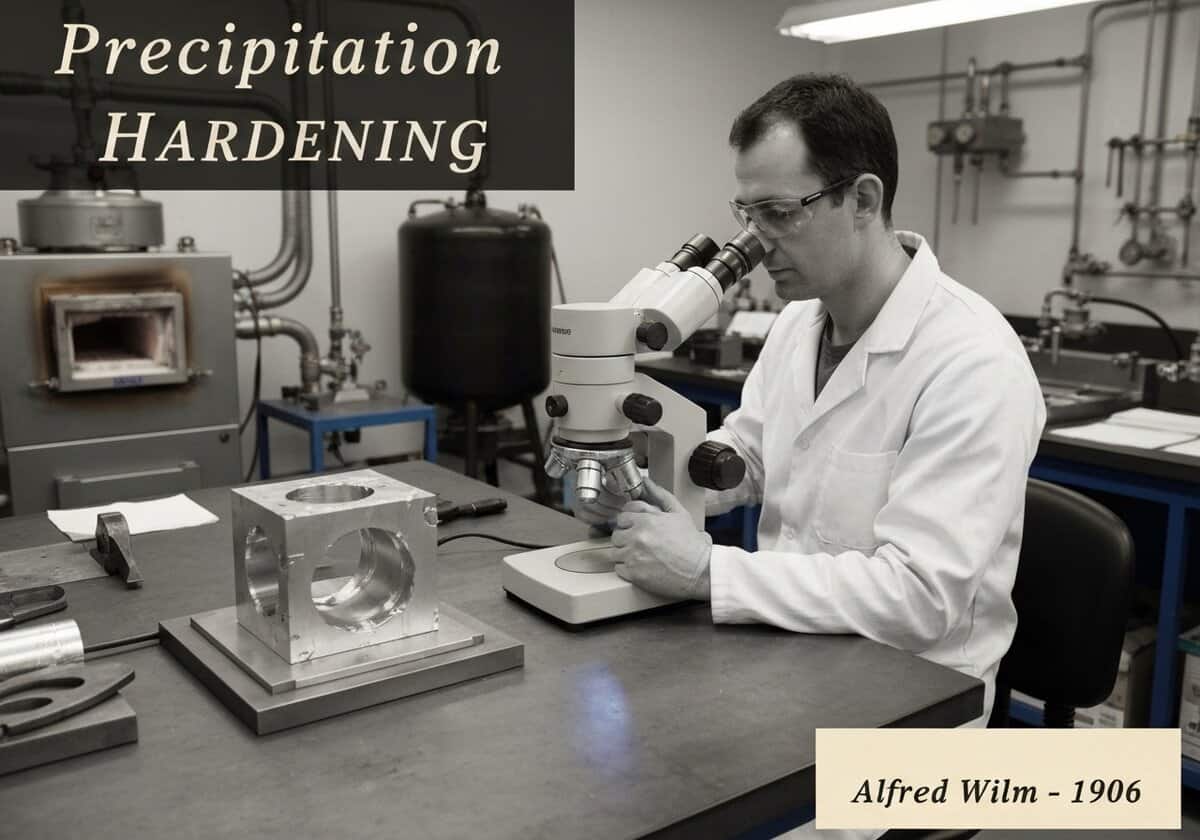
1906
  • Alfred Wilm
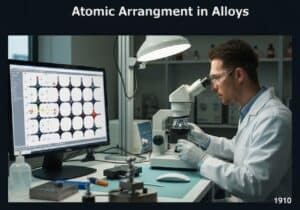
Metalúrgico analisando amostra de liga de alumínio demonstrando efeitos de endurecimento por precipitação.

(Imagem gerada apenas para fins ilustrativos)

O endurecimento por precipitação, ou endurecimento por envelhecimento, é um processo de tratamento térmico que aumenta a resistência ao escoamento de materiais maleáveis. Consiste em aquecer uma liga para dissolver elementos solutos (solubilização), resfriá-los rapidamente (têmpera) para aprisioná-los em uma solução sólida supersaturada e, em seguida, envelhecê-los a uma temperatura mais baixa para permitir a formação de partículas finas de uma segunda fase (precipitados), que obstruem o movimento das discordâncias.


The discovery of precipitation hardening by Alfred Wilm was accidental. While studying an aluminum liga containing copper, magnesium, and manganese (later named Duralumin), he noticed its hardness increased over several days after quenching, even at room temperature. This phenomenon is now understood as a three-step process. First, in solution treatment, the alloy is heated to a temperature high enough to dissolve all the solute atoms into a single-phase solid solution. Second, the alloy is rapidly quenched in a medium like water, which freezes the atoms in place, creating a supersaturated solid solution. This state is thermodynamically unstable. Third, during aging (either at room temperature or an elevated temperature), the supersaturated solute atoms diffuse and cluster together to form extremely small, coherent particles of a new phase called precipitates.

These precipitates act as powerful obstacles to the movement of dislocations, which are the primary carriers of plastic deformation in crystalline materials. The effectiveness of the strengthening depends on the size, shape, and distribution of these precipitates. Initially, as precipitates form and grow, the strength increases. However, if the aging process continues for too long (over-aging), the precipitates become too large and lose coherency with the matrix, allowing dislocations to bypass them more easily, which leads to a decrease in strength. This process allows for the precise tailoring of an alloy’s propriedades mecânicas.

UNESCO Nomenclature: 3308
Metalurgia

Tipo

Processo Químico

Interrupção

Revolucionário

Uso

Uso generalizado

Precursores

  • descoberta de deslocamentos em cristais por Vito Volterra e outros
  • Compreensão da difusão em estado sólido e da equação de Arrhenius
  • desenvolvimento de fornos de tratamento térmico controlado
  • Técnicas metalográficas para observação de microestruturas, pioneiras de Henry Clifton Sorby.

Aplicações

  • ligas de alumínio de alta resistência (ex.: 2024, 7075) para estruturas de aeronaves
  • maraging steels for tooling, foguete casings, and landing gear
  • Superligas à base de níquel (ex.: Inconel 718) para pás de turbina de motores a jato.
  • Ligas de cobre-berílio para ferramentas anti-faísca e molas de alto desempenho.
  • aços inoxidáveis ​​especiais (ex: 17-4ph)

Patentes:

  • German Patent 244554

Ideias de Inovação Potencial

  • 4d printing of metals that self-strengthen via controlled precipitation over time or in response to stimuli
  • alloys with multiple precipitation stages for multi-level strengthening
  • nanoparticle-seeded alloys to control precipitate nucleation sites with high precision
  • in-situ precipitation hardening during additive processos de fabricação
  • alloys designed for ‘dynamic’ precipitation hardening during operational stress
  • biomedical implants that age-harden in the body to match bone stiffness over time
  • self-healing alloys where precipitates form to ‘pin’ crack tips
  • alloys with precipitates that can be dissolved and re-precipitated using localized heating
  • thermoelectric materials whose efficiency is enhanced by precipitate-induced phonon dispersão
  • magnetic alloys where precipitates create pinning sites for magnetic domains
Related to: precipitation hardening, age hardening, heat treatment, resistência ao escoamento, dislocation, precipitate, duralumin, superalloy, metallurgy, strengthening mechanism.

Contexto histórico

Endurecimento por precipitação

1899-01-01
1900
1903
1906
1910
1910
1910
1897
1900
1900
1903-05-10
1910
1910
1910
1910

(Caso a data seja desconhecida ou irrelevante, por exemplo, "mecânica dos fluidos", é fornecida uma estimativa aproximada de seu surgimento notável)

10º ano aniversário

Imagens em tamanho real e downloads estão disponíveis apenas, 100% gratuitos, para membros registrados.