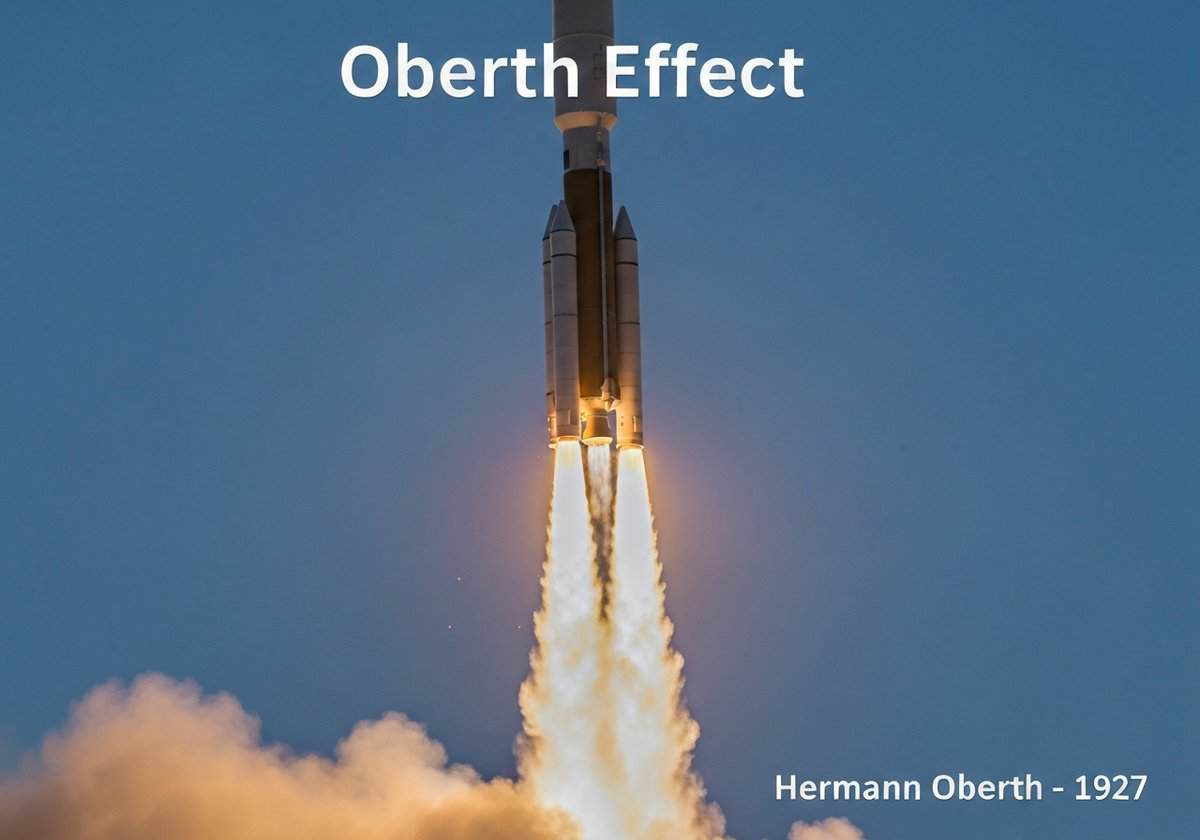
오베르트 효과는 로켓 엔진이 저속보다 고속에서 더 효율적으로 작동한다는 것을 설명합니다. 궤도의 근지점과 같이 고속에서 수행되는 로켓 연소는 저속에서 동일한 연소를 수행할 때보다 더 큰 운동 에너지 변화를 발생시킵니다. 이는 추진제 자체가 연소되기 전에 운동 에너지를 가지고 있기 때문입니다.

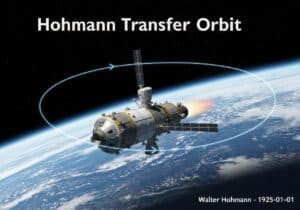
(설명을 위한 생성된 이미지입니다)
오베르트 효과는 로켓 엔진이 저속보다 고속에서 더 효율적으로 작동한다는 것을 설명합니다. 궤도의 근지점과 같이 고속에서 수행되는 로켓 연소는 저속에서 동일한 연소를 수행할 때보다 더 큰 운동 에너지 변화를 발생시킵니다. 이는 추진제 자체가 연소되기 전에 운동 에너지를 가지고 있기 때문입니다.

The Oberth effect is a consequence of the work-energy theorem. The work done on a 로켓 by its engine is the thrust force multiplied by the distance traveled during the burn ([latex]W = F \cdot d[/latex]). At higher speeds, the rocket travels a greater distance during the same burn time. Therefore, the same engine burn (same force, same duration, same 델타-v)는 차량에 더 많은 일을 하고 결과적으로 운동 에너지([latex]Delta E_k[/latex])의 증가량이 더 커집니다.
This effect is most pronounced when a spacecraft is moving fastest, which in an orbit occurs at its lowest point, the periapsis. By firing the engine at periapsis, a spacecraft can gain significantly more orbital energy than if it performed the same burn at apoapsis (the highest, slowest point). This is why interplanetary missions often use a powered flyby or ‘Oberth maneuver’ around a massive body like Jupiter. The spacecraft dives deep into the planet’s gravity well to pick up speed, then fires its engine at maximum velocity to multiply the effect of the burn, flinging it out into the 태양광 system at a much higher final speed than would otherwise be possible. The effect is not about getting more delta-v, but about getting more useful energy out of each unit of delta-v applied.
오베르트 효과
(날짜를 알 수 없거나 관련이 없는 경우, 예를 들어 "유체역학"의 경우, 주목할 만한 등장 시기를 대략적으로 추정하여 제공합니다.)

고화질 이미지 및 다운로드는 등록된 회원에게만 100% 무료로 제공됩니다.
> 로그인 <