Product Design, Manufacturing & Innovation Resources
Lar » Pressupostos da ANOVA

Pressupostos da ANOVA

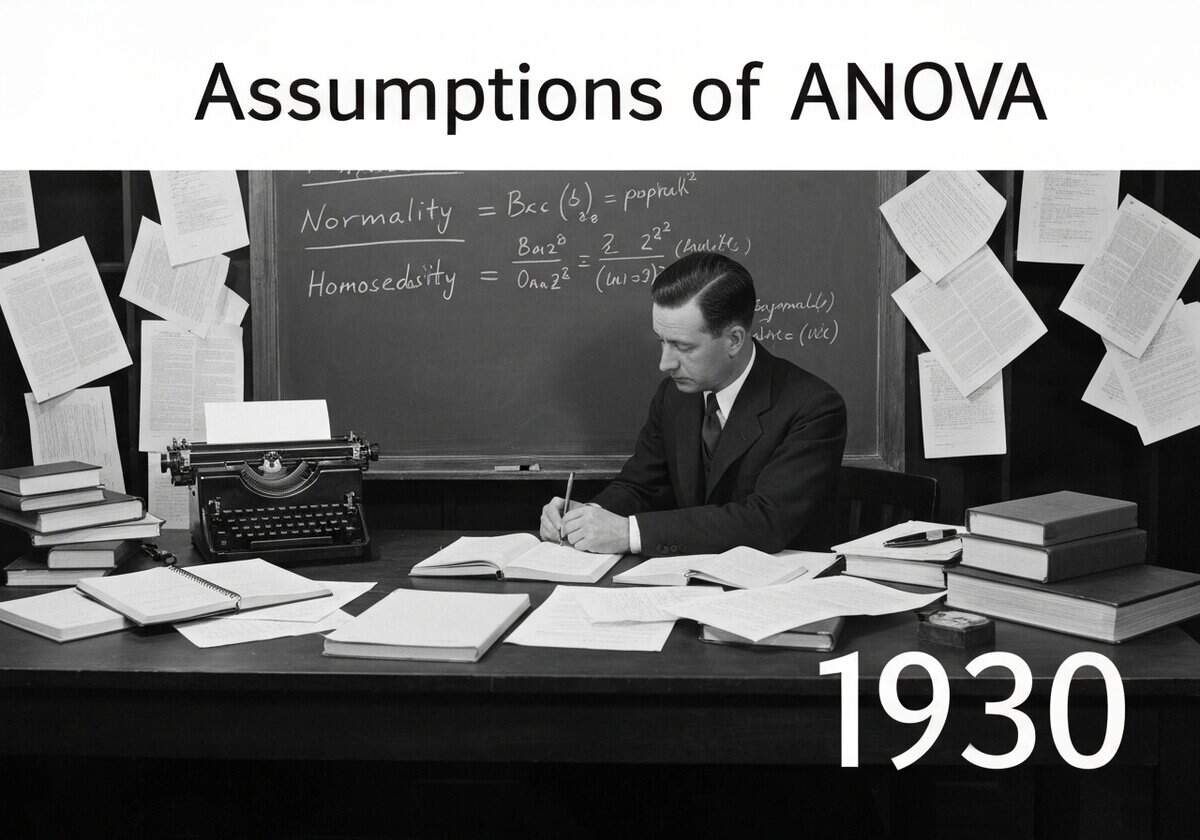
1930
Estatístico validando as suposições da ANOVA em um escritório da década de 1930.

(Imagem gerada apenas para fins ilustrativos)

Para os resultados de um ANOVA to be considered valid, several key assumptions about the data deve be met. These are: (1) Independence of observations, meaning the errors are uncorrelated. (2) Normality, where the residuals for each group are approximately normally distributed. (3) Homoscedasticity, or homogeneity of variances, meaning the variance of residuals is equal across all groups.

These assumptions relate to the residuals (the differences between observed values and the group means), not the raw data itself. Independence is the most critical assumption and is typically ensured by proper experimental design and random sampling; violations can lead to severely biased results. Normality means the distribution of residuals within each group should follow a bell curve. ANOVA is considered relatively robust to moderate violations of this assumption, especially with large and balanced sample sizes, due to the Central Limit Theorem. Homoscedasticity ([latex]\sigma_1^2 = \sigma_2^2 = \dots = \sigma_k^2[/latex]) means the spread or scatter of data points around their group mean should be similar for all groups. Significant violation of this assumption (heteroscedasticity) can increase the rate of Type I errors. Statisticians have developed diagnostic tools to check these assumptions. For example, Q-Q plots can assess normality, and Levene’s test or Bartlett’s test can check for homogeneity of variances. If assumptions are severely violated, researchers may need to transform the data or use alternative statistical methods that do not rely on these assumptions.

UNESCO Nomenclature: 1209
Estatísticas

Tipo

Sistema abstrato

Interrupção

Incremental

Uso

Uso generalizado

Precursores

  • Teorema do Limite Central (Abraham de Moivre, Pierre-Simon Laplace)
  • Teoria da distribuição normal (Carl Friedrich Gauss)
  • Conceito de resíduos estatísticos de modelos de regressão
  • Desenvolvimento de testes formais de hipóteses (Jerzy Neyman, Egon Pearson)

Aplicações

  • Verificação diagnóstica em modelagem estatística para garantir a validade.
  • orientar a transformação de dados (por exemplo, transformação logarítmica para corrigir a heterocedasticidade)
  • informando a escolha de alternativas não paramétricas, como o teste de Kruskal-Wallis, quando as premissas são violadas.
  • Garantir a confiabilidade dos resultados de pesquisas científicas publicadas em periódicos com revisão por pares.
  • Validação dos resultados dos testes A/B em análises de negócios.

Patentes:

NA

Ideias de Inovação Potencial

  • automated data science platforms that automatically check assumptions and suggest appropriate tests or transformations
  • clinical trial software that flags potential data quality issues based on assumption violations in real-time
  • financial risk models that incorporate tests for heteroscedasticity to improve volatility prediction
  • machine learning model validation modules that use these principles to check residual distributions
  • educational software that provides interactive visualizations to help students understand the impact of violating each assumption
  • a browser extension for researchers that scans online datasets and reports on their suitability for ANOVA
  • an integrated development environment (IDE) plugin for R or Python that provides inline warnings about potential assumption violations in statistical code
  • quality control systems that monitor not just the mean but also the variance of a process to detect instability
  • environmental science software that validates sensor network data by checking for spatial independence
  • um bioinformática tool that recommends specific statistical tests based on the characteristics of gene expression data
Relacionado a: pressupostos da ANOVA, independência, normalidade, homocedasticidade, resíduos, teste de Levene, teste de Shapiro-Wilk, robustez, validade estatística, diagnóstico de dados.

Contexto histórico

Pressupostos da ANOVA

1922
1925
1928
1930
1936
1940
1943
1920
1924
1925
1930
1931
1939
1940
1950

(Caso a data seja desconhecida ou irrelevante, por exemplo, "mecânica dos fluidos", é fornecida uma estimativa aproximada de seu surgimento notável)

10º ano aniversário

Imagens em tamanho real e downloads estão disponíveis apenas, 100% gratuitos, para membros registrados.