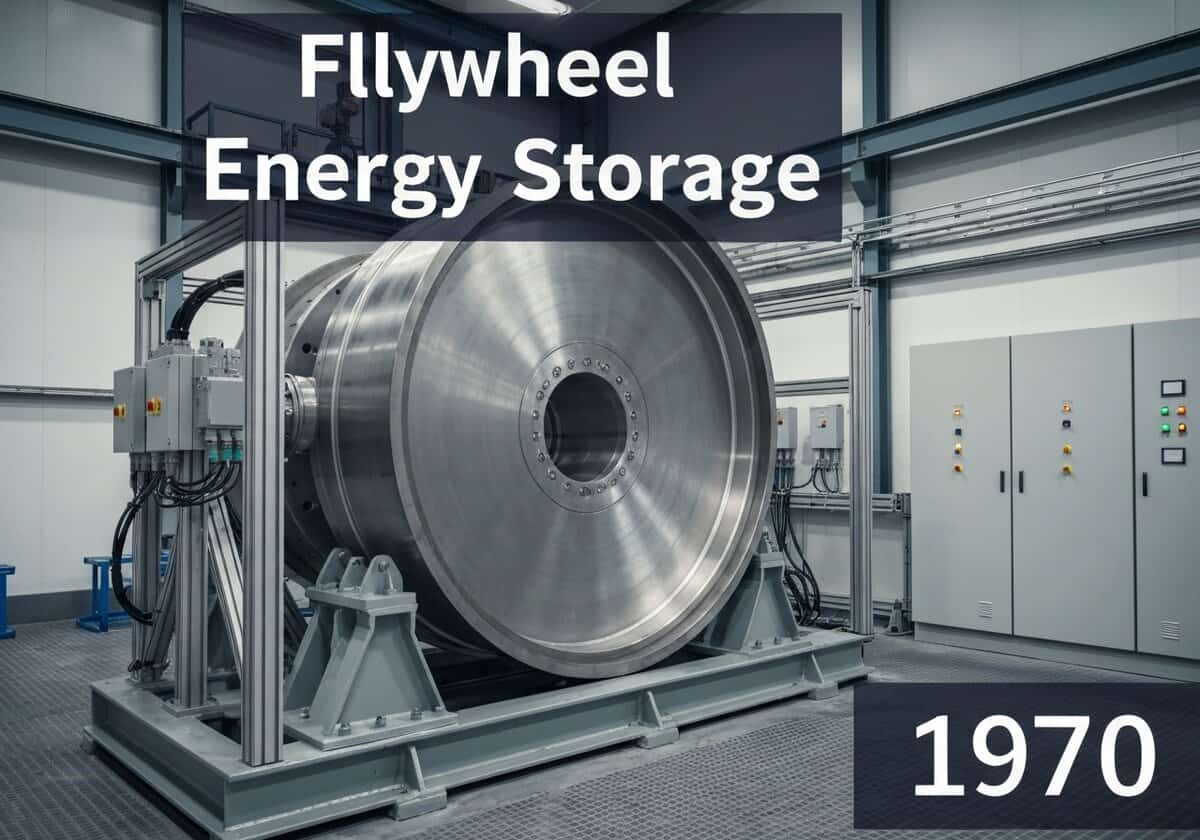
플라이휠 에너지 저장(FES)은 회전자(플라이휠)를 매우 빠른 속도로 가속시켜 회전 운동 에너지 형태로 시스템에 에너지를 저장하는 방식으로 작동합니다. 저장된 에너지는 회전 속도의 제곱에 비례합니다. 에너지를 추출하면 플라이휠의 회전 속도가 느려집니다. 저장된 에너지의 공식은 [latex]E = frac{1}{2} I omega^2[/latex]이며, 여기서 I는 관성 모멘트이고 ω는 각속도입니다.

(설명을 위한 생성된 이미지입니다)
플라이휠 에너지 저장(FES)은 회전자(플라이휠)를 매우 빠른 속도로 가속시켜 회전 운동 에너지 형태로 시스템에 에너지를 저장하는 방식으로 작동합니다. 저장된 에너지는 회전 속도의 제곱에 비례합니다. 에너지를 추출하면 플라이휠의 회전 속도가 느려집니다. 저장된 에너지의 공식은 [latex]E = frac{1}{2} I omega^2[/latex]이며, 여기서 I는 관성 모멘트이고 ω는 각속도입니다.

최신 FES 시스템은 공기 마찰을 최소화하기 위해 거의 진공 상태의 밀폐된 공간에서 회전하는 거대한 로터로 구성됩니다. 로터는 모터/발전기에 연결되어 있습니다. 에너지를 저장하기 위해, 모터 uses electricity to spin the flywheel up to speed. To release energy, the spinning flywheel drives the generator, producing electricity and slowing the rotor down. The amount of energy stored is given by [latex]E = frac{1}{2} I omega^2[/latex]. To maximize energy storage, rotors are designed to have a high moment of inertia and be able to withstand the immense centrifugal forces at very high rotational speeds (tens of thousands of RPM). Advanced FES systems use rotors made from high-strength carbon-fiber 복합재료 and employ magnetic bearings to eliminate friction from mechanical contact, allowing for extremely high efficiency (often over 90%) and very long lifespans with minimal degradation (hundreds of thousands of cycles). FES is particularly well-suited for applications requiring frequent, rapid charge and discharge cycles, such as grid frequency 규정, as it can respond to power fluctuations in milliseconds.
플라이휠 에너지 저장(FES)
(날짜를 알 수 없거나 관련이 없는 경우, 예를 들어 "유체역학"의 경우, 주목할 만한 등장 시기를 대략적으로 추정하여 제공합니다.)

고화질 이미지 및 다운로드는 등록된 회원에게만 100% 무료로 제공됩니다.
> 로그인 <