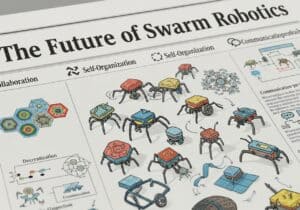
La robotica degli sciami studia i meccanismi di controllo decentralizzati che consentono a grandi gruppi di robot di eseguire compiti complessi in modo collettivo. Il coordinamento di più robot si basa su algoritmi distribuiti e protocolli di consenso per ottenere il controllo della formazione e l'evitamento delle collisioni. Algoritmi stigmatici e bio-ispirati guidano l'auto-organizzazione e il comportamento adattivo all'interno del gruppo. robotic sciami. Comunicazione I protocolli facilitano uno scambio robusto di informazioni, supportando l'assegnazione dei compiti e il rilevamento distribuito. La scalabilità e la tolleranza ai guasti rimangono sfide cruciali nei sistemi di sciami eterogenei.
Questa è la nostra ultima selezione di pubblicazioni e brevetti in inglese sulla robotica degli sciami, tra molte riviste scientifiche online, classificate e focalizzate su robotica degli sciami, controllo decentralizzato, intelligenza degli sciami, coordinamento multi-robot, algoritmo distribuito, flocking robotico, stigmergia, algoritmo di consenso, controllo della formazione, evitamento delle collisioni, localizzazione dei robot, assegnazione dei compiti ai robot, protocollo di comunicazione dei robot, auto-organizzazione dei robot, scalabilità degli sciami robotici, algoritmo bio-ispirato, esplorazione robotica, rilevamento distribuito, aggregazione robotica, simulazione della robotica degli sciami, pianificazione del percorso robotico, navigazione degli sciami robotici, dispiegamento degli sciami robotici, comportamento adattivo dei robot, apprendimento degli sciami robotici, processo decisionale distribuito, mappatura degli sciami robotici e sistemi di sciami eterogenei.
System and method for controlling search operations by swarms of autonomous agents
Patent published on the 2026-06-04 in WO under Ref WO2026117798 by LOK JOHNATHAN [US] (Lok Johnathan [us])
Abstract: A multi-agent control system coordinates autonomous agents to efficiently search two-dimensional and three-dimensional surfaces for targets. The system employs a multi-phase decentralized control strategy including deployment, circle formation, and spiral search phases. During circle formation, agents use a distributed consensus-based auction algorithm with wind-aware or current-aware cost calculations to assign themselves to evenly-spaced angular positions around a mission center. Agents then e[...]
Our summary: The system coordinates autonomous agents for efficient target search on two-dimensional and three-dimensional surfaces. It utilizes a multi-phase decentralized control strategy with auction algorithms for deployment and trajectory planning. Applications include search and rescue, reconnaissance, and environmental monitoring.
multi-agent systems, autonomous agents, decentralized control, search algorithms
Patent
Method and system for providing notification on basis of state of collision avoidance function
Patent published on the 2026-06-04 in WO under Ref WO2026116608 by AVIKUS CO LTD [KR] (Yoo Won Chul [kr], Kim In Beom [kr], Ko Kwang Sung [kr], Cha Je Hyun [kr], Oh Jin Young [kr], Park Ji Yoon [kr], Choi Hwi Yong [kr], Park Jin Mo [kr])
Abstract: The present document relates to a method and system for providing a notification on the basis of a state of a collision avoidance (CA) function. The proposed method for providing a notification defines a notification status to include an active state, a ready state, a low-performance state, and a failure state, wherein the active state and the ready state are defined within an operational design domain (ODD) of a CA function, the low-performance state is defined outside the ODD range of a CA fun[...]
Our summary: The document describes a method and system for notifying users based on the state of a collision avoidance function. It categorizes notification statuses into active, ready, low-performance, and failure states. These states are defined in relation to the operational design domain and operational envelope of the collision avoidance function.
collision avoidance, notification system, operational design domain, performance states
Patent
Autonomous unmanned aerial vehicle
Patent published on the 2026-06-03 in EP under Ref EP4752072 by BUDAPESTI MUESZAKI ES GAZDASAGTUDOMANYI EGYETEM [HU] (KovÁcs GÁbor [hu], Tihanyi Viktor [hu])
Abstract: The present description relates to an autonomous unmanned aerial vehicle (UAV) having at least one stereo optical imaging device and at least one stereo thermal imaging device making the unmanned aerial vehicle capable of operating in a wide range of weather and lighting condition with high confidence. The perception system for the autonomous UAV can sense the environment under a wide range of lighting conditions and offers adaptive coverage for collision avoidance and localization.[...]
Our summary: The autonomous UAV features stereo optical and thermal imaging devices for versatile operation. It can function effectively in various weather and lighting conditions. The perception system enhances collision avoidance and localization capabilities.
autonomous UAV, stereo optical imaging, stereo thermal imaging, perception system
Patent
Windshield sensor environmental shield
Patent published on the 2026-05-28 in US under Ref US20260145623 by CHALMERS MICHELLE [US] (Chalmers Michelle [us])
Abstract: [0000] A shielding device for forward facing and/or windshield mounted/located sensors on an automobile protects sensors in close proximity to the windshield from temperature extremes associated with sunlight and extreme cold or wind. Modern automobiles tend to locate forward-focused collision avoidance sensors (sensors) around the perimeter of the windshield, typically at a central, uppermost portion. The windshield is subject to a substantial solar load, often emphasized by the angle of the wi[...]
Our summary: A shielding device protects automobile sensors from temperature extremes caused by sunlight and cold. It is designed for sensors located near the windshield, which is exposed to significant solar load. The reflective substrate helps mitigate heat damage and can be attached in various ways.
sensor shielding, windshield protection, temperature management, collision avoidance
Patent
Collision detector for vhsp/gpon coexistence with throughput flexibility
Patent published on the 2026-05-21 in WO under Ref WO2026104037 by CANO VALADEZ IVAN NICOLAS [DE] (Cano Valadez Ivan Nicolas [de], Kuschnerov Maxim [de])
Abstract: The present disclosure enhances collision detection in passive optical network standards operation in overlapping wavelength portions. Compared to other methods and devices, it avoids a waste of channel capacity and allows for more efficient communication while at the same time ensuring backwards compatibility with existing standards and thus promoting cost-efficiency. Specifically, the present disclosure provides a method for multi-standard coexistence in a passive optical network, comprising: [...]
Our summary: The disclosure presents an enhanced collision detection method for passive optical networks operating in overlapping wavelengths. It improves communication efficiency while maintaining compatibility with existing standards. The method includes multiple stages for identifying and mitigating potential collisions between optical signals.
collision detection, passive optical networks, wavelength overlap, throughput flexibility
Patent
Adaptive random-walk scheduling for ble beacon transmissions
Patent published on the 2026-05-07 in WO under Ref WO2026094013 by CARTASENSE LTD [IL] (Kaufmann Yaron [il], Berkovitch Shlomo [il], Peled Aviv [il])
Abstract: A method for Bluetooth Low Energy (BLE) advertising includes determining, by a controller of a BLE device, a next transmission time for advertising content using a bounded mean-reverting random-walk process. The determination is based on a next drift variable (Δtn+1), a base interval value (T0), and a random jitter component (J). The next drift variable is determined based on a current drift variable (Δtn), a first parameter (λ), a random variable (ξn) and a scaling factor (σ) set to determ[...]
Our summary: The method uses a bounded mean-reverting random-walk process to determine BLE advertising transmission times. It autonomously transmits content based on drift variables and a random jitter component. This approach enhances collision avoidance in dense environments by enabling desynchronization among nearby BLE devices.
BLE advertising, random-walk process, collision avoidance, autonomous transmission
Patent
A case study for multiple chaotic mapping snake optimizer
Published on 2026-03-26 by @OXFORD
Abstract: AbstractIn recent years, chaos theory has been widely incorporated into metaheuristic optimization algorithms to enhance their search performance. However, for a given algorithm, there is still a lack of systematic and large-scale comparison regarding the effectiveness of different chaotic maps, and no clear consensus has yet been reached. To address this issue, this paper reviews 12 commonly used classical chaotic maps and summarizes three typical integration strategies of chaotic maps in bio-i[...]
Our summary: This study evaluates the effectiveness of 12 chaotic maps integrated into the snake optimizer. Simulation experiments reveal that performance improvements vary based on map type and problem characteristics. The tent chaotic map shows the most consistent enhancement, while a comparative analysis highlights the chaotic snake optimizer s advantages and limitations.
chaotic mapping, snake optimizer, metaheuristic optimization, bio-inspired algorithms
Publication
High-Precision Marine Radar Object Detection Using Tiled Training and SAHI Enhanced YOLOv11-OBB
Published on 2026-02-02 by Sercan Klc @MDPI
Abstract: Reliable object detection in marine radar imagery is critical for maritime situational awareness, collision avoidance, and autonomous navigation. However, it remains challenging due to sea clutter, small targets, and interference from fixed navigational aids. This study proposes a high-precision detection pipeline that integrates tiled training, Sliced Aided Hyper Inference (SAHI), and an oriented bounding box (OBB) variant of the lightweight YOLOv11 architecture. The proposed approach effective[...]
Our summary: This study presents a high-precision detection pipeline for marine radar imagery using tiled training and SAHI with YOLOv11-OBB. The method effectively addresses challenges like sea clutter and small targets, achieving an [email protected] over 0.95. Results indicate improved performance on small targets and enable near real-time inference on edge hardware.
Marine Radar, Object Detection, YOLOv11, Tiled Training
Publication