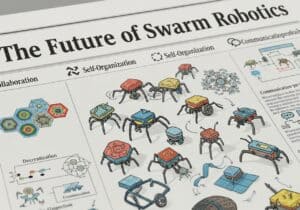
蜂群机器人技术研究的是使大型机器人群能够集体执行复杂任务的分散控制机制。多机器人协调依靠分布式算法和共识协议来实现编队控制和避免碰撞。Stigmergy 算法和生物启发算法可指导机器人内部的自组织和自适应行为。 机器人 群。. 沟通 协议可促进稳健的信息交换,支持任务分配和分布式传感。可扩展性和容错性仍然是异构蜂群系统面临的关键挑战。.
这是我们最新精选的关于蜂群机器人技术的全球出版物和专利(英文),这些出版物和专利来自众多科学在线期刊,分类并侧重于蜂群机器人、分散控制、蜂群智能、多机器人协调、分布式算法、机器人成群、stigmergy、共识算法、编队控制、避免碰撞、机器人定位、机器人任务分配、机器人通信协议、机器人自组织、机器人蜂群可扩展性、生物启发算法、机器人探索、分布式传感、机器人聚集、蜂群机器人模拟、机器人路径规划、机器人蜂群导航、机器人蜂群部署、机器人自适应行为、机器人蜂群学习、分布式决策、机器人蜂群绘图和异构蜂群系统。.
Stationary object collision avoidance system
Patent published on the 2026-07-02 in US under Ref US20260188130 by SOUTHWEST RESEARCH INST [US] (Lee Peter Mark [us])
Abstract: In an approach to detecting stationary objects in a traffic alert and collision avoidance system. The method includes supplying an aircraft with a collision avoidance system (CAS) wherein the CAS provides a display for stationary object detection; providing a stationary object with a transponder where the CAS interrogates the stationary object transponder and determines a height and distance of the stationary object relative to the aircraft; wherein the CAS determines a range, bearing and relati[...]
Our summary: The system detects stationary objects to prevent collisions. It uses a transponder to determine the object s height and distance. Alerts are issued visually or audibly, and lighting systems can be activated for increased visibility.
collision avoidance, stationary object detection, transponder system, traffic alert
Patent
Robot apparatus, multi-robot system comprising the same, and method for assigning tasks between robots in the multi-robot system
Patent published on the 2026-07-02 in US under Ref US20260183946 by KOREA INST OF SCIENCE AND TECHNOLOGY [KR] (Lee Donggil [kr], Lim Yoonseob [kr], Lee Goeun [kr])
Abstract: [0000] A multi-robot system configured to perform task allocation through a network among robots includes a plurality of robots executing a distributed algorithm designed to allocate tasks based on local data. The distributed algorithm transforms a task-allocation problem into a dual-form structure to be individually processed by each robot, and each robot is addable to or removable from the network without centralized information or an initialization procedure.[...]
Our summary: A multi-robot system allocates tasks among robots using a distributed algorithm. Each robot processes tasks based on local data. The system allows for dynamic addition or removal of robots without centralized control.
multi-robot system, task allocation, distributed algorithm, network communication
Patent
Rural e-commerce logistics path optimization method by carbon emission costs and CCSO
Published on 2026-06-25 by @OXFORD
Abstract: AbstractThis study tackles nonlinear programming challenges caused by the dual constraints of sparse, discrete rural e-commerce logistics networks and low-carbon time requirements. The study develops a path optimization model that combines a carbon tax mechanism with dynamic scheduling strategies. Traditional swarm intelligence algorithms often fall into local optima and lose population diversity in high-dimensional discrete spaces. To address these issues, this study proposes an improved Chicke[...]
Our summary: This study presents a path optimization model for rural e-commerce logistics that incorporates carbon emission costs. It introduces an improved Chicken Swarm Optimization (CCSO) to enhance global search capabilities. The results indicate significant reductions in operational and carbon emission costs through optimized routing.
path optimization, carbon emissions, Chicken Swarm Optimization, rural logistics
Publication
System and method for autonomous support of extravehicular activity operations in space
Patent published on the 2026-06-18 in US under Ref US20260167362 by MACDONALD DETTWILER AND ASS INC [CA] (Sorocky Michael Joseph [ca], Langley Christopher Stewart [ca], Watson William [us], Arnold Katherine [ca], Caldwell Jack Austin [ca])
Abstract: [0000] A system and method for autonomously supporting extravehicular activity (“EVA”) on a spacecraft is provided. The system includes: a robotic arm for moving an EVA crew member on a robotic arm to and from a worksite; an autonomy processing device configured to: execute a collision avoidance module that detects a potential collision situation based on telemetry received from sensors of the robotic arm, wherein the collision avoidance module includes preconfigured collision models represe[...]
Our summary: The system provides autonomous support for extravehicular activities on spacecraft. It includes a robotic arm for crew movement and an autonomy processing device for collision avoidance. The device detects unexpected obstacles during the robotic arm s motion using real-time image data.
autonomous systems, extravehicular activity, robotic arm, collision avoidance
Patent
A method and device based on wind-induced motion response for monitoring wind acting on overhead power lines
Patent published on the 2026-06-17 in EP under Ref EP4761023 by AMPACIMON SA [BE] (Godard Bertrand [be])
Abstract: The present invention relates to a method for estimating, measuring or monitoring a gust or wind speed component acting on a suspended cable span of an overhead electrical power line through the dynamic response from the wind-induced excitation, or aerodynamic force, upon said suspended cable span, comprising the following steps:- sensing a tension, vibration, strain or motion of said suspended cable span by using a local or distributed sensing device having access to local, respectively distrib[...]
Our summary: This invention provides a method for monitoring wind effects on overhead power lines. It utilizes sensors to detect the dynamic response of suspended cables. The method calculates wind speed components based on the cable s tension, vibration, and strain.
wind monitoring, power lines, dynamic response, gust estimation
Patent
System and method for controlling search operations by swarms of autonomous agents
Patent published on the 2026-06-04 in WO under Ref WO2026117798 by LOK JOHNATHAN [US] (Lok Johnathan [us])
Abstract: A multi-agent control system coordinates autonomous agents to efficiently search two-dimensional and three-dimensional surfaces for targets. The system employs a multi-phase decentralized control strategy including deployment, circle formation, and spiral search phases. During circle formation, agents use a distributed consensus-based auction algorithm with wind-aware or current-aware cost calculations to assign themselves to evenly-spaced angular positions around a mission center. Agents then e[...]
Our summary: The system coordinates autonomous agents for efficient target search on two-dimensional and three-dimensional surfaces. It utilizes a multi-phase decentralized control strategy with auction algorithms for deployment and trajectory planning. Applications include search and rescue, reconnaissance, and environmental monitoring.
multi-agent systems, autonomous agents, decentralized control, search algorithms
Patent
Method and system for providing notification on basis of state of collision avoidance function
Patent published on the 2026-06-04 in WO under Ref WO2026116608 by AVIKUS CO LTD [KR] (Yoo Won Chul [kr], Kim In Beom [kr], Ko Kwang Sung [kr], Cha Je Hyun [kr], Oh Jin Young [kr], Park Ji Yoon [kr], Choi Hwi Yong [kr], Park Jin Mo [kr])
Abstract: The present document relates to a method and system for providing a notification on the basis of a state of a collision avoidance (CA) function. The proposed method for providing a notification defines a notification status to include an active state, a ready state, a low-performance state, and a failure state, wherein the active state and the ready state are defined within an operational design domain (ODD) of a CA function, the low-performance state is defined outside the ODD range of a CA fun[...]
Our summary: The document describes a method and system for notifying users based on the state of a collision avoidance function. It categorizes notification statuses into active, ready, low-performance, and failure states. These states are defined in relation to the operational design domain and operational envelope of the collision avoidance function.
collision avoidance, notification system, operational design domain, performance states
Patent
A case study for multiple chaotic mapping snake optimizer
Published on 2026-03-26 by @OXFORD
Abstract: AbstractIn recent years, chaos theory has been widely incorporated into metaheuristic optimization algorithms to enhance their search performance. However, for a given algorithm, there is still a lack of systematic and large-scale comparison regarding the effectiveness of different chaotic maps, and no clear consensus has yet been reached. To address this issue, this paper reviews 12 commonly used classical chaotic maps and summarizes three typical integration strategies of chaotic maps in bio-i[...]
Our summary: This study evaluates the effectiveness of 12 chaotic maps integrated into the snake optimizer. Simulation experiments reveal that performance improvements vary based on map type and problem characteristics. The tent chaotic map shows the most consistent enhancement, while a comparative analysis highlights the chaotic snake optimizer s advantages and limitations.
chaotic mapping, snake optimizer, metaheuristic optimization, bio-inspired algorithms
Publication