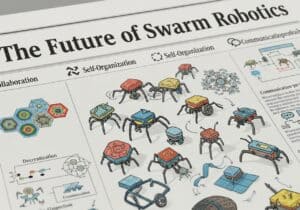
La robotique en essaim étudie les mécanismes de contrôle décentralisés permettant à de grands groupes de robots d'accomplir collectivement des tâches complexes. La coordination multi-robots repose sur des algorithmes distribués et des protocoles de consensus pour assurer le contrôle de formation et l'évitement des collisions. La stigmergie et les algorithmes bio-inspirés guident l'auto-organisation et le comportement adaptatif au sein des essaims robotiques. Les protocoles de communication facilitent un échange d'informations robuste, prenant en charge la répartition des tâches et la détection distribuée. L'évolutivité et la tolérance aux pannes demeurent des défis majeurs pour les systèmes d'essaims hétérogènes.
Les essaims tirent leurs capacités du nombre, et non d'un seul robot intelligent. Les modèles à règles locales sont en cours d'élaboration. automates cellulaires, les bases du robot unique sur robotiqueet des versions à échelle réduite sur poussière intelligenteDes essaims aériens sont en cours. drone, et la version satellite sur CubeSats.
Voici notre dernière sélection de publications et de brevets mondiaux en anglais sur la robotique en essaim, parmi de nombreuses revues scientifiques en ligne, classées et axées sur la robotique en essaim, le contrôle décentralisé, l'intelligence en essaim, la coordination multi-robots, l'algorithme distribué, le flocage robotique, la stigmergie, l'algorithme de consensus, le contrôle de la formation, l'évitement des collisions, la localisation des robots, l'attribution des tâches aux robots, protocole de communication entre robots, auto-organisation des robots, évolutivité des essaims de robots, algorithme bio-inspiré, exploration robotique, détection distribuée, agrégation robotique, simulation de robotique en essaim, planification de trajectoires robotiques, navigation en essaim robotique, déploiement d'essaims robotiques, comportement adaptatif des robots, apprentissage en essaim robotique, prise de décision distribuée, cartographie d'essaims robotiques et systèmes d'essaims hétérogènes.
Collision avoidance perception system
Patent published on the 2026-11-19 in US under Ref US20260367635 by ZOOX INC [US] (Philbin James William Vaisey [us], Charchut Nicholas George [us], Hendy Noureldin Ehab [us], Sloan Cooper Stokes [us], Wang Chuang [us])
Abstract: A collision avoidance system may validate, reject, or replace a trajectory generated to control a vehicle. The collision avoidance system may comprise a secondary perception component that may receive sensor data, receive and/or determine a corridor associated with operation of a vehicle, classify a portion of the sensor data associated with the corridor as either ground or an object, determine a position and/or velocity of at least the nearest object, determine a threshold distance associated w[...]
Our summary: The collision avoidance system evaluates vehicle trajectories for safety. It uses sensor data to identify objects and their positions. The system controls the vehicle based on proximity to detected objects.
Collision avoidance, perception system, sensor data, trajectory control
Patent
Swarm intelligence powered kolmogorov arnold network (kan) based fraud detection-prevention-response mechanism
Patent published on the 2026-11-19 in US under Ref US20260368738 by BANK OF AMERICA [US] (Gupta Saurabh [in], Hasan Wahid [in], Tanwani Barkha [in])
Abstract: A method for providing a swarm-intelligence-powered Kolmogorov Arnold Network (KAN) based fraud detection-prevention-response mechanism is provided. The method includes detecting fraudulent transaction information stored in each of a threshold number of data repositories, using a mobile application programming interface associated with each of the threshold number of data repositories to derive one or more location codes associated with the fraudulent transaction information at each of the thres[...]
Our summary: This method utilizes swarm intelligence and a Kolmogorov Arnold Network for fraud detection. It detects fraudulent transactions across multiple data repositories. The system alerts users about fraudulent activities based on their proximity to affected regions.
Swarm Intelligence, Kolmogorov Arnold Network, Fraud Detection, Mobile API
Patent
Information processing device, information processing method, and operation management system
Patent published on the 2026-11-19 in US under Ref US20260368438 by MITSUBISHI ELECTRIC CORP [JP] (Watanabe Misato [jp], Kuriyama Taiki [jp], Kubota Yuri [jp], Kataoka Tatsunari [jp], Fukagawa Hirofumi [jp])
Abstract: An information processing device including: a current information acquiring unit that acquires current information that is information received at the current time; a conversational information controlling unit that outputs a conversation screen including a conversational sentence and an operation region related to an action task by a virtual responder generated on the basis of the current information and know-how information about each past responder related to an operation of a moving object; [...]
Our summary: The device acquires current information and generates a conversation screen. It includes a controlling unit for interaction and an output unit for action commands. The system facilitates operations related to moving objects through virtual responses.
information processing, conversational interface, operation management, virtual responder
Patent
A collision avoidance system for an unmanned aerial vehicle (uav) and a method thereof
Patent published on the 2026-11-19 in WO under Ref WO2026239362 by AYAAN AUTONOMOUS SYSTEMS PVT LTD [IN] (Chaudhari Atul Narayan [in])
Abstract: The present disclosure envisages a collision avoidance system for an unmanned aerial vehicle (UAV) and a method thereof. The UAV comprises a main body and a plurality of arms supporting propulsion motor assemblies. A plurality of wide-angle camera assemblies mounted on the body, collectively defines a continuous perimeter and generates a first set of image frames. A pair of auxiliary wide-angle cameras (206A, 206B) are mounted on an upper surface and a lower surface of the main body respectively[...]
Our summary: The collision avoidance system for UAVs utilizes multiple wide-angle cameras and sensors to detect surrounding objects. It processes image frames and sensor signals to create navigation commands. These commands are then converted into motor control signals for safe flight operations.
collision avoidance, unmanned aerial vehicle, image processing, sensor integration
Patent
Method and device for transmitting and receiving signal in wireless communication system
Patent published on the 2026-11-19 in US under Ref US20260367234 by LG ELECTRONICS INC [KR] (Jang Jihwan [kr], Chung Jaehoon [kr], Oh Jaeky [kr])
Abstract: The present disclosure may provide an operation method of a terminal in a wireless communication system. The operation method of the terminal may comprise the steps of: receiving a synchronization signal block (SSB) from a first base station; identifying a master information block (MIB) on the basis of the SSB; identifying a system information block (SIB) on the basis of the MIB; receiving resource allocation information included in the SIB; sensing a first object through some of resources alloc[...]
Our summary: The method involves a terminal receiving a synchronization signal block from a base station. It identifies a master information block and a system information block to obtain resource allocation information. The terminal senses an object and, if unsuccessful due to NLOS conditions, requests and receives distributed sensing information from the base station.
wireless communication, synchronization signal, resource allocation, distributed sensing
Patent
Carbon emission calculation method based on gradient boosting trees and swarm intelligence algorithm
Patent published on the 2026-11-19 in WO under Ref WO2026237221 by YUNNAN ELECTRIC POWER TEST AND RESEARCH INST GROUP CO LTD [CN] (Ding Xinzhi [cn], Shen Jiaxu [cn], Li Shenzhang [cn], Shen Xin [cn], Gu Jianlong [cn], Jin Qi [cn], Wang Qing [cn], Li Xuefang [cn], Yang Wenrui [cn], Shi Susu [cn], Li Li [cn], Zhang Jianwei [cn], Xu Shoudong [cn], Shi Hengchu [cn], He Chunhong [cn])
Abstract: The present invention relates to the technical field of carbon emissions, and in particular to a carbon emission calculation method based on gradient boosting trees and a swarm intelligence algorithm. The calculation method comprises the following steps: acquiring basic data, and preprocessing the basic data, wherein the preprocessing comprises removing abnormal values and processing missing values, and the basic data includes power generation data on a power generation side, meteorological cond[...]
Our summary: This method calculates carbon emissions using gradient boosting trees and swarm intelligence. It involves data preprocessing, feature extraction, and model training. The output is a prediction of the dynamic carbon emission factor for a power system.
carbon emission, gradient boosting, swarm intelligence, prediction model
Patent
Computational framework for makespan-aware multi-robot task allocation in obstacle-rich environments
Published on 2026-07-25 by @OXFORD
Abstract: AbstractStatic multi-robot task allocation in obstacle-rich environments becomes more challenging as the problem size increases because trivial and contested assignments are typically addressed during the same planning process. This paper presents the computational depot-frontier growth partitioning (DFGP) framework for organizing assignment decisions in static depot-aware multi-robot task allocation. In a centralized, full-information setting, DFGP expands depot-centred frontiers so that tasks [...]
Our summary: The DFGP framework organizes task assignments in multi-robot systems within obstacle-rich environments. It utilizes depot-centered frontiers to manage tasks efficiently, resolving contested assignments through entropy-based prioritization. Benchmark evaluations demonstrate DFGP s effectiveness, achieving a lower-bound gap of 8.5% and efficient runtime performance.
multi-robot task allocation, obstacle-rich environments, computational framework, depot-frontier growth partitioning
Publication
Rural e-commerce logistics path optimization method by carbon emission costs and CCSO
Published on 2026-06-25 by @OXFORD
Abstract: AbstractThis study tackles nonlinear programming challenges caused by the dual constraints of sparse, discrete rural e-commerce logistics networks and low-carbon time requirements. The study develops a path optimization model that combines a carbon tax mechanism with dynamic scheduling strategies. Traditional swarm intelligence algorithms often fall into local optima and lose population diversity in high-dimensional discrete spaces. To address these issues, this study proposes an improved Chicke[...]
Our summary: This study presents a path optimization model for rural e-commerce logistics that incorporates carbon emission costs. It introduces an improved Chicken Swarm Optimization (CCSO) to enhance global search capabilities. The results indicate significant reductions in operational and carbon emission costs through optimized routing.
path optimization, carbon emissions, Chicken Swarm Optimization, rural logistics
Publication