Product Design, Manufacturing & Innovation Resources
Casa » Potenziale elettrochimico nelle membrane biologiche

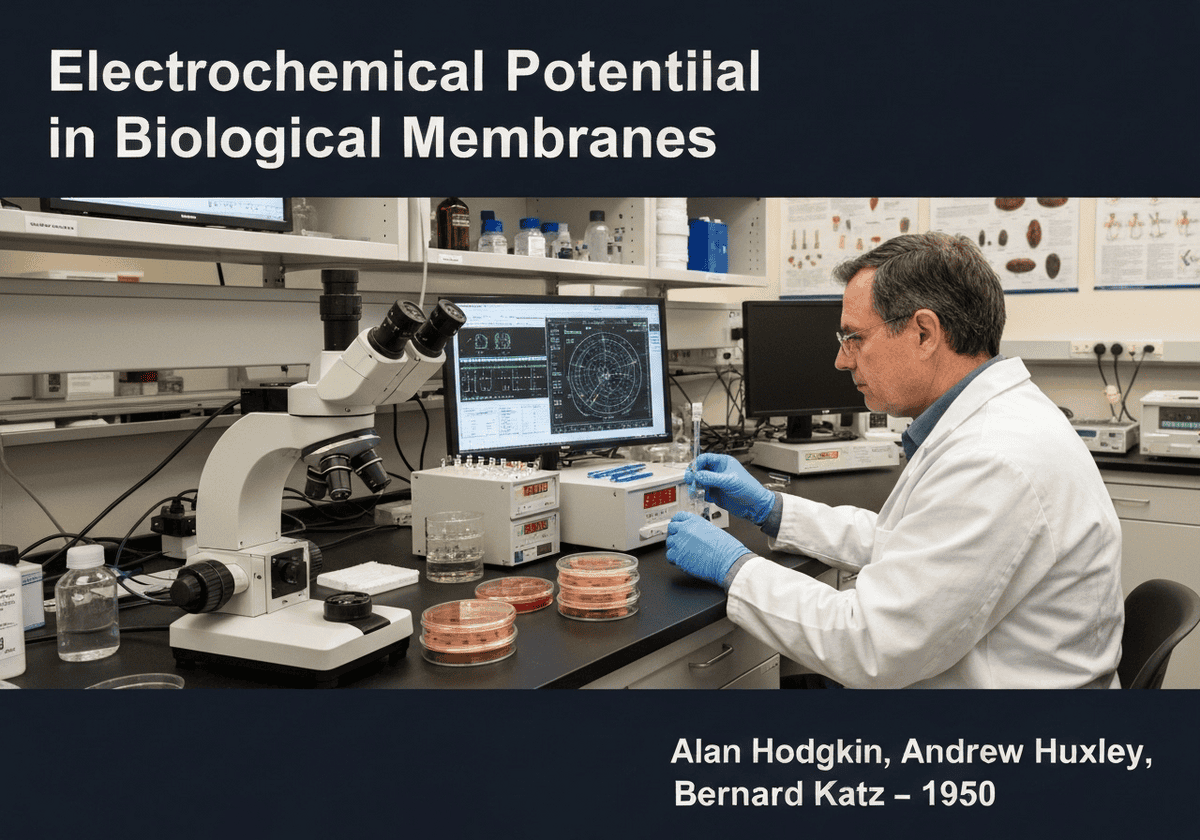
Potenziale elettrochimico nelle membrane biologiche

1950
  • Alan Hodgkin
  • Andrew Huxley
  • Bernard Katz
Biophysicist studying electrochemical potential in cell membranes with laboratory equipment.

(Immagine generata a solo scopo illustrativo)

Electrochemical potential is fundamental to life, driving processes across cell membranes. Ion pumps actively create concentration gradients, while the selective permeability of ion channels establishes an electrical potential (membrane potential). The resulting electrochemical gradient dictates the passive flow of ions, which is crucial for nerve signaling (action potentials), muscle contraction, and cellular energy production (ATP synthesis) in mitochondria.

The existence of life depends on maintaining a state of disequilibrium across cell membranes, which is quantified by electrochemical potential gradients. The sodium-potassium pompa ([latex]Na^+/K^+[/latex]-ATPase), for example, uses the energy from ATP hydrolysis to actively transport [latex]Na^+[/latex] ions out of the cell and [latex]K^+[/latex] ions in. This action establishes steep concentration gradients (a chemical potential difference) and contributes to an electrical potential difference, as more positive charge is pumped out than in.

The cell membrane is studded with ion channels, which are proteins that allow specific ions to pass through. The resting membrane potential is primarily established by ‘leak’ channels that are more permeable to [latex]K^+[/latex] than [latex]Na^+[/latex]. [latex]K^+[/latex] ions flow out of the cell down their concentration gradient, leaving behind a net negative charge inside and thus creating an electrical potential that opposes further outflow. The equilibrium, described by the Goldman-Hodgkin-Katz equation, is reached when the electrical force pulling [latex]K^+[/latex] in balances the chemical force pushing it out.

This stored energy in the electrochemical gradient is harnessed for vital functions. In neurons, a stimulus can open voltage-gated ion channels, allowing a rapid influx of [latex]Na^+[/latex] that depolarizes the membrane and creates an action potential. In mitochondria, the electron transport chain pumps protons across the inner membrane, creating a powerful electrochemical gradient that drives ATP synthase to produce the cell’s primary energy currency, ATP.

UNESCO Nomenclature: 2406
– Biophysics

Tipo

Biological Process

Interruzione

Revolutionary

Utilizzo

Uso diffuso

Precursori

  • luigi galvani’s discovery of ‘animal electricity’
  • julius bernstein’s membrane hypothesis for nerve potential
  • walther nernst’s equation for equilibrium potential
  • la scoperta della pompa sodio-potassio di jens christian skou

Applicazioni

  • farmacologia (farmaci che prendono di mira i canali ionici)
  • neuroscienze (comprensione della propagazione degli impulsi nervosi)
  • cardiologia (elettrocardiogramma, ecg e comprensione del ritmo cardiaco)
  • bioenergetica (studio della funzione e delle malattie mitocondriali)
  • sviluppo di anestetici e neurotossine

Brevetti:

NA

Idee e potenziali innovazioni

  • terapie bioelettriche che modulano la rigenerazione nervosa controllando i gradienti elettrochimici locali
  • cellule sintetiche che svolgono compiti complessi alimentati da potenziali di membrana ingegnerizzati
  • canali ionici attivati ​​dalla luce (optogenetica) per un controllo preciso dei circuiti neurali
  • biosensori che utilizzano i cambiamenti del potenziale di membrana per rilevare tossine o agenti patogeni
  • architetture di calcolo ad alta efficienza energetica che imitano il flusso di ioni neurali
  • terapie mirate contro il cancro che interrompono il potenziale di membrana delle cellule maligne
  • artificial fotosintesi systems using proton gradients across synthetic membranes
  • self-powered impianti medici that harvest energy from the body’s natural ion gradients
Related to: membrane potential, ion channel, action potential, atp synthesis, hodgkin-huxley model, bioenergetics, neuroscience, sodium-potassium pump.

Contesto storico

Potenziale elettrochimico nelle membrane biologiche

1928
1930
1940
1950
1950
1954
1960
1921
1930
1930
1940
1950
1951
1958
1960

(se la data è sconosciuta o non rilevante, ad esempio "meccanica dei fluidi", viene fornita una stima approssimativa della sua notevole comparsa)

decimo anno anniversario

Le immagini a grandezza naturale e i download sono disponibili, gratuitamente al 100%, solo per gli utenti registrati.

> Login <