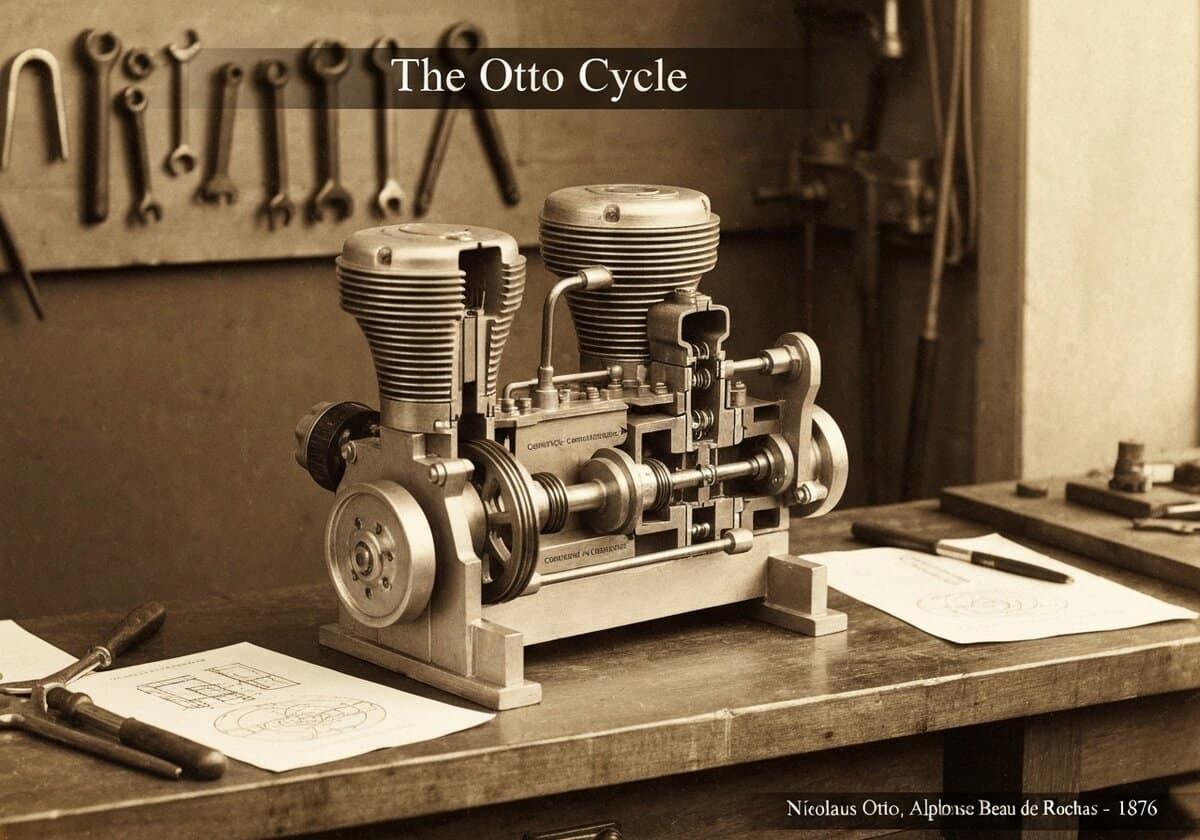
The Otto Cycle
1876
- Nicolaus Otto
- Alphonse Beau de Rochas
The ideal Otto cycle is a thermodynamic model for spark-ignition engines. It consists of four internally reversible processes: isentropic compression (1-2), constant volume (isochoric) heat addition (2-3), isentropic expansion (3-4), and constant volume (isochoric) heat rejection (4-1). This cycle forms the theoretical basis for analyzing the performance of gasoline engines, assuming an ideal gas as the working fluid.
The Otto cycle is visualized on a Pressure-Volume (P-V) diagram, forming a closed loop. The analysis begins at state 1, at the start of the compression stroke, with the piston at bottom dead center (BDC).
Process 1–2: Isentropic Compression. The piston moves from BDC to top dead center (TDC), compressing the air-fuel mixture. In this idealized, adiabatic process, there is no heat transfer to or from the system, so entropy remains constant. Work is done on the gas, increasing its internal energy, which manifests as a rise in both pressure and temperature.
Process 2–3: Constant-Volume Heat Addition. At TDC, the spark plug ignites the mixture. The combustion is assumed to be instantaneous, occurring while the volume does not change (an isochoric process). This adds heat (\(Q_{in}\)) to the working fluid, causing a sharp increase in temperature and pressure to state 3, the point of maximum cycle pressure and temperature.
Process 3–4: Isentropic Expansion (Power Stroke). The high-pressure gas from combustion expands, pushing the piston from TDC back to BDC. This expansion is also idealized as adiabatic and reversible (isentropic). The expanding gas does work on the piston, which is the useful work output of the cycle. As the gas expands, its pressure and temperature decrease.
Process 4–1: Constant-Volume Heat Rejection. At BDC, the exhaust valve is assumed to open, and the pressure instantly drops back to the initial pressure of state 1. This is modeled as an isochoric process where heat (\(Q_{out}\)) is rejected from the working fluid to the surroundings, completing the cycle and returning the fluid to its initial state.
UNESCO Nomenclature: 2212
– Thermodynamics
Precursors
- Carnot cycle theory
- laws of thermodynamics
- invention of the piston and cylinder mechanism
- development of spark ignition systems
- Alphonse Beau De Rochas’s prior theoretical description (1862)
Applications
- gasoline internal combustion engines
- rotary engines (wankel engine)
- performance analysis of spark-ignition engines
- automotive engineering education
- basis for modified cycles like the miller and atkinson cycles
Potential Innovations Ideas
Due to scrapping bot traffic, currently more than 40k per day, this content is reserved to community members.
> Login < or > Register < (100% free) to access this, so as all other restricted content and tools.
Related to: Otto cycle, thermodynamics, isentropic, isochoric, internal combustion engine, four-stroke, p-v diagram, spark-ignition, ideal gas, heat engine.