Product Design, Manufacturing & Innovation Resources
Home » Nickel-Cadmium Battery (NiCd)

Nickel-Cadmium Battery (NiCd)

1899
  • Waldemar Jungner
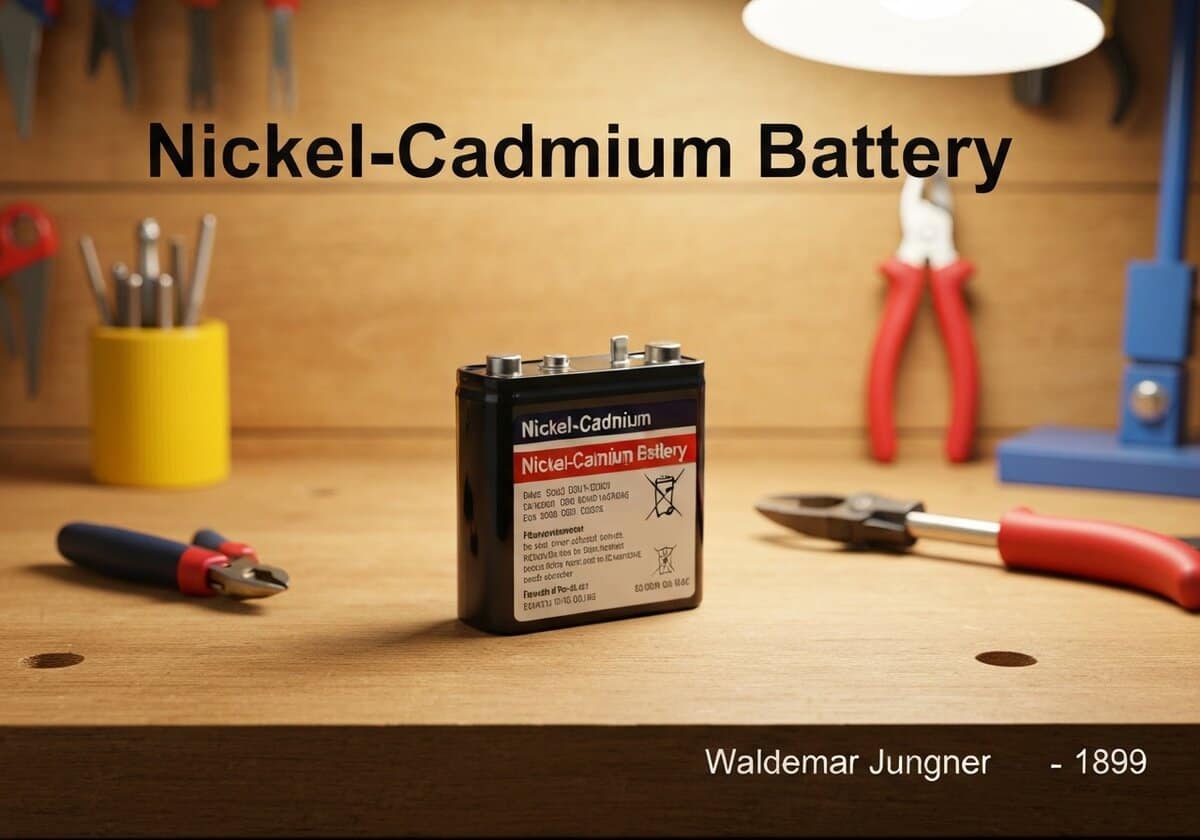
Nickel-Cadmium battery showcasing electrochemical properties and applications in electronics.

(generated image for illustration only)

Invented by Waldemar Jungner in 1899, the NiCd battery uses nickel oxide hydroxide (NiO(OH)) as the positive electrode and metallic cadmium (Cd) as the negative electrode, with an alkaline electrolyte like potassium hydroxide (KOH). It is known for its long cycle life and good performance at low temperatures, but suffers from the memory effect and the toxicity of cadmium.


The nickel-cadmium battery was a significant step forward from the lead-acid battery, offering a higher energy density and a much longer cycle life in a sealed, maintenance-free package. Waldemar Jungner’s invention provided a robust and reliable power source that became dominant in portable applications for much of the 20th century. The core chemical reaction during discharge is \(2 NiO(OH) + Cd + 2 H_2O rightarrow 2 Ni(OH)_2 + Cd(OH)_2\).

The use of an alkaline electrolyte, typically potassium hydroxide, was a key difference from the acidic electrolyte of lead-acid cells. This chemistry allowed for a very flat discharge voltage curve, meaning the battery delivered a nearly constant voltage until it was almost fully depleted. However, its major drawbacks led to its decline. Cadmium is a heavy metal with significant environmental toxicity, making disposal and recycling a critical issue. Furthermore, NiCd batteries are prone to the ‘memory effect,’ where repeated partial discharge/charge cycles can cause a reduction in usable capacity. This necessitated periodic full discharge cycles to maintain performance. Despite being largely replaced by NiMH and Li-ion technologies in consumer goods, its durability ensures it remains in some niche industrial and aviation applications.

UNESCO Nomenclature: 2204
– Electrochemistry

Type

Physical Device

Disruption

Substantial

Usage

Niche/Specialized

Precursors

  • Gaston Planté’s lead-acid battery (1859)
  • development of alkaline electrolytes
  • Thomas Edison’s work on nickel-iron batteries (1901), which shared similar cathode chemistry

Applications

  • early cordless power tools
  • emergency lighting systems
  • model aircraft and boats
  • portable electronic devices before li-ion
  • aviation batteries

Patents:

NA

Potential Innovations Ideas

Due to scrapping bot traffic, currently more than 40k per day, this content is reserved to community members.
> Login < or > Register < (100% free) to access this, so as all other restricted content and tools.

Related to: NiCd, nickel-cadmium, Waldemar Jungner, memory effect, alkaline battery, cadmium, nickel oxide hydroxide, rechargeable, cycle life, portable electronics.

Historical Context

Nickel-Cadmium Battery (NiCd)

1890
1895
1895
1899
1900
1900
1900
1890
1895
1895
1896
1900
1900
1900
1900

(if date is unknown or not relevant, e.g. "fluid mechanics", a rounded estimation of its notable emergence is provided)

Related Invention, Innovation & Technical Principles

Full size images and downloads are only available, 100% free, for registered members.

> Login <