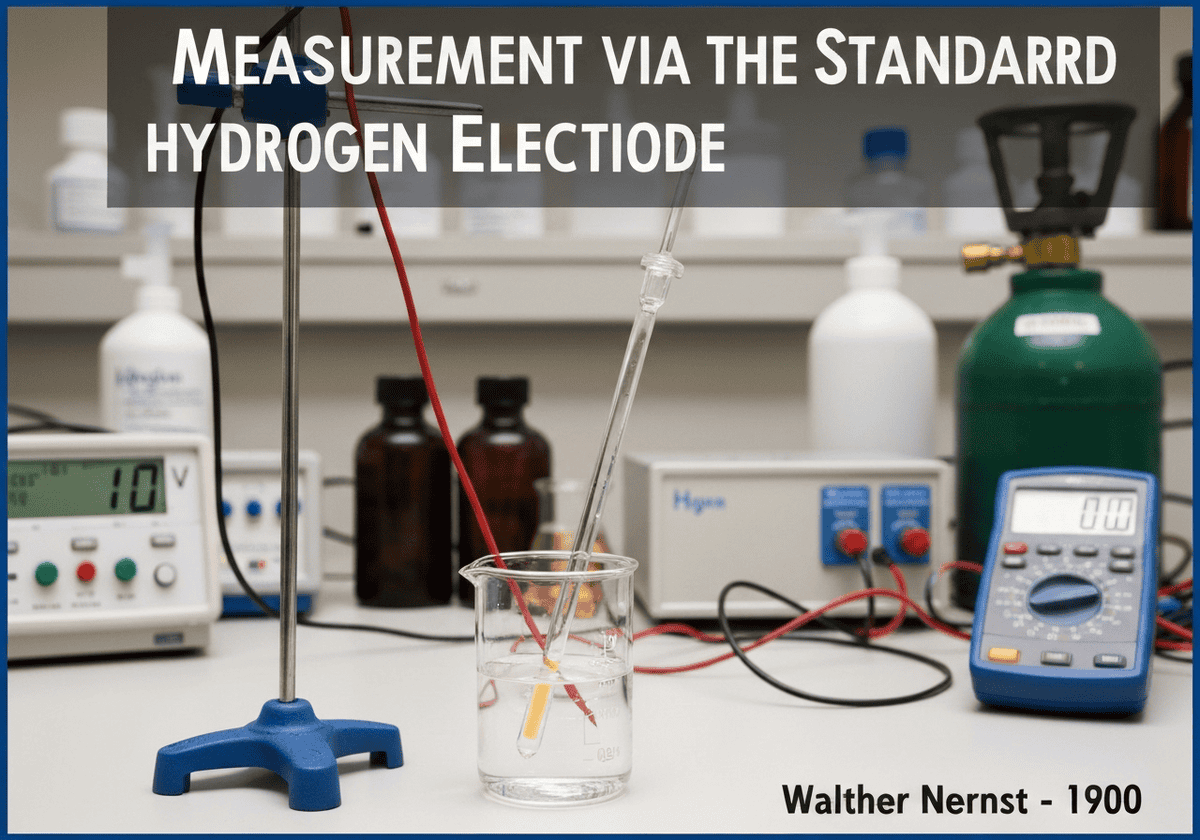
Measurement via the Standard Hydrogen Electrode (SHE)
The absolute electrochemical potential of a single electrode cannot be measured. Instead, potentials are measured relative to a universally accepted reference. The Standard Hydrogen Electrode (SHE) is the primary reference, assigned a potential of exactly 0 volts under standard conditions (1 M \(H^+\) concentration, 1 bar \(H_2\) gas, 298 K). All other standard electrode potentials are reported relative to this zero point.
The impossibility of measuring an absolute single electrode potential stems from the fact that any measurement requires a complete electrical circuit, which inevitably introduces a second electrode-electrolyte interface. What is measured is always a potential difference between two electrodes. To create a standardized, comparable scale, the scientific community agreed upon a common reference point.
The Standard Hydrogen Electrode (SHE) serves this purpose. It consists of a platinum electrode, often coated with platinum black to increase its surface area and catalytic activity, immersed in a solution with a hydrogen ion activity of 1. Purified hydrogen gas is bubbled over the electrode at 1 bar pressure. The half-reaction is \(2H^+(aq) + 2e^- rightleftharpoons H_2(g)\). By international convention, the standard potential of this half-reaction is defined as 0.000 V at all temperatures.
To measure the standard potential of another half-cell, for example, a zinc electrode in a zinc sulfate solution (\(Zn^{2+}/Zn\)), it is connected to the SHE to form a galvanic cell. The measured voltage of this cell is, by definition, the standard potential of the zinc half-cell. This process has been used to compile extensive tables of standard electrode potentials, which are invaluable for predicting the direction and cell potential of any redox reaction under standard conditions.
UNESCO Nomenclature: 2209
– Physical chemistry
Type
Measurement Standard
Precursors
- alessandro volta’s invention of the voltaic pile
- michael faraday’s laws of electrolysis
- the development of the concept of electromotive force (emf)
- walther nernst’s formulation of the nernst equation, which relates cell potential to concentration
Applications
- creating the standard electrode potential series (electrochemical series)
- predicting the spontaneity of redox reactions
- calibrating other reference electrodes (e.g., silver chloride or calomel electrodes)
- analytical chemistry (potentiometry)
- corrosion studies
Potential Innovations Ideas
Due to scrapping bot traffic, currently more than 40k per day, this content is reserved to community members.
> Login < or > Register < (100% free) to access this, so as all other restricted content and tools.
Related to: standard hydrogen electrode, she, reference electrode, electrode potential, redox reaction, electrochemistry, potentiometry, galvanic cell.