Product Design, Manufacturing & Innovation Resources
Home » The Gas Liquefaction Cascade Process

The Gas Liquefaction Cascade Process

1877
  • Raoul Pictet
  • Louis Paul Cailletet
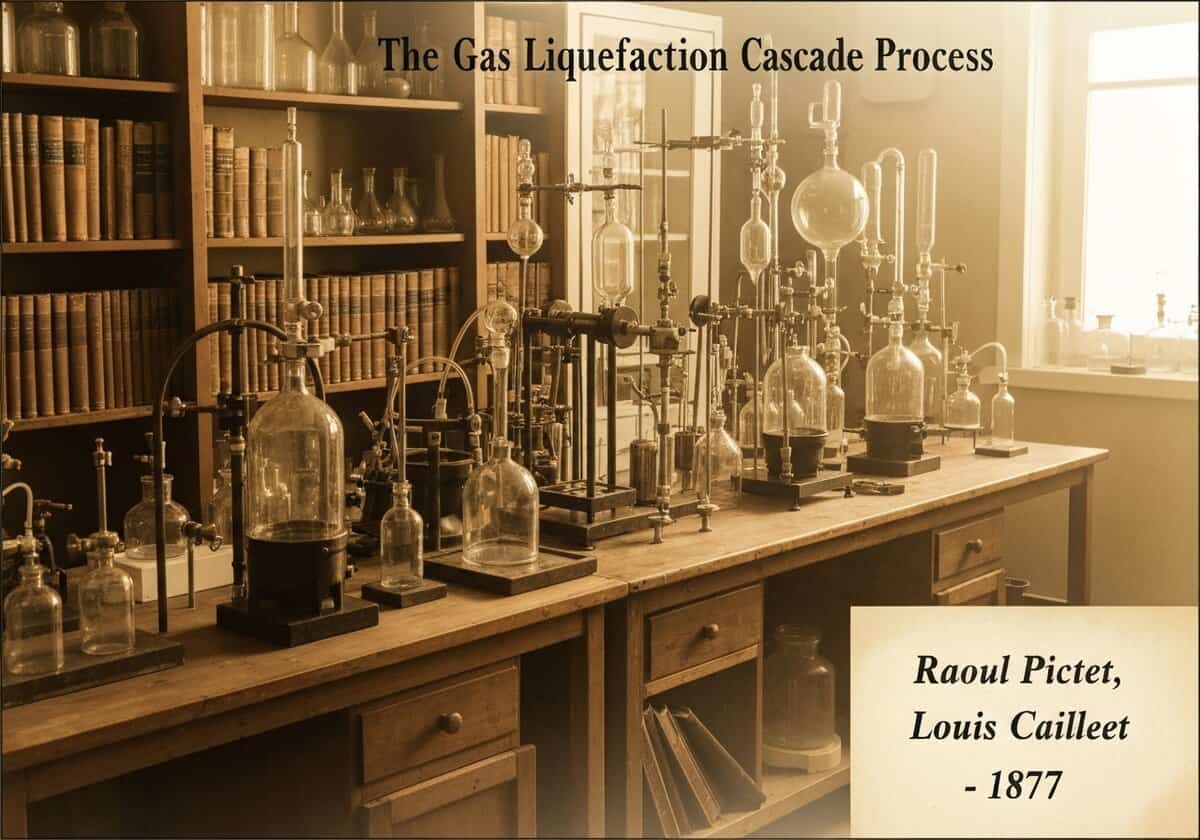
Historical laboratory showcasing the Gas Liquefaction Cascade Process with vintage cryogenic equipment.

(generated image for illustration only)

This gas liquefaction process, pioneered by Raoul Pictet, liquefies a gas by using a series of other gases with progressively lower boiling points. The first gas is liquefied by pressure at ambient temperature. Its evaporation is then used to cool and liquefy a second, more volatile gas, which in turn is used to cool and liquefy the target gas, creating a ‘cascade’ of cooling stages.

Raoul Pictet’s apparatus in 1877 was a landmark achievement. He used sulfur dioxide (SO2), which liquefies at -10 °C under pressure, as the first stage. By allowing the liquid SO2 to evaporate, he cooled carbon dioxide (CO2) below its critical temperature, allowing it to be liquefied. The evaporating liquid CO2, which boils at -78 °C, then provided the intense cold needed to cool oxygen gas below its critical temperature (-118 °C). By subjecting this cold oxygen gas to very high pressure, Pictet produced the first visible droplets of liquid oxygen. Louis Paul Cailletet achieved a similar result independently at the same time using a different method. The cascade method is thermodynamically efficient but complex, requiring multiple refrigeration circuits with different refrigerants. It was a crucial step before the development of more integrated systems like the Hampson-Linde cycle, and its principles are still applied in modern multi-stage refrigeration cycles, particularly in large-scale LNG production.

UNESCO Nomenclature: 2212
– Thermodynamics

Type

Chemical Process

Disruption

Substantial

Usage

Widespread Use

Precursors

  • Discovery of critical temperatures (Thomas Andrews)
  • Michael Faraday’s work on liquefying gases like chlorine and ammonia
  • Understanding of latent heat of vaporization
  • Development of mechanical compressors and pumps

Applications

  • liquefaction of natural gas (LNG) in large-scale plants
  • early liquefaction of oxygen and nitrogen
  • scientific research requiring multiple cryogenic temperature stages
  • industrial gas separation processes
  • multi-stage refrigeration systems

Patents:

NA

Potential Innovations Ideas

Due to scrapping bot traffic, currently more than 40k per day, this content is reserved to community members.
> Login < or > Register < (100% free) to access this, so as all other restricted content and tools.

Related to: cascade process, liquefaction, Raoul Pictet, cryogenics, refrigeration cycle, boiling point, oxygen, phase change, multi-stage cooling, thermodynamics.

Historical Context

The Gas Liquefaction Cascade Process

1869
1871
1876
1877
1880
1882-01-01
1884
1868
1870
1873
1877
1880
1882-01-01
1883
1884

(if date is unknown or not relevant, e.g. "fluid mechanics", a rounded estimation of its notable emergence is provided)

Related Invention, Innovation & Technical Principles

Full size images and downloads are only available, 100% free, for registered members.

> Login <