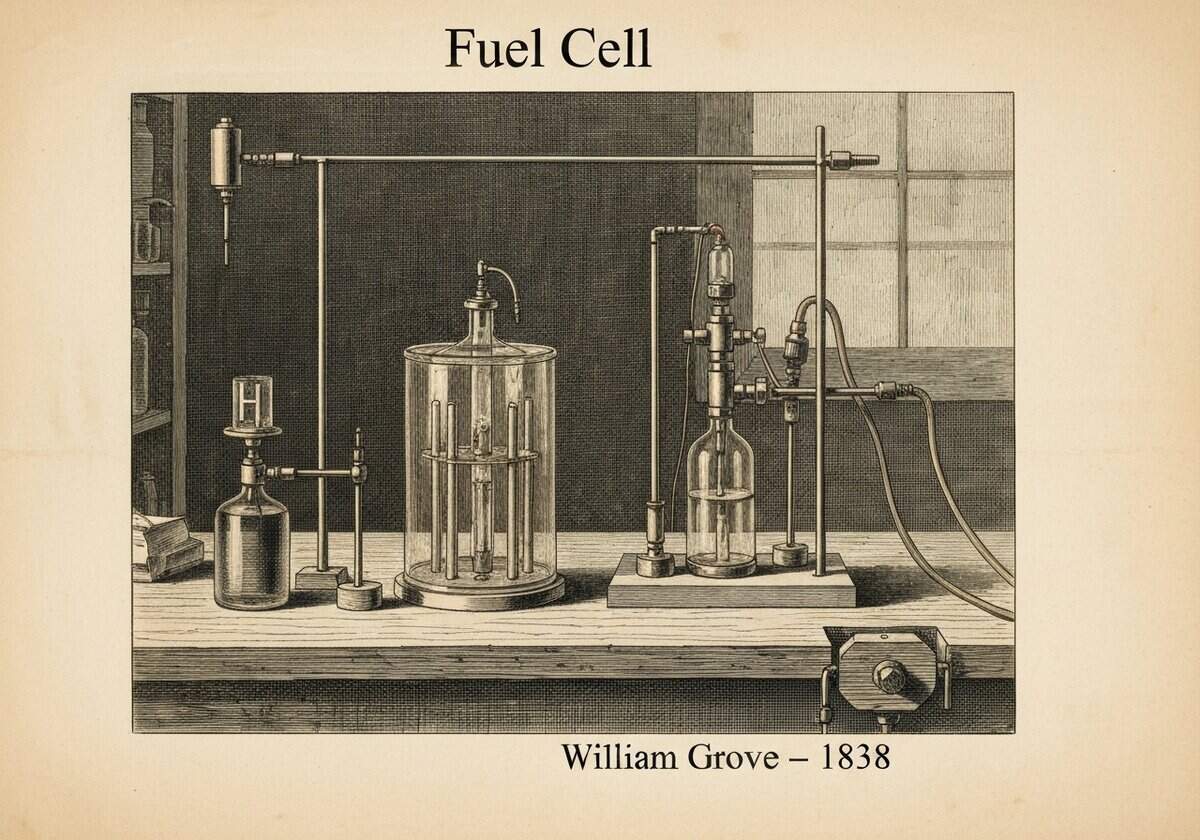
Fuel Cell
A fuel cell is an electrochemical device that directly converts the chemical energy of a fuel, typically hydrogen, and an oxidizing agent, often oxygen, into electricity. Unlike a battery, it requires a continuous external supply of fuel and oxidant to operate. The core components are an anode, a cathode, and an electrolyte that separates them, facilitating ion transport.
The fundamental operation of a fuel cell involves two simultaneous redox reactions. At the anode (the negative electrode), the fuel (e.g., hydrogen) is oxidized, releasing electrons and creating positive ions. For a hydrogen fuel cell, this reaction is \(2H_2 \rightarrow 4H^+ + 4e^-\). These electrons cannot pass through the electrolyte; instead, they are forced to travel through an external circuit, creating a usable electric current. The ions, however, migrate through the electrolyte to the cathode (the positive electrode). At the cathode, the oxidizing agent (e.g., oxygen from the air) reacts with the incoming ions and electrons to form a waste product, which is typically water in a hydrogen fuel cell. The cathode reaction is \(O_2 + 4H^+ + 4e^- \rightarrow 2H_2O\).
This process is a direct energy conversion, transforming chemical potential energy directly into electrical energy without an intermediate combustion step. This is a key advantage over traditional heat engines (like internal combustion engines), which are limited by the Carnot cycle and lose a significant amount of energy as waste heat. The electrolyte is a critical component, as its properties define the type of fuel cell. It must be an excellent conductor for the specific ion it is designed to transport (e.g., protons, hydroxide ions, or oxide ions) but a poor conductor for electrons, thereby preventing the cell from short-circuiting internally.
UNESCO Nomenclature: 2203
– Physical chemistry
Precursors
- discovery of hydrogen by Henry Cavendish (1766)
- discovery of oxygen by Joseph Priestley and Carl Wilhelm Scheele (c. 1774)
- invention of the voltaic pile by Alessandro Volta (1800)
- formulation of the laws of electrolysis by Michael Faraday (1833)
Applications
- automotive propulsion (FCEVs)
- stationary power generation
- portable power devices
- backup power systems for data centers and telecommunications
- power for spacecraft and remote locations
Patents:
- US391381A (Francis Bacon, 1959, for alkaline fuel cell)
Potential Innovations Ideas
Due to scrapping bot traffic, currently more than 40k per day, this content is reserved to community members.
> Login < or > Register < (100% free) to access this, so as all other restricted content and tools.
Related to: fuel cell, electrochemistry, hydrogen, oxygen, anode, cathode, electrolyte, redox reaction, direct energy conversion, william grove.