Color Temperature
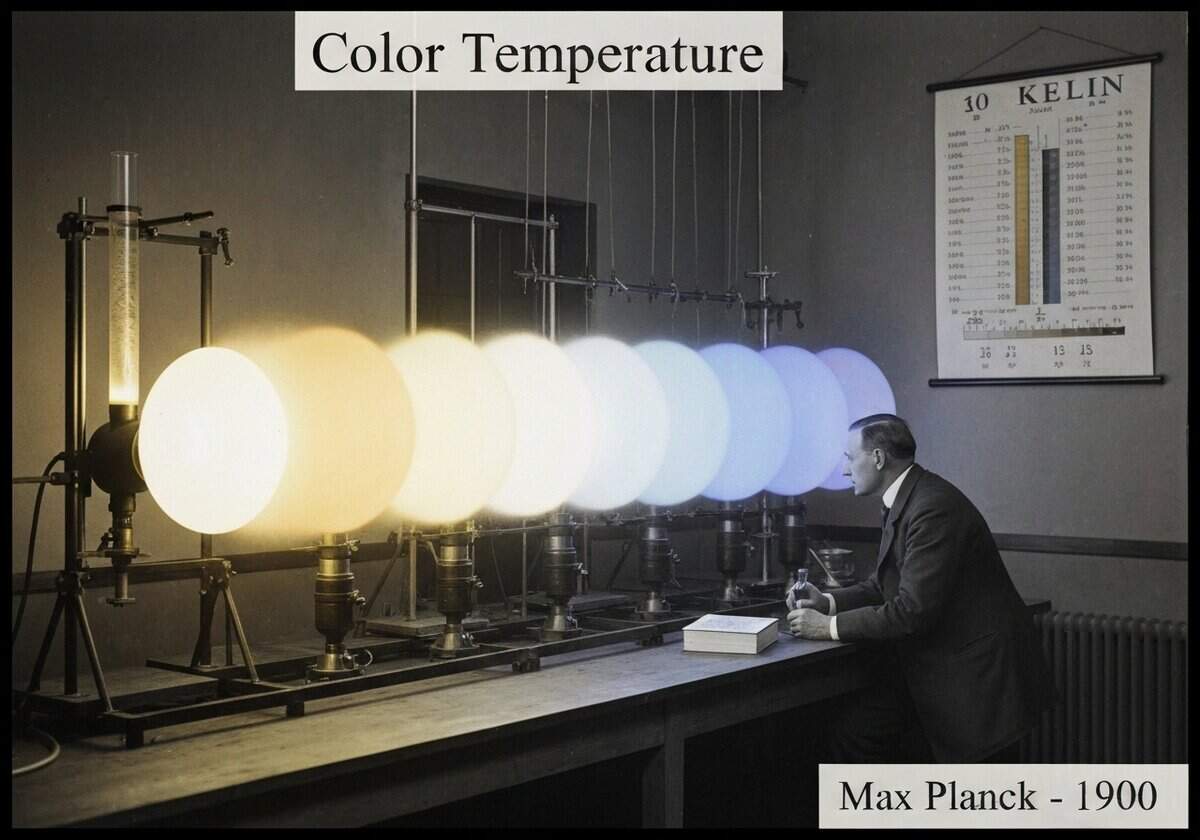
The color temperature is a characteristic of visible light that measures its hue on a scale from warm (yellowish) to cool (bluish). It is defined as the temperature of an ideal black-body radiator that radiates light of a comparable hue to that of the light source. The unit of measurement is kelvin (K).
The concept of color temperature is fundamentally derived from black-body radiation, a phenomenon described by Max Planck in 1900. A black body is a theoretical object that absorbs all incident electromagnetic radiation and, when heated, emits radiation with a spectral distribution dependent only on its temperature. As the temperature of this black body increases, the light it emits shifts from red, to orange, to yellow, to white, and finally to a bluish-white. This sequence of colors provides a one-dimensional scale to characterize light sources.
For example, a traditional incandescent bulb, which works by heating a filament until it glows, is a close approximation of a black-body radiator. Its warm, yellowish light has a color temperature of around 2700 K. In contrast, the midday sun, which appears as a neutral white, has a much higher color temperature of about 5500-6500 K. This scale is counter-intuitive to cultural associations of color, where red is ‘hot’ and blue is ‘cool’. In physics, a higher color temperature corresponds to a ‘cooler’, more bluish light. This metric is only truly applicable to light sources that have a spectrum similar to a black-body radiator.
UNESCO Nomenclature: 2212
– Thermodynamics, statistical physics, and random processes
Precursors
- Kirchhoff’s law of thermal radiation (1859)
- Stefan-Boltzmann law (1879)
- Wien’s displacement law (1893)
Applications
- lighting design for homes and offices
- photography and cinematography white balance
- astrophysics for classifying the temperature and age of stars
- display calibration for monitors and televisions
- horticulture using grow lights with specific color temperatures
Potential Innovations Ideas
Due to scrapping bot traffic, currently more than 40k per day, this content is reserved to community members.
> Login < or > Register < (100% free) to access this, so as all other restricted content and tools.
Related to: color temperature, black-body radiation, kelvin, light source, Planck’s law, visible spectrum, hue, warm light, cool light, photometry.