Product Design, Manufacturing & Innovation Resources
घर » MEMS के लिए बल्क माइक्रोमैकेनिंग

MEMS के लिए बल्क माइक्रोमैकेनिंग

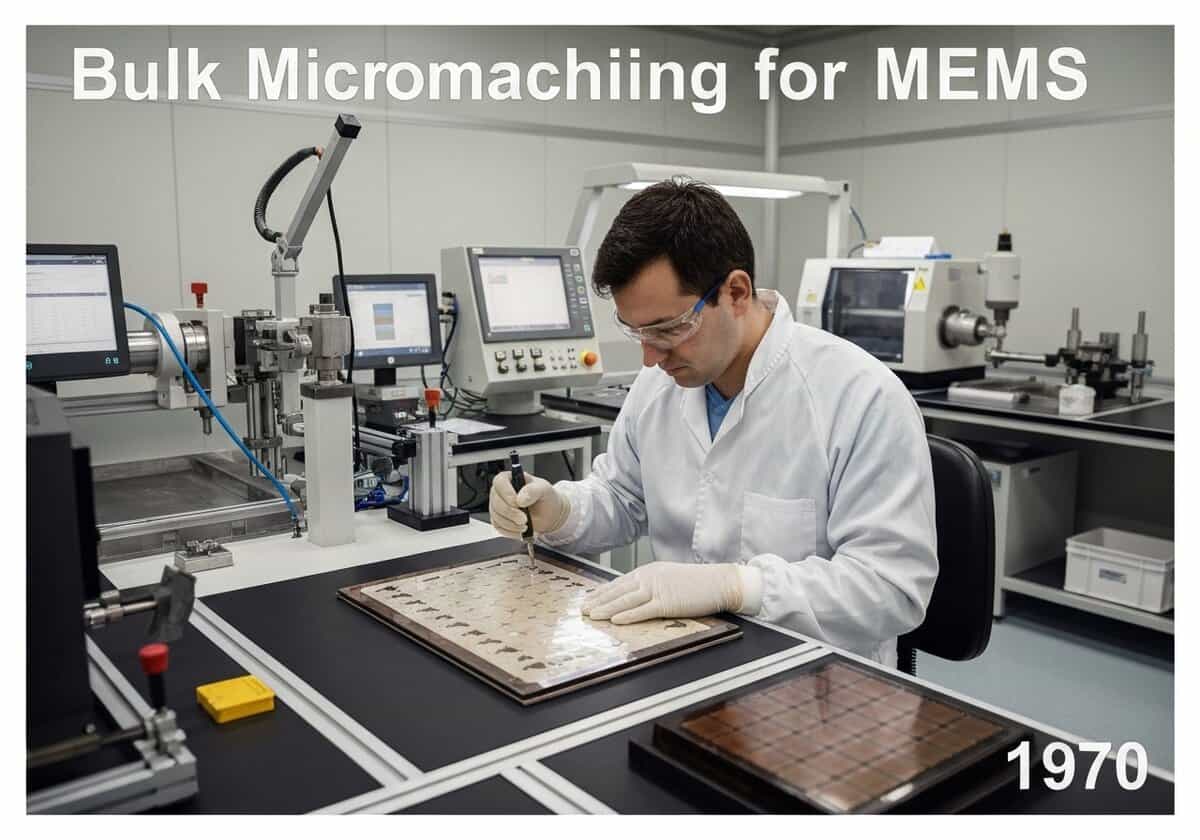
1970
सिलिकॉन वेफर्स पर एमईएमएस निर्माण के लिए बल्क माइक्रोमशीनिंग प्रक्रिया।

(यह छवि केवल उदाहरण के लिए बनाई गई है)

बल्क माइक्रोमैकेनिंग एक घटाव फैब्रिकेशन प्रक्रिया है जो एक सब्सट्रेट, आमतौर पर एक सिलिकॉन वेफर में चुनिंदा रूप से नक्काशी करके MEMS संरचनाएँ बनाती है। यह बल्क सामग्री को तराशने के लिए गीली या सूखी नक्काशी तकनीकों का उपयोग करती है। पोटेशियम हाइड्रॉक्साइड (KOH) जैसे अनिसोट्रोपिक एचेंट आम हैं, क्योंकि वे सिलिकॉन के विभिन्न क्रिस्टल तलों को अलग-अलग दरों पर नक्काशी करते हैं, जिससे सटीक V-ग्रूव और कैविटीज़ का निर्माण संभव होता है।

Bulk micromachining is one of the oldest and most established methods for creating MEMS. As a subtractive process, it involves sculpting the device’s features directly from the bulk of a substrate, usually a single-crystal silicon wafer. The technique relies heavily on etching, which can be broadly categorized as wet (chemical) or dry (plasma-based).

Wet etching is the more traditional approach. It can be isotropic, etching at the same rate in all directions, which results in rounded, undercut features. More commonly for MEMS, anisotropic wet etching is used. This method exploits the fact that the etch rate in single-crystal silicon depends on the crystallographic orientation. Etchants like potassium hydroxide (KOH), tetramethylammonium hydroxide (TMAH), and ethylenediamine pyrocatechol (EDP) etch the (100) and (110) crystal planes much faster than the (111) planes. By aligning the mask pattern with the crystal axes on a (100)-oriented wafer, this property can be used to create precisely defined structures with angled sidewalls, such as V-grooves for fiber optics or pyramidal pits. The (111) planes act as natural etch-stops, allowing for excellent control over the final geometry. Diaphragms for pressure सेंसर are a classic application, formed by etching from the backside of a wafer until an etch-stop layer (like a heavily doped boron layer or an electrochemical stop at a p-n junction) is reached.

Dry etching, particularly Deep Reactive-Ion Etching (DRIE), has become a dominant bulk micromachining technique. DRIE allows for the creation of very deep, high-aspect-ratio structures with nearly vertical sidewalls, something not possible with wet etching. The most common method is the ‘Bosch process,’ which alternates between an etching step (using a plasma like SF6) and a passivation step (using a polymerizing gas like C4F8). The passivation layer protects the sidewalls from being etched, forcing the etch to proceed primarily in the vertical direction. This cycle is repeated hundreds or thousands of times to achieve depths of hundreds of microns. DRIE is essential for manufacturing modern high-performance inertial sensors, microfluidic 3डी चिप स्टैकिंग के लिए डिवाइस और थ्रू-सिलिकॉन वाया (टीएसवी)।

UNESCO Nomenclature: 3313
औद्योगिक इंजीनियरिंग

Type

रासायनिक प्रक्रिया

व्यवधान

मूलभूत

उपयोग

व्यापक उपयोग

शगुन

  • सिलिकॉन वेफर्स में क्रिस्टल अभिविन्यास का ज्ञान
  • सिलिकॉन के लिए रासायनिक एचेंट का विकास
  • पैटर्न निर्धारण के लिए फोटोलिथोग्राफी
  • ऐसे मास्किंग पदार्थ जो एनचैंट्स के प्रति प्रतिरोधी हों (जैसे, सिलिकॉन नाइट्राइड)

आवेदन

  • दबाव सेंसर डायाफ्राम
  • इंकजेट प्रिंटर नोजल
  • माइक्रोफ्लुइडिक चैनल
  • परमाणु बल सूक्ष्मदर्शी (एएफएम) कैंटिलीवर
  • ऑप्टिकल फाइबर संरेखण के लिए वी-ग्रूव

पेटेंट:

  • US4187139A
  • US5501893A

संभावित नवाचार विचार

  • उच्च-प्रदर्शन जड़त्वीय नेविगेशन इकाइयाँ जिनमें गहरे उत्कीर्ण प्रूफ द्रव्यमान होते हैं
  • पोर्टेबल बिजली उत्पादन के लिए माइक्रो-टर्बाइन
  • माइक्रो-चैनल हीट सिंक वाले सीपीयू के लिए उन्नत शीतलन प्रणाली
  • जटिल, गहन द्रव नेटवर्क वाले लैब-ऑन-ए-चिप उपकरण
  • सटीक रूप से उत्कीर्ण संरेखण विशेषताओं के साथ चिप पर ऑप्टिकल बेंच
  • 3डी एकीकृत परिपथ स्टैकिंग के लिए थ्रू-सिलिकॉन वाया (टीएसवी)
  • टाइमिंग अनुप्रयोगों के लिए उच्च-क्यू कारक वाले यांत्रिक अनुनादक
  • दर्द रहित दवा वितरण के लिए सूक्ष्म सुइयों की श्रृंखला
  • लघु द्रव्यमान स्पेक्ट्रोमीटर
  • ईंधन सेल components with high surface area electrodes
संबंधित विषय: बल्क माइक्रोमशीनिंग, एमईएमएस, एचिंग, सिलिकॉन, एनिसोट्रोपिक एचिंग, केओएच, डीआरआईई, डीप रिएक्टिव-आयन एचिंग, सबट्रैक्टिव प्रोसेस, माइक्रोफैब्रिकेशन।

ऐतिहासिक संदर्भ

MEMS के लिए बल्क माइक्रोमैकेनिंग

1970
1970
1970
1970
1972
1974
1975-06-01
1965-12-21
1970
1970
1970
1970
1974
1974
1978

(यदि तिथि अज्ञात है या प्रासंगिक नहीं है, उदाहरण के लिए "द्रव यांत्रिकी", तो इसके उल्लेखनीय उद्भव का एक अनुमानित आंकड़ा प्रदान किया गया है)

नवीनतम परिवर्धन

शीर्ष पोस्ट और लेख

शीर्ष मूल उपकरण

10वां वर्ष सालगिरह

पंजीकृत सदस्यों के लिए पूर्ण आकार की छवियाँ और डाउनलोड 100% निःशुल्क उपलब्ध हैं।