Product Design, Manufacturing & Innovation Resources
Maison » Effet Paschen-Back

Effet Paschen-Back

1912
  • Friedrich Paschen
  • Ernst Back
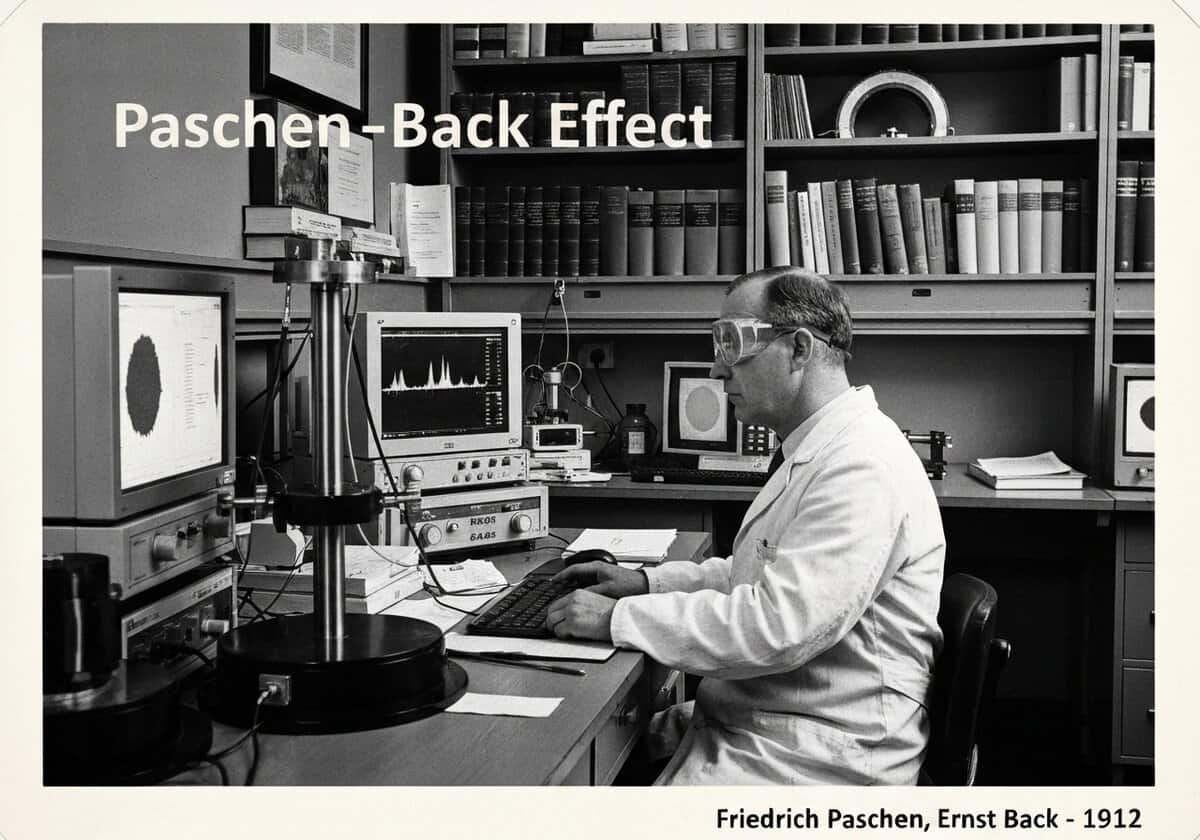
Un physicien réalise des expériences de spectroscopie dans un champ magnétique intense.

(Image générée à titre d'illustration uniquement)

The Paschen-Back effect occurs in the presence of a very strong magnetic field, where the Zeeman splitting energy becomes much larger than the fine-structure (spin-orbit) interaction energy. In this regime, the coupling between orbital ([latex]vec{L}[/latex]) and spin ([latex]vec{S}[/latex]) angular momentum is broken. They precess independently around the strong external magnetic field, simplifying the spectral pattern.


The Paschen-Back effect represents the high-field limit of the Zeeman effect. While the anomalous Zeeman effect describes the case where the external field is a small perturbation compared to the internal spin-orbit coupling, the Paschen-Back effect describes the opposite scenario. When the magnetic field is sufficiently strong, the interaction energy of the magnetic moments with the external field, [latex]\hat{H}_Z[/latex], dominates over the spin-orbit interaction Hamiltonian, [latex]\hat{H}_{SO}[/latex].

As a result, [latex]vec{L}[/latex] and [latex]vec{S}[/latex] are effectively decoupled. The ‘good’ quantum numbers are no longer J and [latex]m_J[/latex], but rather [latex]m_L[/latex] and [latex]m_S[/latex], which describe the independent projections of orbital and spin angular momentum along the magnetic field axis. The first-order energy shift is then given by the sum of the independent interactions: [latex]Delta E = (m_L + g_s m_S)mu_B B[/latex]. With [latex]g_s approx 2[/latex], this leads to a splitting pattern that closely resembles the normal Zeeman triplet, although the fine-structure interaction, now treated as a small perturbation, causes each of these lines to have a small residual substructure. The transition from the anomalous Zeeman regime to the Paschen-Back regime is continuous and can be calculated using intermediate-field theories.

UNESCO Nomenclature: 2202
- Physique atomique et moléculaire

Taper

Phénomène physique

Perturbation

Incrémentale

Usage

Créneau/spécialité

Précurseurs

  • l'effet Zeeman en champs faibles
  • la théorie de la structure fine et du couplage spin-orbite
  • la disponibilité de techniques permettant de générer des champs magnétiques puissants, comme l'électroaimant Weiss
  • progrès de la spectroscopie à haute résolution

Applications

  • spectroscopie d'objets astrophysiques dotés de champs magnétiques immenses (par exemple, étoiles à neutrons, naines blanches)
  • recherche dans les laboratoires de physique des champs élevés utilisant des aimants supraconducteurs
  • comprendre la structure atomique dans des conditions physiques extrêmes
  • test de l'électrodynamique quantique (QFD) dans la limite du champ fort
  • diagnostics pour plasmas haute densité

Brevets:

NA

Idées d'innovations potentielles

En raison du trafic généré par les robots de scraping, actuellement supérieur à 40 000 par jour, ce contenu est réservé aux membres de la communauté.
> Connexion < ou > Registre < (100% gratuit) pour y accéder, ainsi qu'à tous les autres contenus et outils à accès restreint.

Related to: Paschen-Back effect, strong magnetic field, fine structure, spin-orbit decoupling, spectroscopy, atomic physics, high-field limit, quantum mechanics, energy levels, decoupling.

Contexte historique

Effet Paschen-Back

1907
1909
1910
1912
1915
1915-11
1916
1907
1909
1910
1911-04-08
1913
1915
1916
1917

(si la date est inconnue ou non pertinente, par exemple « mécanique des fluides », une estimation arrondie de son émergence notable est fournie)

Inventions, innovations et principes techniques connexes

Les images en pleine résolution et les téléchargements sont uniquement disponibles, et 100% gratuits, pour les membres inscrits.