Product Design, Manufacturing & Innovation Resources
Maison » pH Glass Electrode

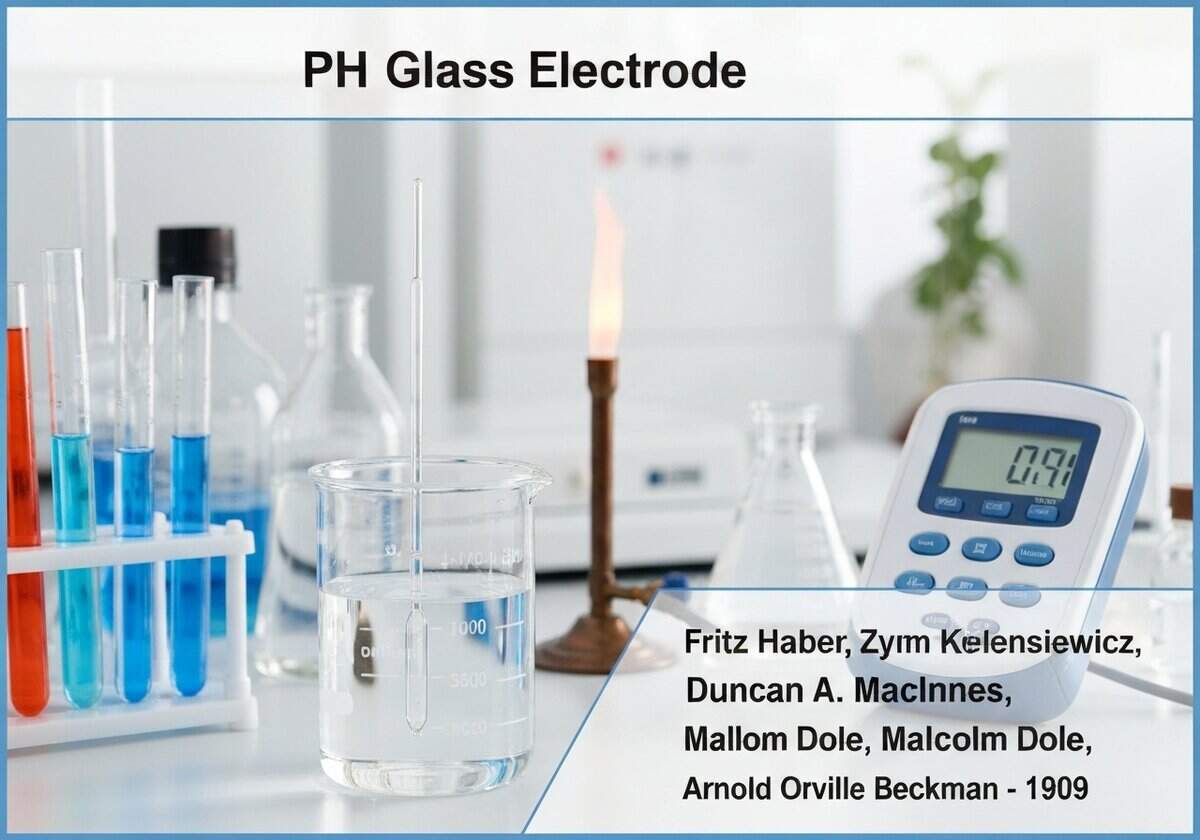
pH Glass Electrode

1909
  • Fritz Haber
  • Zygmunt Klemensiewicz
  • Duncan A. MacInnes
  • Malcolm Dole
  • Arnold Orville Beckman
Électrode de verre pH utilisée en chimie analytique pour mesurer la concentration en ions hydrogène.

(Image générée à titre d'illustration uniquement)

A pH meter measures the voltage between two electrodes and converts it to a pH value. The core component is the glass electrode, which has a thin glass bulb sensitive to ion hydrogène activity. The potential difference, E, between the glass electrode and a stable reference electrode is linearly proportional to the pH according to a form of the Nernst equation: [latex]E = K + frac{2.303RT}{F}pH[/latex].


The glass electrode functions as an ion-selective electrode. Its tip is a thin membrane of a special glass (typically a silicate glass doped with alkali metal ions) that has been hydrated. This hydration creates a gel layer on both the inner and outer surfaces. An ion-exchange equilibrium is established between the alkali metal ions in the glass and the hydrogen ions in the solution. This process creates a boundary potential across the membrane that is dependent on the difference in hydrogen ion activity between the internal solution (which has a fixed pH) and the external sample solution.

This potential is measured against a reference electrode, such as a silver/silver chloride (Ag/AgCl) or calomel electrode, which maintains a constant potential. The complete device, often a single combination probe, is calibrated using buffer solutions of known pH. The high internal resistance of the glass electrode requires a high-impedance voltmeter (the pH meter itself) to accurately measure the small potential difference without drawing significant current, which would alter the system’s equilibrium.

UNESCO Nomenclature: 2201
– Chimie analytique

Taper

Dispositif physique

Perturbation

Révolutionnaire

Usage

Utilisation généralisée

Précurseurs

  • Nernst equation (1889)
  • discovery of galvanic cells by Volta
  • understanding of ion-exchange phenomena
  • development of stable reference electrodes (e.g., calomel electrode)

Applications

  • laboratory chemical analysis
  • industrial process control
  • surveillance environnementale
  • diagnostic médical
  • food science
  • aquaculture

Brevets:

  • US2058761

Idées d'innovations potentielles

En raison du trafic généré par les robots de scraping, actuellement supérieur à 40 000 par jour, ce contenu est réservé aux membres de la communauté.
> Connexion < ou > Registre < (100% gratuit) pour y accéder, ainsi qu'à tous les autres contenus et outils à accès restreint.

Related to: pH meter, glass electrode, reference electrode, Nernst equation, potentiometry, electrochemistry, analytical instrument, calibration, buffer solution, voltage.

Contexte historique

Électrode de verre pH

1902
1904
1907
1909
1910
1912
1915
1902
1902
1907
1909
1910
1911-04-08
1913
1915

(si la date est inconnue ou non pertinente, par exemple « mécanique des fluides », une estimation arrondie de son émergence notable est fournie)

Inventions, innovations et principes techniques connexes

Les images en pleine résolution et les téléchargements sont uniquement disponibles, et 100% gratuits, pour les membres inscrits.