Product Design, Manufacturing & Innovation Resources
Maison » Modèle Aghion-Howitt de la Destruction Créatrice

Modèle Aghion-Howitt de la Destruction Créatrice

1992
  • Philippe Aghion
  • Peter Howitt
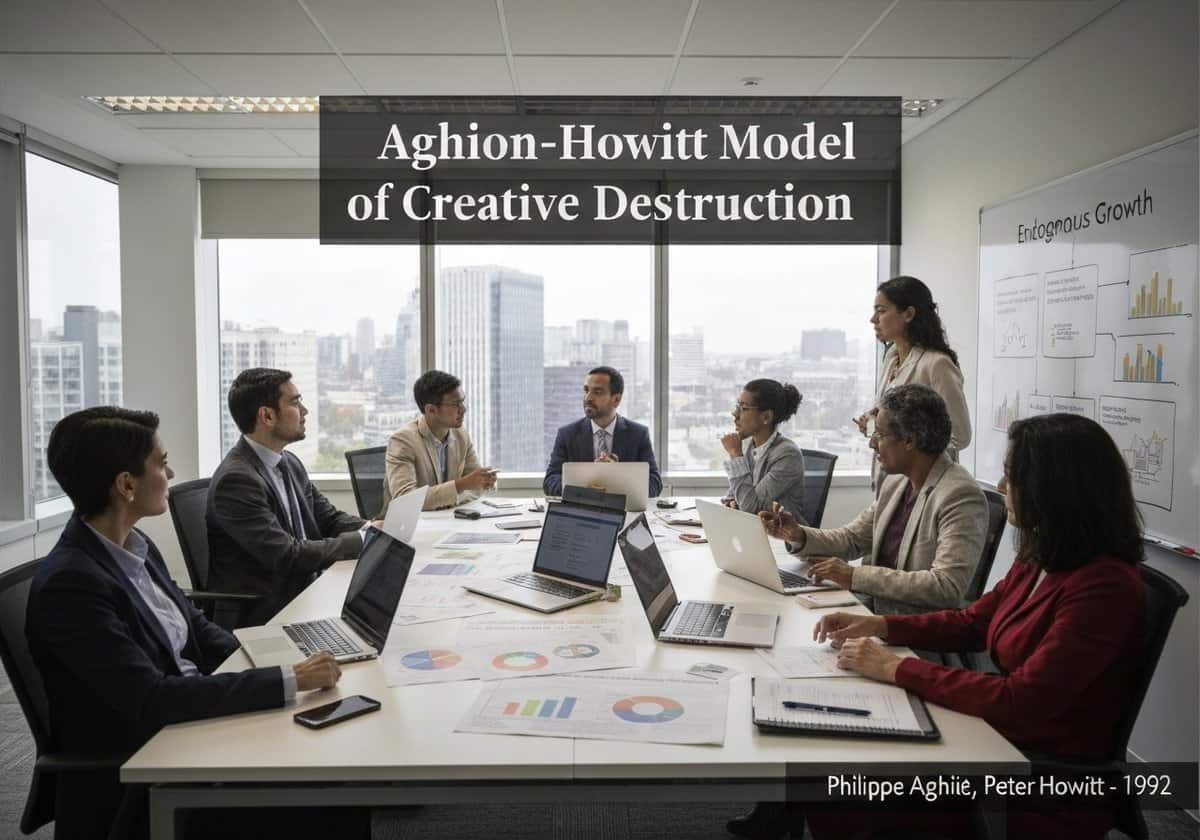
Des économistes discutent du modèle de destruction créatrice d'Aghion-Howitt dans un bureau moderne.

(Image générée à titre d'illustration uniquement)

Philippe Aghion and Peter Howitt developed a mathematical model of destruction créatrice based on Schumpeter’s ideas. In their endogenous growth model, technological progress is the engine of long-run economic growth. New innovations destroy the monopoly rents of previous innovators, creating a process where growth is inherently uncertain and occurs in bursts as new, higher-quality products replace old ones.

The Aghion-Howitt model was a landmark achievement in formalizing Schumpeter’s insights within a general equilibrium framework. It belongs to the class of endogenous growth models, where the rate of technological progress, and thus long-term economic growth, is determined by economic factors within the model, rather than being assumed as an external, exogenous force as in earlier neoclassical models like the Solow-Swan model.

In the model, innovation is a purposeful R&D activity undertaken by firms seeking to gain monopoly profits. A successful innovation creates a new, better-quality product that displaces the existing one, granting the innovator a temporary monopoly. However, this monopoly is itself vulnerable to future innovation. This constant threat of displacement is the “destruction” aspect. The “creative” aspect is that each new innovation builds upon the last, increasing the overall productivity of the economy. The model generates a clear trade-off: stronger brevet protection can increase the incentive to innovate by protecting monopoly rents, but it can also slow down the diffusion of technology and subsequent innovations. This makes it a powerful tool for analyzing policies related to R&D, competition, and propriété intellectuelle.

UNESCO Nomenclature: 5312
- Macroéconomie

Taper

Système abstrait

Perturbation

Substantiel

Usage

Utilisation généralisée

Précurseurs

  • Joseph Schumpeter’s theory of destruction créatrice
  • Paul Romer’s work on endogenous growth theory
  • Robert Solow’s neoclassical growth model (as a point of departure)
  • Kenneth Arrow’s work on the economics of information and R&D

Applications

  • théorie de la croissance endogène
  • analyse de la politique économique concernant les subventions à la R&D
  • droit de la propriété intellectuelle et conception de la politique des brevets
  • modélisation macroéconomique du changement technologique
  • analyse de la politique de concurrence

Brevets:

NA

Idées d'innovations potentielles

  • outils d'analyse de brevets alimentés par l'IA pour optimiser les investissements en R&D
  • systèmes de propriété intellectuelle dynamiques avec des durées de brevets adaptables
  • algorithmes d'allocation de subventions gouvernementales pour la recherche et le développement basés sur l'impact économique prévu
  • plateformes de simulation pour tester les effets macroéconomiques de différentes politiques de concurrence
  • ‘innovation bonds’ that fund research with returns tied to gdp growth
  • programmes éducatifs qui intègrent la modélisation macroéconomique à l'entrepreneuriat
  • modèles d'investissement en capital-risque qui tiennent compte des cycles de destruction créatrice
  • cadres politiques pour gérer la transition du travail entre les industries obsolètes et émergentes
  • outils de stratégie d'entreprise pour équilibrer l'amélioration progressive avec la R&D disruptive
  • indices nationaux d'innovation qui mesurent le taux de destruction créatrice
Related to: endogenous growth, Aghion-Howitt model, Schumpeterian growth, technological progress, R&D, monopoly rents, economic modeling, macroeconomics, innovation economics, patent policy.

Contexte historique

Modèle Aghion-Howitt de la Destruction Créatrice

1982
1986
1990
1992
1995
1995
2000
1980
1983
1990
1992
1994
1995
2000
2002-05-01

(si la date est inconnue ou non pertinente, par exemple « mécanique des fluides », une estimation arrondie de son émergence notable est fournie)

10e année anniversaire

Les images en pleine résolution et les téléchargements sont uniquement disponibles, et 100% gratuits, pour les membres inscrits.