Product Design, Manufacturing & Innovation Resources
Maison » Centrifugal Extractor

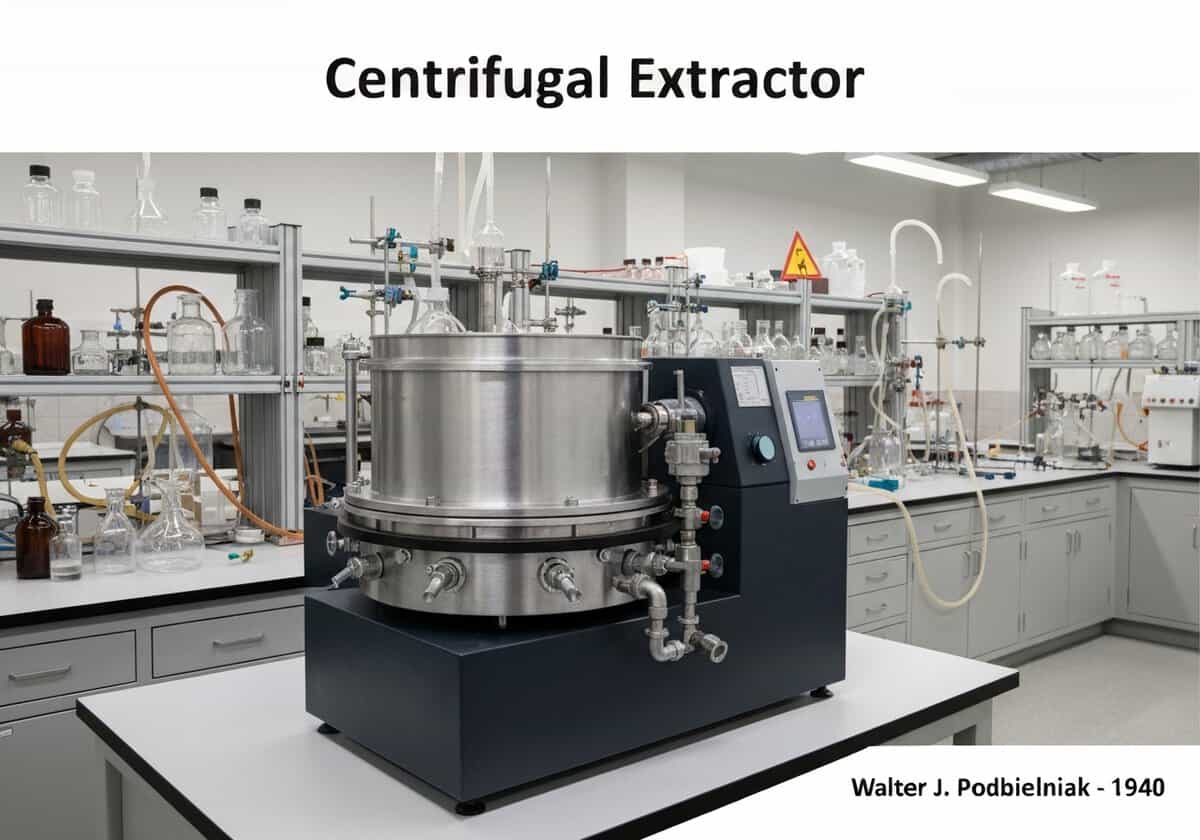
Centrifugal Extractor

1940
  • Walter J. Podbielniak
Extracteur centrifuge utilisé en génie chimique pour l'extraction liquide-liquide.

(Image générée à titre d'illustration uniquement)

A centrifugal extractor is a high-speed device that uses force centrifuge, often thousands of times greater than gravity, to achieve rapid and efficient liquid-liquid extraction. It provides very short residence times and high throughput in a compact volume. This makes it ideal for separating liquids with small density differences, systems prone to emulsification, or for processing unstable compounds.

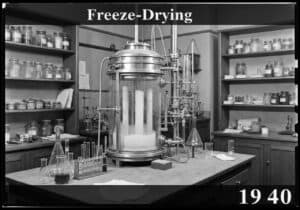
Centrifugal extractors, such as the Podbielniak or Luwesta contactors, represent a significant advancement over gravity-based equipment like mixer-settlers or columns. The core principle involves introducing the heavy and light liquid phases into a rapidly spinning rotor. Inside the rotor, the liquids flow counter-currently through a complex path, often involving concentric perforated cylinders or a spiral channel. The immense centrifugal force creates a highly efficient mixing and dispersion of the phases, leading to rapid mass transfer. Crucially, this same force then drives the rapid separation of the phases, forcing the denser liquid to the periphery of the rotor and the lighter liquid towards the center, from where they are discharged through separate outlets.

The key advantages are a very short residence time (seconds rather than minutes or hours), which is vital for extracting chemically unstable products like antibiotics. The high g-force allows for the effective separation of systems with very small density differences or high viscosity, which would be impossible in gravity settlers. It also readily breaks emulsions that would otherwise halt a process. The equipment is compact, providing many theoretical stages in a single machine, which drastically reduces the plant footprint and solvent inventory compared to a mixer-settler cascade of equivalent capacity. However, they are mechanically complex, have high capital and maintenance costs, and are less suitable for processes involving solids.

UNESCO Nomenclature: 3305
- Génie chimique

Taper

Dispositif physique

Perturbation

Substantiel

Usage

Créneau/spécialité

Précurseurs

  • invention of the cream separator centrifuge by gustaf de laval
  • development of high-speed rotating machinery and bearings
  • understanding of fluid mechanics under high acceleration
  • industrial need for purifying unstable compounds like penicillin during wwii

Applications

  • penicillin production and other antibiotic purification
  • extraction of active pharmaceutical ingredients (APIs)
  • food industry for vegetable oil refining and citrus oil extraction
  • fine chemical and specialty polymer production
  • hydrometallurgical extraction of precious metals
  • environmental remediation for removing contaminants from water

Brevets:

  • US2044854A
  • US2578348A

Idées d'innovations potentielles

En raison du trafic généré par les robots de scraping, actuellement supérieur à 40 000 par jour, ce contenu est réservé aux membres de la communauté.
> Connexion < ou > Registre < (100% gratuit) pour y accéder, ainsi qu'à tous les autres contenus et outils à accès restreint.

Voir aussi : extracteur centrifuge, podbielniak, luwesta, extraction liquide-liquide, force de gravité élevée, temps de séjour court, rupture d'émulsion, contre-courant, génie chimique, production pharmaceutique.

Contexte historique

Centrifugal Extractor

1940
1940
1940
1940
1945-01-01
1949
1950
1940
1940
1940
1940
1940
1948
1950
1950

(si la date est inconnue ou non pertinente, par exemple « mécanique des fluides », une estimation arrondie de son émergence notable est fournie)

Inventions, innovations et principes techniques connexes

Les images en pleine résolution et les téléchargements sont uniquement disponibles, et 100% gratuits, pour les membres inscrits.