Biodiversité alpha, bêta et gamma
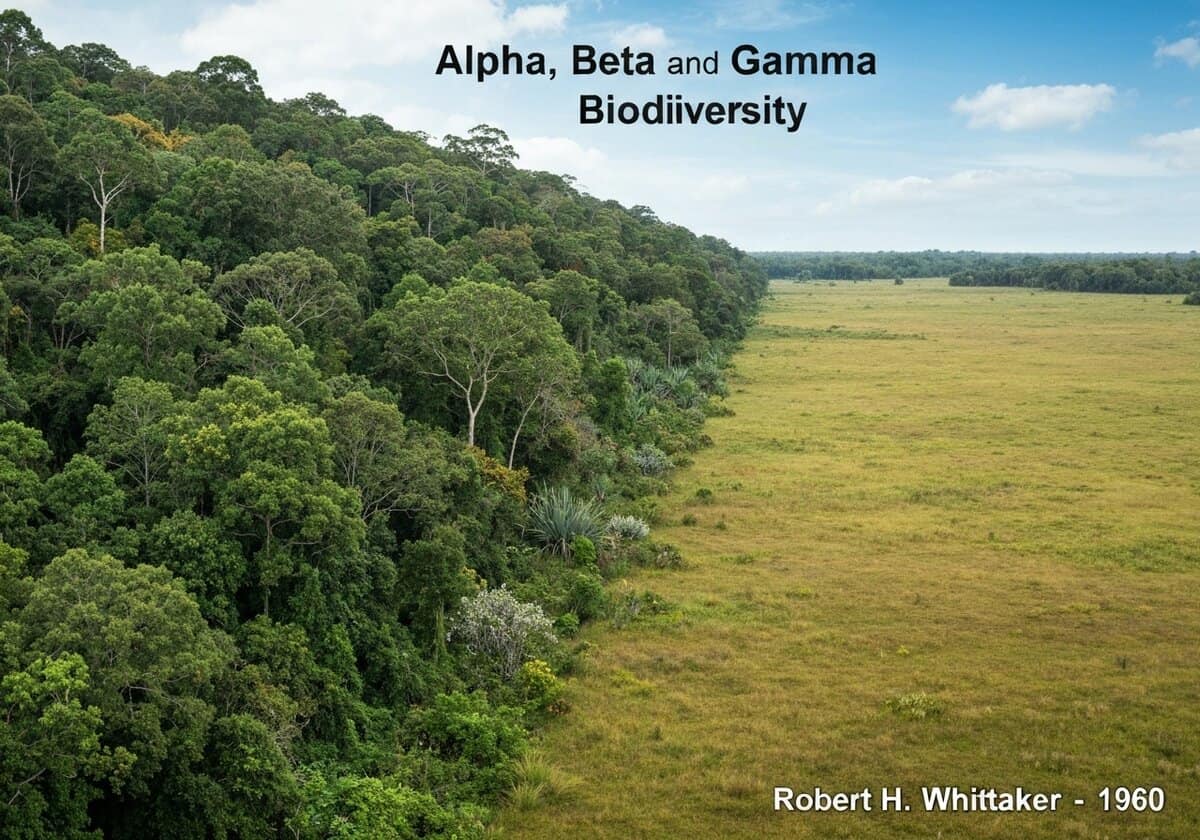
This framework partitions biodiversité into three spatial scales. Alpha (α) diversity is the species richness within a single, local habitat or écosystème. Beta (β) diversity measures the change or turnover in species composition between different habitats. Gamma (γ) diversity represents the total species richness over a large geographical area or landscape, encompassing both alpha and beta diversity.
Introduced by ecologist Robert H. Whittaker in the 1960s, the concepts of alpha, beta, and gamma diversity provided a crucial vocabulary and mathematical framework for analyzing biodiversity at different spatial scales. Prior to this, ecologists often just counted species in a given area (a measure of richness) without a standardized way to compare diversity within and between locations. Whittaker’s partitioning clarified these comparisons. Alpha diversity is the most intuitive measure: it’s the number of species found at a local scale, like a specific pond, forest patch, or coral reef. It is a measure of local community richness.
Beta diversity is the conceptual link between local and regional diversity. It quantifies how different the species compositions are between two or more local habitats. A high beta diversity implies that the habitats have very different sets of species, meaning there is high species turnover along an environmental gradient. Conversely, low beta diversity means the same species are found across multiple habitats. Whittaker originally proposed simple formulas, such as [latex]beta = gamma / alpha[/latex], but numerous other metrics have since been developed to measure beta diversity more robustly, such as the Jaccard index or Sørensen index, which account for shared and unshared species between sites.
Gamma diversity is the total biodiversity across a larger landscape or region that comprises multiple habitats. It is the product of the diversity within those habitats (alpha) and the diversity between them (beta). This hierarchical framework is fundamental to conservation biology and landscape ecology. For example, a conservation plan might aim to protect a network of sites that, while having moderate alpha diversity individually, collectively exhibit high beta diversity. This strategy would conserve more total species (high gamma diversity) than protecting a single, large, homogenous area with high alpha diversity but low beta diversity. The framework allows scientists to understand how processes like habitat fragmentation or changement climatique affect biodiversity not just by reducing local species counts, but by altering the distinctiveness of ecological communities across the landscape.
UNESCO Nomenclature: 2407
- Écologie
Perturbation
Incrémentale
Usage
Utilisation généralisée
Précurseurs
- Gleason’s individualistic concept of the plant association
- premières études sur les relations espèces-zones
- concepts fondamentaux de la niche écologique
- développement de méthodes quantitatives en écologie
Applications
- comparer la biodiversité dans différents écosystèmes pour les évaluations d'impact environnemental
- concevoir des réseaux d'aires protégées pour maximiser la représentation des espèces
- surveiller les effets de la fragmentation de l'habitat sur le renouvellement des espèces
- guider des projets de restauration écologique pour recréer des structures communautaires complexes
- étudier les modèles biogéographiques de répartition des espèces
Idées d'innovations potentielles
- developing ‘functional beta diversity’ metrics to measure turnover in species traits, not just identity
- using genomic data to calculate ‘genetic beta diversity’ between populations
- création de modèles prédictifs de changement de diversité bêta dans différents scénarios climatiques
- applying the alpha-beta-gamma framework to microbiome analysis in medicine and agriculture
- concevoir un logiciel d'urbanisme optimisant la diversité bêta élevée dans les parcs urbains
- intégration de la diversité bêta temporelle (renouvellement au fil du temps) dans la surveillance environnementale à long terme
- création d'une base de données mondiale open source de mesures de diversité bêta pour la méta-analyse
- developing ‘acoustique beta diversity’ indices based on soundscape recordings
- utiliser le cadre pour évaluer la diversité des pratiques culturelles ou des langues selon les régions
- ingénierie des paysages agricoles avec une grande diversité bêta de cultures et de pollinisateurs pour améliorer la résilience
Related to: alpha diversity, beta diversity, gamma diversity, Robert Whittaker, community ecology, species richness, species turnover, spatial scale, biodiversity measurement, landscape ecology.