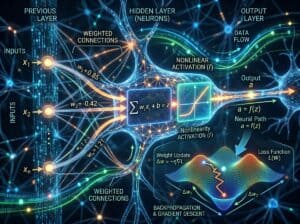
신경망은 입력값을 출력값으로 매핑하기 위해 경사 하강법을 사용하여 학습된 단순한 단위들의 계층으로 구성된 매개변수화된 함수입니다. 각 인공 뉴런은 가중 합을 계산하고 비선형성을 적용합니다. 깊이, 너비 및 연결성은 신경망의 구조를 정의합니다. 합성곱 신경망은 이미지 처리에 적합하고, 순환 신경망과 어텐션 기반 신경망은 시퀀스 처리에 적합합니다.
Training cost and data quality now drive most engineering decisions. An epoch is cheap on a small model and prohibitive on a large one. Overfitting, calibration and robustness to distribution shift decide whether a model survives deployment. Alongside 딥 러닝, classical methods such as the support vector machine still win on small tabular datasets. The literature below mixes architecture research with applied patents.
네트워크는 예제를 통해 학습하는 간단한 함수들의 집합입니다. 언어는 켜져 있습니다. 법학 석사(LLM)이미지 컴퓨터 비전그리고 스파이크는 뉴로모픽 컴퓨팅고속 추론 하드웨어가 켜져 있습니다. FPGA두뇌 관련 용도는 다음과 같습니다. 뇌-컴퓨터 인터페이스.
본 자료는 전 세계 과학 온라인 저널에 게재된 신경망 관련 영문 논문 및 특허를 엄선하여 정리한 최신 자료입니다. 신경망, 인공 뉴런, 에포크, 신경망 아키텍처, 머신 러닝, 딥 러닝, 서포트 벡터 머신 등의 키워드를 중심으로 분류했습니다.
Spatially localized fMRI metrics as predictive and highly distinct state-independent fingerprints
Published on 2026-11-06 by @MIT
Abstract: AbstractPrecision medicine and the investigation of brain–behavior associations require biomarkers that are stable (low intraindividual variability) and unique (high-interindividual variability) at the same time, hence calling them “fingerprints”. The functional connectome (FC) has good “fingerprint properties”, as individuals can be accurately identified in a database based on their FC. Importantly, research has shown lower intraindividual variability of more localized measures of bra[...]
Our summary: Localized fMRI metrics can serve as distinct state-independent fingerprints for individuals. The regional homogeneity (ReHo) fingerprint shows low intraindividual variability and high interindividual variability. This fingerprint demonstrates predictive capabilities for intelligence and clinical applicability, particularly in schizophrenia.
fMRI, regional homogeneity, precision medicine, machine learning
Publication
A comprehensive review of emerging trends, innovations, and future prospects in battery storage technology with real-world examples
Published on 2026-11-05 by @OXFORD
Abstract: AbstractThe technology of battery storage is fast developing, owing to the increasing need for effective, sustainable, safe, and economical energy storage systems. This review provides an in-depth evaluation of the current state of the art in lithium-ion batteries (LIBs), solid-state batteries, flow batteries, and alternative battery chemistries with specific focus on energy density, charging and discharging capability, cycle life, thermal management, and operational safety. Recent developments [...]
Our summary: This review evaluates emerging trends in battery storage technology, focusing on lithium-ion and solid-state batteries. It highlights advancements in smart battery management systems and their role in optimizing performance and safety. Future research should prioritize sustainable chemistries and enhanced recycling methods for improved energy infrastructure.
battery storage, lithium-ion batteries, smart battery management systems, energy density
Publication
Deep learning system for ophthalmic image registration and disease progression visualization
Patent published on the 2026-11-05 in WO under Ref WO2026231702 by THE REGENTS OF THE UNIV OF COLORADO A BODY CORPORATE [US] (Singh Praveer [us], Mandava Naresh [us], Kahook Malik [us], Manoharan Niranjan [us], Kalpathy-cramer Jayashree [us], Nebbia Giacomo [us], Mcnamara Stephen [us], Veturi Yoga [us], Kinder Scott [us], Clark Christopher [us], Bearce Benjamin [us], Beckwith Aa)
Abstract: A method for analyzing retinal images is provided herein. The method includes receiving a time sequence of ophthalmic images, generating a flicker chronoscopy animation by alternating between registered images from different timepoints, analyzing the flicker chronoscopy animation to detect changes in anatomical structures over time, classifying disease progression based on the detected changes, and outputting the disease progression classification. The method enables efficient visualization and [...]
Our summary: This method analyzes retinal images using a time sequence to generate flicker chronoscopy animations. It detects changes in anatomical structures over time and classifies disease progression. This approach enhances visualization and monitoring of ophthalmic conditions like glaucoma and diabetic retinopathy.
deep learning, ophthalmic images, disease progression, image registration
Patent
Transaction validation optimization using generative artificial intelligence
Patent published on the 2026-11-05 in US under Ref US20260350607 by MASTERCARD INT INCORPORATED [US] (Balasubramanian Balamurali [in], Chandra Vikas [in])
Abstract: Examples use a machine learning model to select a first subset of validation rules from a plurality of validation rules. This first subset of validation rules is applied to a first payment card transaction, thereby identifying the first payment card transaction as passing the first subset of validation rules. A second subset of validation rules is then applied to the first payment card transaction, thereby identifying the first payment card transaction as failing the second subset of validation [...]
Our summary: Generative AI optimizes transaction validation by selecting subsets of rules. A first subset is applied to a payment card transaction, resulting in a pass. A second subset identifies errors, transmitting an error code to a computing device.
transaction validation, generative AI, machine learning, error identification
Patent
Video encoding or decoding
Patent published on the 2026-11-05 in WO under Ref WO2026228919 by BRAND FABIAN [DE] (Brand Fabian [de], Solovyev Timofey Mikhailovich [de], Alshina Elena Alexandrovna [de])
Abstract: In some examples, a method of coding implemented by a decoding device comprises receiving a bitstream comprising encoded video data, determining a minimum block size for blocks that can be coded using a neural network, NN, reference frame, when a current slice permits use of the NN reference frame, at least one dimension of a current block of the current slice is smaller than the minimum block size, inferring that the current block is to be decoded using an intra prediction mode of decoding inst[...]
Our summary: The method involves receiving a bitstream with encoded video data. It determines a minimum block size for coding using a neural network reference frame. The current block is decoded using an intra prediction mode when its dimensions are smaller than the minimum block size.
Video encoding, decoding, neural network, intra prediction
Patent
Enhanced ultrasound blood flow visualization and imaging
Patent published on the 2026-11-05 in WO under Ref WO2026231837 by EVIDENT VASCULAR INC [US] (Phillips Patrick [us], Piazza Danielo [us], Cai Anming [us])
Abstract: Systems and methods are provided that can image vessels and other target tissue, using, for example, ultrasound. Intravascular ultrasound (IVUS), peripheral, neurovascular, and coronary imaging are examples of the imaging technology and imaging locations described herein. Enhanced blood flow visualization and lumen detection are provided. Automation, semi-automation, artificial intelligence (AI) and/or machine learning (ML) techniques can be employed to enhance image interpretation, diagnosis an[...]
Our summary: Enhanced ultrasound systems improve visualization of blood flow and target tissues. Techniques include intravascular, peripheral, neurovascular, and coronary imaging. Automation and AI/ML enhance image interpretation and diagnosis.
Ultrasound, Imaging, Blood Flow, Artificial Intelligence
Patent
Computing device for detecting user's valvular disease from electrocardiogram data on basis of artificial intelligence model, control method therefor,
Patent published on the 2026-11-05 in WO under Ref WO2026230841 by MEDICAL AI CO LTD [KR] (Kwon Joonmyoung [kr], Lee Minsung [kr], Kang Sora [kr])
Abstract: The present disclosure provides a computing device for detecting a user s valvular disease from electrocardiogram data on the basis of an artificial intelligence model, a control method therefor, and a computer program. The control method according to one embodiment of the present disclosure comprises the steps of: acquiring a user s electrocardiogram data; obtaining a score corresponding to the likelihood of a first disease by analyzing the acquired electrocardiogram data using a first neural n[...]
Our summary: The device detects valvular disease using electrocardiogram data analyzed by an artificial intelligence model. It employs a control method to acquire data and predict diseases related to heart valves. The system utilizes a neural network to assess the likelihood of disease and make predictions based on the analysis.
Artificial Intelligence, Electrocardiogram, Valvular Disease, Neural Network
Patent
Personalized thresholds for vital sign monitoring
Patent published on the 2026-11-05 in US under Ref US20260351395 by UNIV OF VIRGINIA PATENT FOUNDATION [US] (Sande Margaret Kramer [us], Adu-jamfi William [us], Srioudom Jesse Thanouphet [us])
Abstract: [0000] A physiological monitoring system generates personalized alarm thresholds for patient physiological signs using patient-specific data and a trained neural network model. The system receives patient-specific data including medical history data, medication information, demographic data, and prior physiological sign measurements, preprocesses the patient-specific data, and inputs the preprocessed data into a feedforward neural network. The feedforward neural network generates patient-specifi[...]
Our summary: A physiological monitoring system uses patient-specific data and a trained neural network to generate personalized alarm thresholds. It computes individualized risk zones for vital signs and classifies measurements relative to these zones. Alerts are generated when abnormal classifications indicate potential patient deterioration.
physiological monitoring, neural network, personalized thresholds, clinical notification
Patent