This category concentrates on the engineering discipline of creating products that deliver maximum function and reliability at a targeted cost. It is a resource for moving past the trade-off between quality and price. The content includes structured methodologies for value analysis and value engineering (VAVE), ensuring that all components contribute directly to the product’s core purpose. You will find practical guides for implementing robust design frameworks, such as the Überprüfung des Designs Tree™ (DRT), to identify and mitigate risks early in the development cycle.
The advantage for engineering managers and product architects is the ability to instill a rigorous, data-informed design process. This section provides information on reliability engineering, failure mode analysis, and material selection for long-term durability. By applying these principles, your teams can systematically eliminate over-engineering, reduce production costs, and build products that earn market trust through consistent, dependable performance.
Tipp: innovation.world enthält mehr als 300+ vollständige Artikel (Verzeichnisse und Jobs nicht mitgerechnet), Veranstaltungen, Online-Tools, Erfindungen, Foren ...) → Suche ist Ihr Freund.
Main related category: > Product Design < and its subcategories.
Core Values & Aims in Design
- User empathy: understand user needs to create meaningful and relevant products. Avoid technical solutions that please engineers vs addressing user needs (except if investors are your business model or only customers).
- Simplicity: prioritize clarity and ease of use to enhance user experience and adoption (KISS principle).
- Quality commitment: uphold rigorous standards to ensure durability and reliability.
- Innovation with feasibility: balance creativity with practical constraints for viable solutions.
- Sustainability mindset: design with environmental impact and resource efficiency in mind.
- Iterative refinement: continuously improve products based on feedback and data.
- Customer-centric value: focus on delivering measurable benefits that justify cost and effort.
Pro-Level-Tipps
- Embed user testing early and often to validate assumptions before costly development.
- Quantify value propositions with clear KPIs linked to user outcomes and business goals.
- Integrate design for manufacturability (DFM) and purchasers from the concept phase reduce initial costs and reduce rework.
- Apply value engineering to optimize cost without compromising critical features.
- Utilize digital prototyping and virtual reality to accelerate design validation cycles.
- Prioritize critical-to-quality (CTQ) attributes to focus resources on what matters most.
- Strongly enforce cross-functional design reviews to identify risks and innovation opportunities early.
- Institutionalize post-launch feedback loops to capture real-world performance and inform next iterations.
Top Picks for Value Analysis and Value Engineering

Product Unique Selling Proposition (USP): Definition and Strategies
A Unique Selling Proposition (USP) is crucial for setting your business apart. It highlights what’s special about your product or service in a busy market. Essentially, your USP tells customers

Concept Explorer™ von Innovation.world
Facilitate ideation and creative exploration.[/caption] Innovation.word’s Concept Explorer™ offers a dynamic and visual method for navigating concepts and linguistic connections: it renders conceptual relationships as an interactive radial graph. Starting

"Es ist kein Bug, es ist ein Feature" Spickzettel für schlechte Marketer und Designer
Der Satz "It's not a bug, it's a feature" hat sich seit dem späten 20. Jahrhundert in den Bereichen Software- und Produktdesign zu einem bemerkenswerten Ausdruck entwickelt. Ursprünglich war es

Persona Card Creator™
A persona card distills key demographic and behavioral attributes of a target customer segment into a concise reference format. Marketers and product teams rely on these cards to communicate user
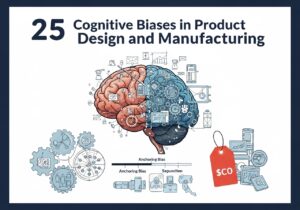
Use or Abuse 25 Cognitive Biases in Product Design and Manufacturing
Understanding cognitive biases enhances product design and decision-making throughout the entire product life-cycle.[/caption] Cognitive biases are shortcuts in human thinking that shape all decisions. Product designers and engineers can improve
101 zum optimalen Lesen eines Patents (für Nicht-Patentanwälte)
Reading a patent document presents a unique challenge for those unfamiliar with its structure and specialized terminology. Patent language often employs precise, legally defined terms, specific phrasing for claim construction,