Product Design, Manufacturing & Innovation Resources
Heim » Beweis durch vollständige Induktion

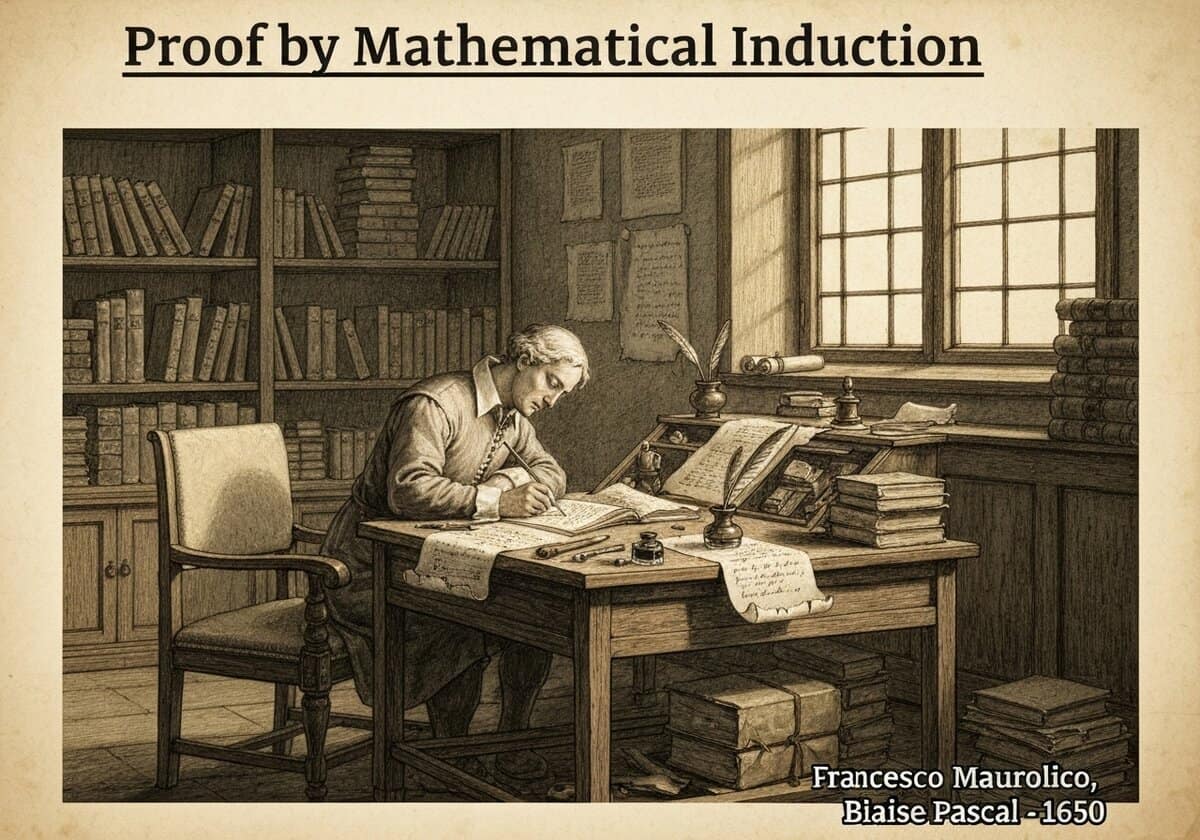
Beweis durch vollständige Induktion

1650
  • Francesco Maurolico
  • Blaise Pascal
Studierzimmer mit Mathematiker, der Eigenschaften mithilfe mathematischer Induktion beweist.

(Abbildung dient nur zur Veranschaulichung)

Die mathematische Induktion ist eine Technik, mit der bewiesen wird, dass eine Eigenschaft [latex]P(n)[/latex] für jede natürliche Zahl [latex]n[/latex] gilt. Sie umfasst zwei Schritte: den Basisfall, in dem bewiesen wird, dass [latex]P(0)[/latex] oder [latex]P(1)[/latex] wahr ist, und den induktiven Schritt, in dem bewiesen wird, dass, wenn [latex]P(k)[/latex] für eine natürliche Zahl [latex]k[/latex] wahr ist (die Induktionshypothese), dann ist auch [latex]P(k+1)[/latex] wahr.
Proof by mathematical induction is analogous to the domino effect. If you can prove the first domino will fall (the base case) and that any falling domino will knock over the next one (the inductive step), you can conclude that all dominoes will fall. The base case establishes the truth of the statement for the initial value, typically [latex]n=0[/latex] or [latex]n=1[/latex]. The inductive step is the core of the proof. It assumes the statement holds for an arbitrary case [latex]n=k[/latex], an assumption known as the induction hypothesis. Then, using this assumption, it must be shown that the statement also holds for the next case, [latex]n=k+1[/latex]. For example, to prove the formula for the sum of the first n integers, [latex]\sum_{i=1}^{n} i = \frac{n(n+1)}{2}[/latex]. Base case (n=1): [latex]1 = \frac{1(1+1)}{2}[/latex], which is true. Inductive step: Assume [latex]\sum_{i=1}^{k} i = \frac{k(k+1)}{2}[/latex]. We need to show [latex]\sum_{i=1}^{k+1} i = \frac{(k+1)(k+2)}{2}[/latex]. We start with the left side: [latex]\sum_{i=1}^{k+1} i = (\sum_{i=1}^{k} i) + (k+1)[/latex]. By the induction hypothesis, this is [latex]\frac{k(k+1)}{2} + (k+1)[/latex]. Factoring out [latex](k+1)[/latex] gives [latex](k+1)(\frac{k}{2} + 1) = (k+1)(\frac{k+2}{2}) = \frac{(k+1)(k+2)}{2}[/latex], which completes the proof. This powerful method is indispensable in discrete mathematics and computer science.

UNESCO Nomenclature: 1202
– Algebra

Typ

Abstraktes System

Störung

Wesentliche

Verwendung

Weitverbreitete Verwendung

Vorläufer

  • Euklids Beweis der Unendlichkeit der Primzahlen (der einen induktiven Charakter hat)
  • Die Methode des unendlichen Abstiegs von Pierre de Fermat
  • Entwicklung der algebraischen Notation

Anwendungen

  • den Korrektheitsnachweis von Computeralgorithmen, insbesondere von rekursiven Algorithmen
  • Analyse von Finanzmodellen mit sequenziellen Schritten
  • Beweisen von Formeln in der Kombinatorik und Zahlentheorie
  • Eigenschaften von Datenstrukturen in der Informatik ermitteln

Patente:

NA

Potenzielle Innovationsideen

Aufgrund des hohen Datenverkehrs durch Web-Scraping-Bots, der derzeit mehr als 40.000 Anfragen pro Tag umfasst, ist dieser Inhalt ausschließlich Community-Mitgliedern vorbehalten.
> Anmelden < oder > Registrieren < (100% kostenlos) Zugriff darauf sowie auf alle anderen eingeschränkten Inhalte und Tools.

Verwandt mit: mathematischer Induktion, Rekursion, Induktionsanfang, Induktionsschritt, Zahlentheorie, diskrete Mathematik, Korrektheit von Algorithmen, Reihen, Summe, Peano-Axiome.

Historischer Kontext

Beweis durch vollständige Induktion

-500
150
1640
1650
1747
1758
1777
-400
-550
1635
1650
1736
1750
1763-12-23
1780

(wenn das Datum unbekannt oder nicht relevant ist, z. B. „Strömungsmechanik“, wird eine gerundete Schätzung seines bemerkenswerten Auftretens bereitgestellt)

Verwandte Erfindungen, Innovationen und technische Prinzipien

Bilder in voller Größe und Downloads sind nur für registrierte Mitglieder 100% kostenlos verfügbar.

> Login <