Product Design, Manufacturing & Innovation Resources
Heim » Detonationschemie von Nitroglycerin

Detonationschemie von Nitroglycerin

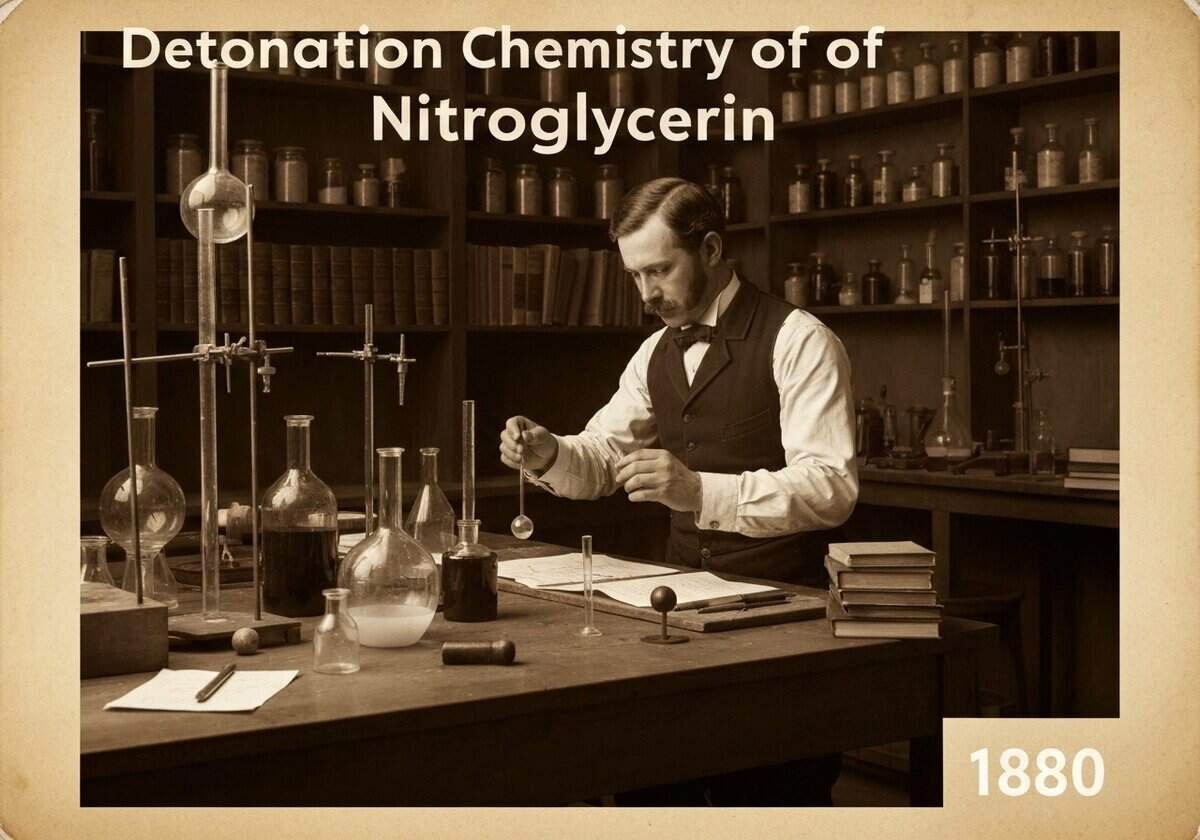
1880
Chemiker bei der Messung von Nitroglyzerin in einem historischen Labor, physikalische Chemie.

(Abbildung dient nur zur Veranschaulichung)

Nitroglycerin ist ein sauerstoffpositiver Sprengstoff, d. h., er enthält mehr Sauerstoff, als für die vollständige Oxidation seiner Kohlenstoff- und Wasserstoffatome bei der Zersetzung benötigt wird. Dies führt zu einer sehr schnellen, exothermen Zersetzung in gasförmige Produkte. Die ausgeglichene chemische Gleichung für seine Detonation lautet: [latex]4 C_3H_5(NO_3)_3(l) rightarrow 12 CO_2(g) + 10 H_2O(g) + 6 N_2(g) + O_2(g)[/latex]. Diese Reaktion bewirkt eine massive Volumenausdehnung.


The detonation of nitroglycerin is a supersonic decomposition process that propagates through the material via a shock wave. The velocity of detonation (VoD) for liquid nitroglycerin is approximately 7,700 meters per second. The extreme speed of the reaction is due to its molecular structure; the fuel (the C-H backbone) and the oxidizer (the nitrate groups) are held in intimate contact within the same molecule. When initiated by a sufficient shock, the molecule essentially tears itself apart. The energy released, about 1.5 MJ per mole (6.3 MJ/kg), rapidly heats the resulting gases to temperatures around 5,000 °C. According to the ideal gas law, this high temperature and the conversion of a small volume of liquid into a large volume of gas (one mole of liquid NG produces 7.25 moles of gas) creates immense pressure, on the order of 20 GPa. This rapid pressure rise is what generates the powerful shockwave responsible for the explosive’s destructive effect. The presence of excess oxygen in the products is unusual for many organic explosives and contributes to the high temperature and efficiency of the detonation.

UNESCO Nomenclature: 2307
- Physikalische Chemie

Typ

Chemischer Prozess

Störung

Wesentliche

Verwendung

Weitverbreitete Verwendung

Vorläufer

  • Entwicklung der Stöchiometrie durch Jeremias Richter und John Dalton
  • Formulierung der Gesetze der Thermodynamik
  • Chapman-Jouguet-Theorie der Detonation
  • Synthese von Nitroglycerin

Anwendungen

  • Grundlage für die Berechnung der Sprengkraft (Branz) von Sprengstoffen
  • Entwicklung rauchloser Pulver, bei denen die Sauerstoffbilanz von entscheidender Bedeutung ist
  • Formulierung von Verbundsprengstoffen
  • thermodynamische Modellierung von Detonationsprozessen
  • Entwicklung von Unterwassersprengstoffen

Patente:

NA

Potenzielle Innovationsideen

Aufgrund des hohen Datenverkehrs durch Web-Scraping-Bots, der derzeit mehr als 40.000 Anfragen pro Tag umfasst, ist dieser Inhalt ausschließlich Community-Mitgliedern vorbehalten.
> Anmelden < oder > Registrieren < (100% kostenlos) Zugriff darauf sowie auf alle anderen eingeschränkten Inhalte und Tools.

Related to: detonation, nitroglycerin, oxygen balance, exothermic, velocity of detonation, shock wave, thermochemistry, explosive decomposition, brisance, high explosive.

Historischer Kontext

1880
1897
1970
1890
1955
1980

(wenn das Datum unbekannt oder nicht relevant ist, z. B. „Strömungsmechanik“, wird eine gerundete Schätzung seines bemerkenswerten Auftretens bereitgestellt)

Verwandte Erfindungen, Innovationen und technische Prinzipien

Bilder in voller Größe und Downloads sind nur für registrierte Mitglieder 100% kostenlos verfügbar.

> Login <