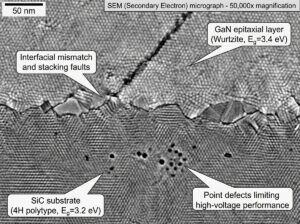
Wide-bandgap semiconductors, mainly silicon carbide (SiC) and gallium nitride (GaN), sustain higher electric fields, junction temperatures and switching frequencies than silicon. Bandgaps of about 3.3 eV for 4H-SiC and 3.4 eV for GaN cut conduction and switching losses. They also shrink passive components and cooling hardware. SiC MOSFETs dominate traction inverters and high-voltage chargers. GaN HEMTs lead in compact converters, from 650 V industrial supplies down to consumer adapters and data center power shelves.
Several issues still limit adoption. SiC suffers from substrate defects, costly wafer growth and gate oxide reliability. GaN faces dynamic on-resistance, threshold voltage instability and the absence of cheap native substrates, which pushes GaN-on-silicon heteroepitaxy. Gallium oxide and vertical GaN devices target higher voltages. Automotive use is gated by qualification under AEC-Q101 and JEDEC guidelines. The publications and patents indexed below cover device structures, epitaxy and wafer processing, gate drivers, module packaging and reliability testing.
1