Product Design, Manufacturing & Innovation Resources
بيت » كيوب سات

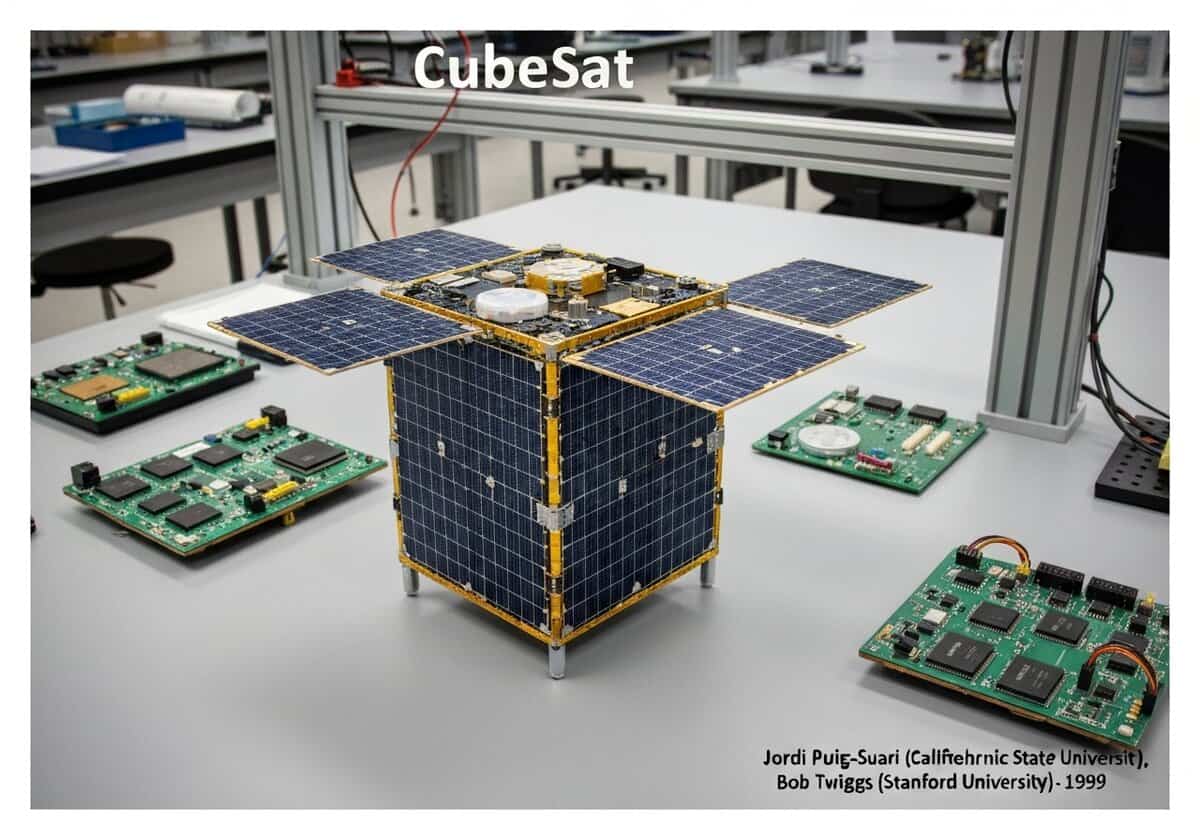
كيوب سات

1999
  • Jordi Puig-Suari (California Polytechnic State University)
  • Bob Twiggs (Stanford University)
تصميم الأقمار الصناعية النانوية المكعبة في مختبر هندسة الطيران والفضاء.

(صورة توضيحية فقط)

A specification for a class of nanosatellites using a standard unit size of 10x10x10 cm, known as 1U, with a mass up to 2 kg. CubeSats can be scaled to 1.5U, 2U, 3U, 6U, or 12U+ sizes. This standardization dramatically lowered the barrier to entry for space missions by enabling shared launch dispensers and a market for off-the-shelf components.


ال كيوب سات تم ابتكار هذا المعيار عام ١٩٩٩ كأداة تعليمية لتزويد طلاب الدراسات العليا بخبرة عملية في تصميم وبناء واختبار وتشغيل الأقمار الصناعية. لم يقتصر الابتكار الأساسي على صغر الحجم فحسب، بل شمل توحيد الشكل الخارجي وتكامله مع مركبة الإطلاق. وقد تحقق ذلك من خلال جهاز إطلاق الأقمار الصناعية الصغيرة متعددة الأجزاء (P-POD)، وهو عبارة عن آلية صندوقية الشكل تُثبّت الأقمار الصناعية المكعبة بإحكام أثناء الإطلاق، ثم تُطلقها إلى المدار باستخدام نظام زنبركي.

By standardizing the external dimensions and providing a simple, reliable deployment method, the CubeSat specification decoupled the satellite’s design from the specifics of the launch vehicle. This allowed launch providers to treat CubeSats as a uniform type of secondary payload, simplifying integration and safety reviews. This predictability fueled the creation of a vibrant ecosystem of commercial-off-the-shelf (COTS) components. Companies began mass-producing CubeSat-compatible subsystems like power systems, on-board computers, radios, and attitude أنظمة التحكم. This COTS market drastically reduced the cost and development time for new missions, transforming the CubeSat from a purely educational tool into a viable platform for commercial ventures, government science, and even interplanetary exploration.

UNESCO Nomenclature: 3302
هندسة الطيران والفضاء

يكتب

معيار التصميم

خلل

ثوري

الاستخدام

استخدام واسع النطاق

مقدمات

  • earlier picosatellite projects at stanford university’s space systems development laboratory
  • the need for a standardized, low-cost platform for graduate student education
  • advances in commercial-off-the-shelf (cots) electronics
  • development of standardized launch vehicle adapters for secondary payloads like the asap ring

التطبيقات

  • university-led space science missions
  • commercial earth observation constellations (e.g., planet labs)
  • in-orbit technology demonstration for new hardware and software
  • interplanetary missions (e.g., marcopolo-a and marcopolo-b)
  • amateur radio communication satellites

براءات الاختراع:

NA

أفكار ابتكارية محتملة

  • modular, reconfigurable cubesats that can change function in orbit by swapping modules
  • a ‘cubesat app store’ for uploading and running new software experiments on orbiting satellites
  • self-assembling cubesat structures that connect in orbit to form larger arrays
  • cubesat-based space debris removal tugs
  • lunar and martian surface science stations deployed from a cubesat bus
  • a network of interplanetary cubesats serving as a deep space gps system
  • 3d-printed, custom-material cubesat frames for specialized radiation shielding
  • biomedical experiment cubesats for studying cell growth in microgravity
  • cubesat swarms for creating temporary, localized communication networks for disaster relief
  • in-orbit manufacturing demonstration using a cubesat platform
Related to: CubeSat, nanosatellite, satellite standard, 1U, p-pod, Bob Twiggs, Jordi Puig-Suari, newspace, cots, standardized design.

السياق التاريخي

كيوب سات

1993-07-22
1996
1998
1999
2000
2000
2000
1993
1994
1997
1998
1999-05-01
2000
2000
2000

(إذا كان التاريخ غير معروف أو غير ذي صلة، على سبيل المثال "ميكانيكا الموائع"، يتم توفير تقدير تقريبي لظهوره الملحوظ)

أحدث الإضافات

أهم المنشورات والمقالات

أفضل الأدوات الأصلية

السنة العاشرة عيد

الصور والتنزيلات بالحجم الكامل متاحة فقط، ومجانية تمامًا، للأعضاء المسجلين.