Product Design, Manufacturing & Innovation Resources
بيت » معيار رايلي (الدقة البصرية)

معيار رايلي (الدقة البصرية)

1900
  • John William Strutt, 3rd Baron Rayleigh
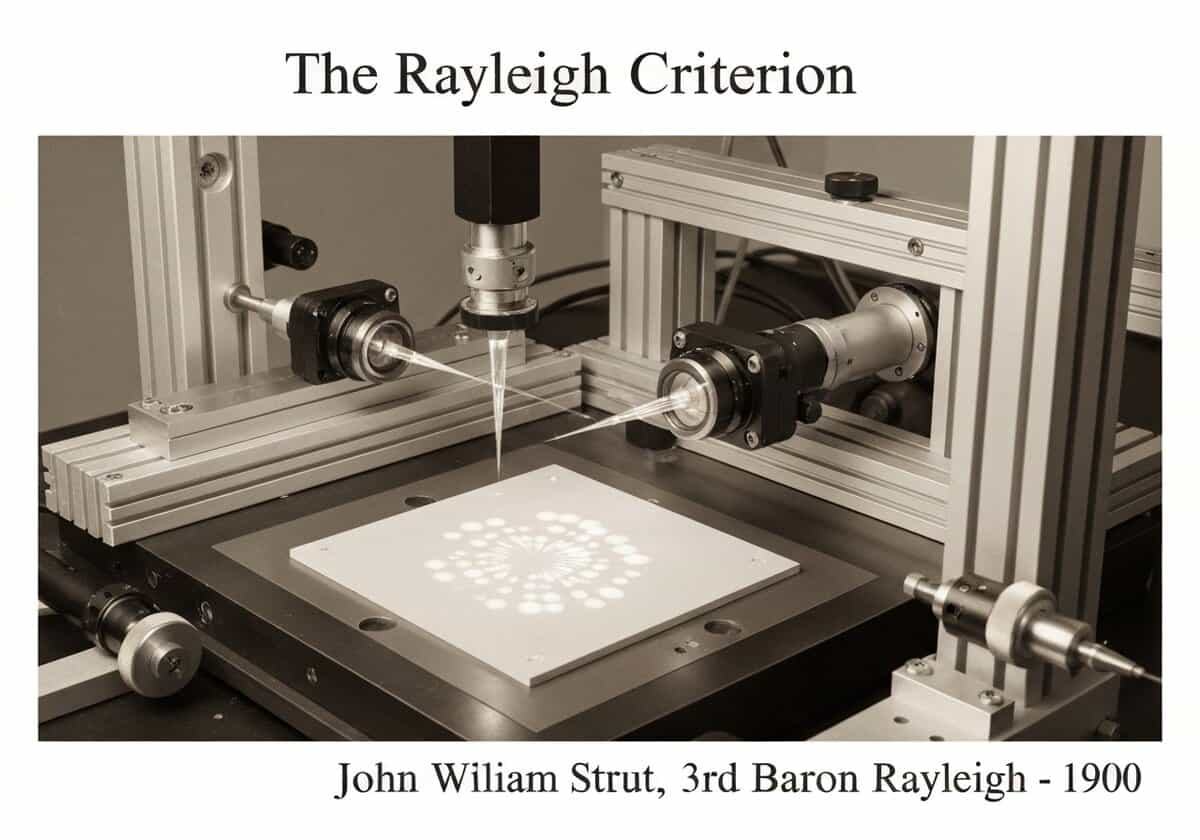
نظام الإسقاط الليثوغرافي الضوئي الذي يوضح معيار رايلي في علم البصريات.

(صورة تم إنشاؤها للتوضيح فقط)

إن الحد الأدنى لحجم الميزة الذي يمكن لنظام الطباعة الليثوغرافية الضوئية الإسقاط طباعته محدود بالحيود ويتم تقريبه بمعيار رايلي. ويُعطى البُعد الحرج (CD) بالمعادلة [latex]CD = k_1 \cdot \frac{\lambda}{NA}[/latex]، حيث [latex]\lambda[/latex] هو الطول الموجي للضوء، وNA هو الفتحة العددية للعدسة، و[latex]k_1[/latex] هو معامل مرتبط بالعملية. تتطلب السمات الأصغر أطوال موجية أقصر أو فتحات عددية أعلى.

The Rayleigh criterion is a fundamental principle in optics that defines the limit of resolution for any imaging system, including the projection systems used in photolithography. It states that two point sources are just resolvable when the center of the diffraction pattern of one is directly over the first minimum of the diffraction pattern of the other. In the context of lithography, this translates to the smallest line or space that can be reliably printed. The formula [latex]CD = k_1 \cdot \frac{\lambda}{NA}[/latex] encapsulates the three primary levers for improving resolution. Firstly, reducing the wavelength ([latex]\lambda[/latex]) of the light source has been a major driver of progress, moving from g-line (436 nm) and i-line (365 nm) mercury lamps to Deep UV (DUV) excimer lasers like KrF (248 nm) and ArF (193 nm), and ultimately to Extreme UV (EUV) at 13.5 nm. Secondly, increasing the numerical aperture (NA) of the projection lens allows it to capture more diffracted light orders, leading to a sharper image. NA is defined as [latex]NA = n \sin \theta[/latex], where n is the refractive index of the medium between the lens and the wafer. Thirdly, the process factor [latex]k_1[/latex] represents the ‘cleverness’ of the process, encompassing improvements like resolution enhancement techniques (RET), photoresist chemistry, and process control. While theoretically [latex]k_1[/latex] has a minimum of 0.25, practical manufacturing values have been pushed down from ~0.8 towards ~0.3 through immense engineering effort. This equation has been the guiding principle for the semiconductor industry’s roadmap for decades, driving the relentless scaling predicted by Moore’s Law.

UNESCO Nomenclature: 2209
- الكهرومغناطيسية

يكتب

النظام التجريدي

الاضطراب

التأسيسية

الاستخدام

الاستخدام الواسع النطاق

السلائف

  • Huygens-Fresnel principle of wave propagation
  • Fraunhofer diffraction theory
  • development of high-quality optical lenses

التطبيقات

  • design of high-resolution microscopes
  • semiconductor lithography process development
  • astronomical telescope design
  • data storage density limits in optical discs (cd, dvd, blu-ray)

براءات الاختراع:

NA

أفكار ابتكارات محتملة

بسبب عمليات جمع البيانات من خلال برامج الروبوت، والتي تتجاوز حاليًا 40 ألفًا يوميًا، فإن هذا المحتوى مخصص لأعضاء المجتمع فقط.
> تسجيل الدخول < أو > سجل < (مجاني 100٪) للوصول إلى هذا، وكذلك جميع المحتويات والأدوات الأخرى المقيدة.

ذات صلة بـ: معيار رايلي، الدقة، الفتحة العددية، الطول الموجي، عامل k1، حد الحيود، الطباعة الضوئية، الأشعة فوق البنفسجية العميقة، الأشعة فوق البنفسجية الشديدة، البصريات.

السياق التاريخي

معيار رايلي (الدقة البصرية)

1900
1900
1900
1900
1902
1902
1907
1900
1900
1900
1900
1900-12-14
1902
1904
1907

(إذا كان التاريخ غير معروف أو غير ذي صلة، على سبيل المثال "ميكانيكا الموائع"، يتم توفير تقدير تقريبي لظهوره الملحوظ)

الاختراع والابتكار والمبادئ التقنية ذات الصلة

الصور بالحجم الكامل والتنزيلات متاحة فقط 100% مجاناً للأعضاء المسجلين.