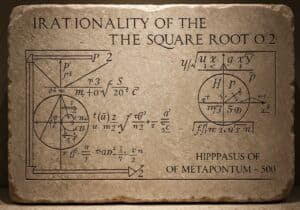
The logical foundation for proof by contradiction is the law of non-contradiction, which states that a proposition cannot be both true and false, and the law of the excluded middle, which states that a proposition must be either true or false. The method begins by assuming the opposite of what one wants to prove. For example, to prove that the square root of 2 is irrational, one starts by assuming it is rational. If [latex]\sqrt{2}[/latex] is rational, it can be expressed as a fraction [latex]a/b[/latex] in lowest terms, where a and b are integers. This leads to [latex]2 = a^2/b^2[/latex], or [latex]a^2 = 2b^2[/latex]. This implies [latex]a^2[/latex] is even, which means [latex]a[/latex] must also be even. So, [latex]a = 2k[/latex] for some integer k. Substituting this back gives [latex](2k)^2 = 2b^2[/latex], or [latex]4k^2 = 2b^2[/latex], which simplifies to [latex]2k^2 = b^2[/latex]. This means [latex]b^2[/latex] is even, and therefore [latex]b[/latex] is also even. If both a and b are even, the fraction [latex]a/b[/latex] was not in lowest terms, which contradicts the initial assumption. This contradiction forces the conclusion that the initial assumption—that [latex]\sqrt{2}[/latex] is rational—must be false. This method is powerful but can be non-constructive, as it proves a statement is true without providing a direct example or construction.
Related to: contradiction, reductio ad absurdum, indirect proof, irrational numbers, logic, law of non-contradiction, negation, assumption, Cantor, halting problem.