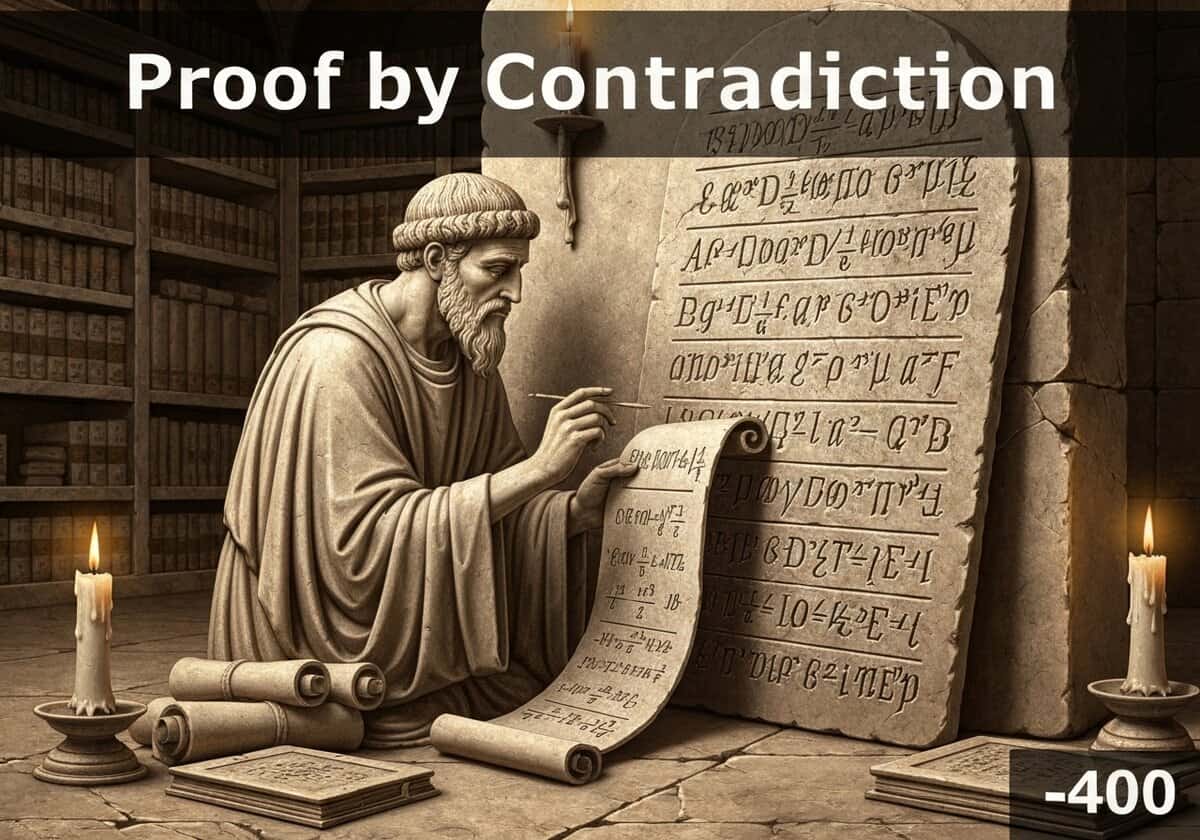
귀류법 또는 귀류법은 간접 증명의 한 형태입니다. 이는 어떤 명제가 거짓이라고 가정했을 때 논리적 모순이 발생함을 보여줌으로써 그 명제의 참을 증명하는 방법입니다. 명제 p를 증명하려면, 먼저 그 명제의 부정인 n=p를 가정하고, q=n=q와 같은 모순을 추론하여 p가 참임을 결론짓습니다.
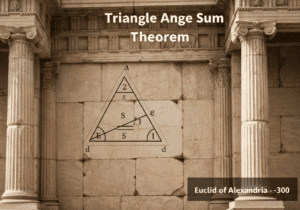
(설명을 위한 생성된 이미지입니다)
귀류법 또는 귀류법은 간접 증명의 한 형태입니다. 이는 어떤 명제가 거짓이라고 가정했을 때 논리적 모순이 발생함을 보여줌으로써 그 명제의 참을 증명하는 방법입니다. 명제 p를 증명하려면, 먼저 그 명제의 부정인 n=p를 가정하고, q=n=q와 같은 모순을 추론하여 p가 참임을 결론짓습니다.

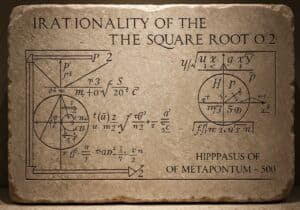
The logical foundation for proof by contradiction is the law of non-contradiction, which states that a proposition cannot be both true and false, and the law of the excluded middle, which states that a proposition must be either true or false. The method begins by assuming the opposite of what one wants to prove. For example, to prove that the square root of 2 is irrational, one starts by assuming it is rational. If [latex]\sqrt{2}[/latex] is rational, it can be expressed as a fraction [latex]a/b[/latex] in lowest terms, where a and b are integers. This leads to [latex]2 = a^2/b^2[/latex], or [latex]a^2 = 2b^2[/latex]. This implies [latex]a^2[/latex] is even, which means [latex]a[/latex] must also be even. So, [latex]a = 2k[/latex] for some integer k. Substituting this back gives [latex](2k)^2 = 2b^2[/latex], or [latex]4k^2 = 2b^2[/latex], which simplifies to [latex]2k^2 = b^2[/latex]. This means [latex]b^2[/latex] is even, and therefore [latex]b[/latex] is also even. If both a and b are even, the fraction [latex]a/b[/latex] was not in lowest terms, which contradicts the initial assumption. This contradiction forces the conclusion that the initial assumption—that [latex]\sqrt{2}[/latex] is rational—must be false. This method is powerful but can be non-constructive, as it proves a statement is true without providing a direct example or construction.
현재 하루 4만 건이 넘는 봇 트래픽을 차단하기 위해 이 콘텐츠는 커뮤니티 회원만 이용할 수 있습니다.
> 로그인 < 또는 >등록 < 이 콘텐츠를 비롯한 모든 제한된 콘텐츠와 도구는 (100% 무료로) 이용할 수 있습니다.
모순에 의한 증명(reductio ad absurdum)
(날짜를 알 수 없거나 관련이 없는 경우, 예를 들어 "유체역학"의 경우, 주목할 만한 등장 시기를 대략적으로 추정하여 제공합니다.)
고화질 이미지 및 다운로드는 등록된 회원에게만 100% 무료로 제공됩니다.
> 로그인 <