普朗克关系式是量子力学中的一个基本方程。 力学 它量化了单个光子的能量。公式为 E = hν,其中 E 是光子的能量,ν 是其频率,h 是普朗克常数。该关系式确立了光的粒子性,表明其能量以离散的包或量子形式存在。
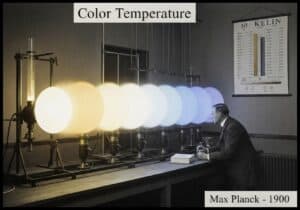
Max Planck first introduced this relationship in 1900 as part of his solution to the black-body radiation problem, which classical physics could not explain. He postulated that energy could only be emitted or absorbed by the walls of the black body in discrete packets, which he called “quanta”. The energy of each quantum was proportional to the frequency of the radiation, with the proportionality constant being [latex]h[/latex]. This was a radical departure from classical physics, where energy was considered continuous. In 1905, Albert Einstein extended this concept to light itself, proposing that light is not just emitted or absorbed in packets but actually consists of these discrete energy packets, later named photons. He used this idea to explain the photoelectric effect, where electrons are ejected from a material when light shines on it. The relation [latex]E = h\nu[/latex] is central to all of spectroscopy because it directly links the measurable frequency (or wavelength, since [latex]c = \lambda\nu[/latex]) of light to the discrete energy level transitions within atoms and molecules. When a substance absorbs or emits light, the photon’s energy [latex]E[/latex] must exactly match the energy difference [latex]\Delta E[/latex] between two quantum states of the atom or molecule, providing a direct probe into the quantum structure of matter.