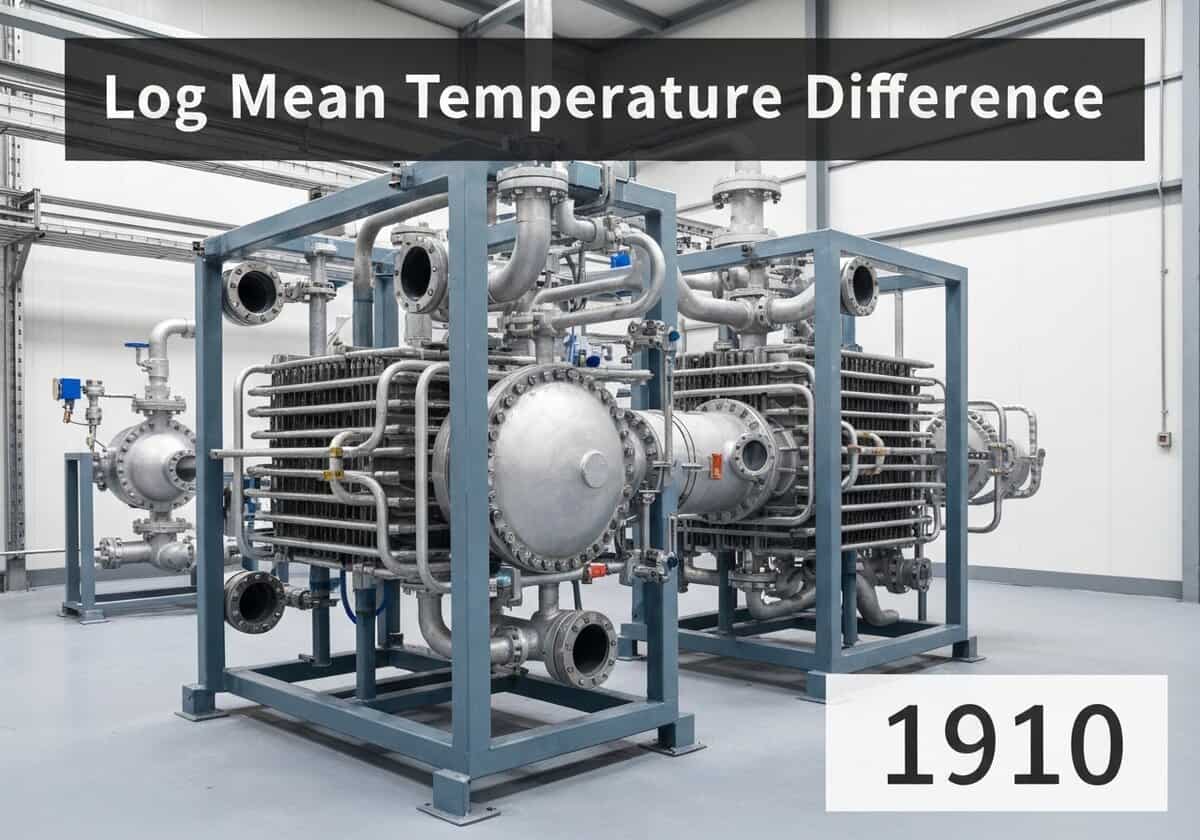
The LMTD method is a cornerstone of heat exchanger analysis. It arises from the integration of the heat transfer rate equation along the length of the exchanger, assuming constant fluid properties and overall heat transfer coefficient. The fundamental heat transfer equation is [latex]Q = U A \Delta T_{LM}[/latex], where Q is the rate of heat transfer, U is the overall heat transfer coefficient, and A is the heat transfer surface area. The LMTD correctly accounts for the non-linear temperature profile of the fluids as they flow through the exchanger. For a counter-current flow exchanger, [latex]\Delta T_A[/latex] and [latex]\Delta T_B[/latex] are the temperature differences at the two ends of the exchanger. For a parallel flow exchanger, the same formula applies, but the temperature differences are calculated differently based on the inlet and outlet positions. The counter-flow arrangement is generally more efficient as it yields a higher LMTD for given inlet and outlet temperatures, allowing for a smaller required surface area A for the same heat duty Q. However, when the temperature difference at one end is equal to the other, the LMTD is simply that temperature difference. If one of the temperature differences is zero, the LMTD is mathematically undefined, but in practice, this represents a limit where heat transfer ceases to be effective. For more complex geometries like cross-flow or multi-pass shell-and-tube exchangers, a correction factor F is applied to the LMTD, such that [latex]\Delta T_{eff} = F \cdot \Delta T_{LM, counterflow}[/latex].