Product Design, Manufacturing & Innovation Resources
» 化学电动势

化学电动势

1890
  • Walther Nernst
  • Josiah Willard Gibbs
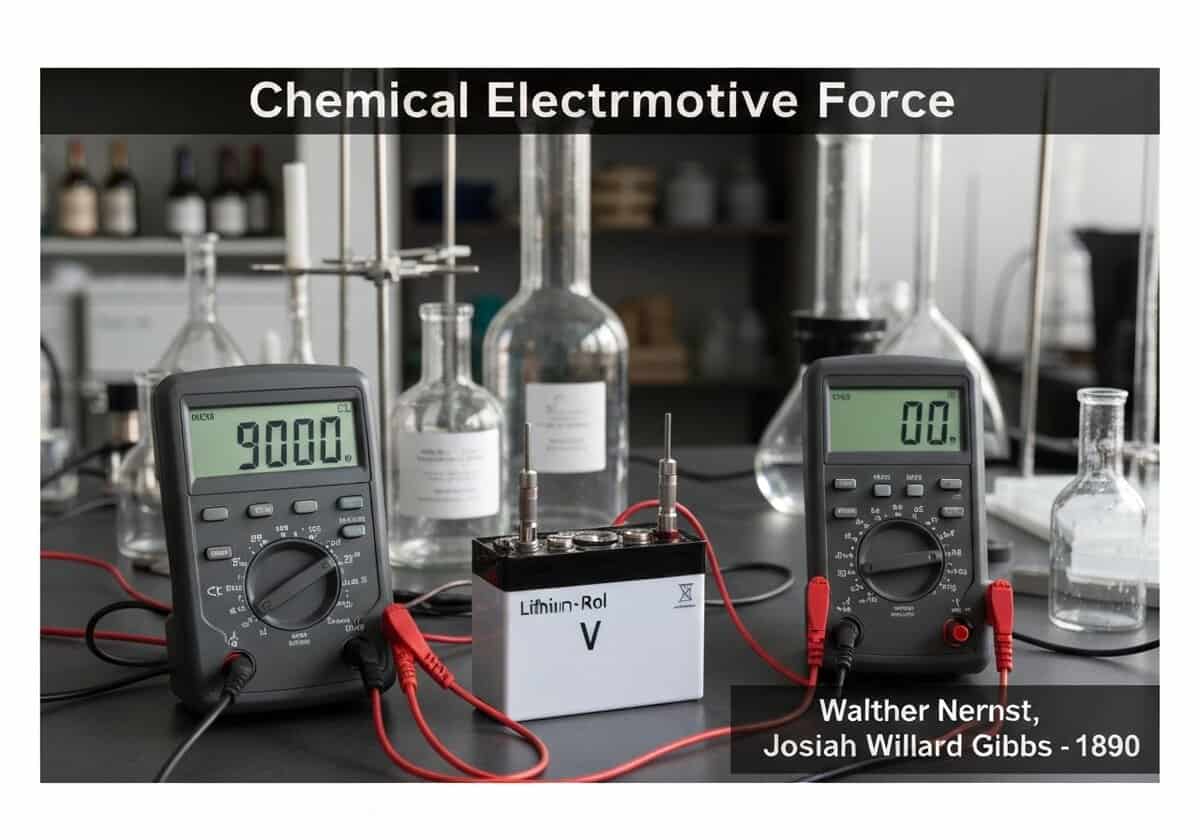
电化学实验室的锂离子电池测试。

(图片仅供参考)

In electrochemical cells like batteries and fuel cells, 电磁场 is generated by chemical reactions. The separation of charge is driven by oxidation and reduction reactions occurring at two different electrodes. The maximum EMF of a cell is related to the change in Gibbs free energy ([latex]Delta G[/latex]) of the reaction by [latex]mathcal{E} = -frac{Delta G}{nF}[/latex], where [latex]n[/latex] is moles of electrons and [latex]F[/latex] is the Faraday constant.


The electromotive force in a chemical source arises from the potential energy difference of electrons in different chemical species. In a galvanic cell, two dissimilar metals (electrodes) are placed in an electrolyte, creating two half-cells. At one electrode (the anode), an oxidation reaction occurs, releasing electrons. At the other electrode (the cathode), a reduction reaction occurs, consuming electrons. This creates an electrical potential difference between the electrodes. The chemical reactions effectively act as a “charge pump,” doing work on the electrons to move them from a lower potential energy state to a higher one, thus establishing the EMF.

The theoretical maximum EMF is determined by the thermodynamics of the reaction, specifically the change in Gibbs free energy ([latex]Delta G[/latex]), which represents the maximum non-expansion work that can be extracted from a thermodynamically closed system. The Nernst equation further refines this by relating the EMF to the standard electrode potential and the concentrations (or activities) of the reactants and products, showing how the cell’s voltage changes as the reaction proceeds and concentrations vary. This thermodynamic basis is fundamental to designing batteries with specific voltage outputs and energy densities, and for understanding processes like electrolysis, where an external EMF is used to drive a non-spontaneous chemical reaction.

UNESCO Nomenclature: 2203
– Electro-chemistry

类型

化学过程

中断

革命

用法

广泛使用

前体

  • Luigi Galvani’s experiments with frog legs
  • Alessandro Volta’s invention of the voltaic pile
  • 迈克尔-法拉第的电解定律
  • Josiah Willard Gibbs’s development of chemical thermodynamics

应用程序

  • 电池(碱性电池、锂离子电池、铅酸电池)
  • 燃料电池
  • 电解
  • 防腐蚀(阴极保护)
  • 电镀

专利:

NA

潜在创新理念

由于机器人流量被拦截(目前每天超过 4 万),此内容仅限社区成员查看。
> 登录 > 或者 > 注册 < (100% 免费)即可访问此内容,以及所有其他受限内容和工具。

Related to: electrochemistry, battery, galvanic cell, Gibbs free energy, Nernst equation, electrode, electrolyte, redox reaction.

历史背景

化学电动势

1885
1887
1889
1890
1890
1895
1895
1884
1887
1888
1889
1890
1890
1895
1895

(如果日期未知或不相关,例如“流体力学”,则提供其显著出现的近似估计)

相关发明、创新和技术原理

只有注册会员才能免费获得 100% 的全尺寸图片和下载。.

> 登录 <