Product Design, Manufacturing & Innovation Resources
» 化学起電力

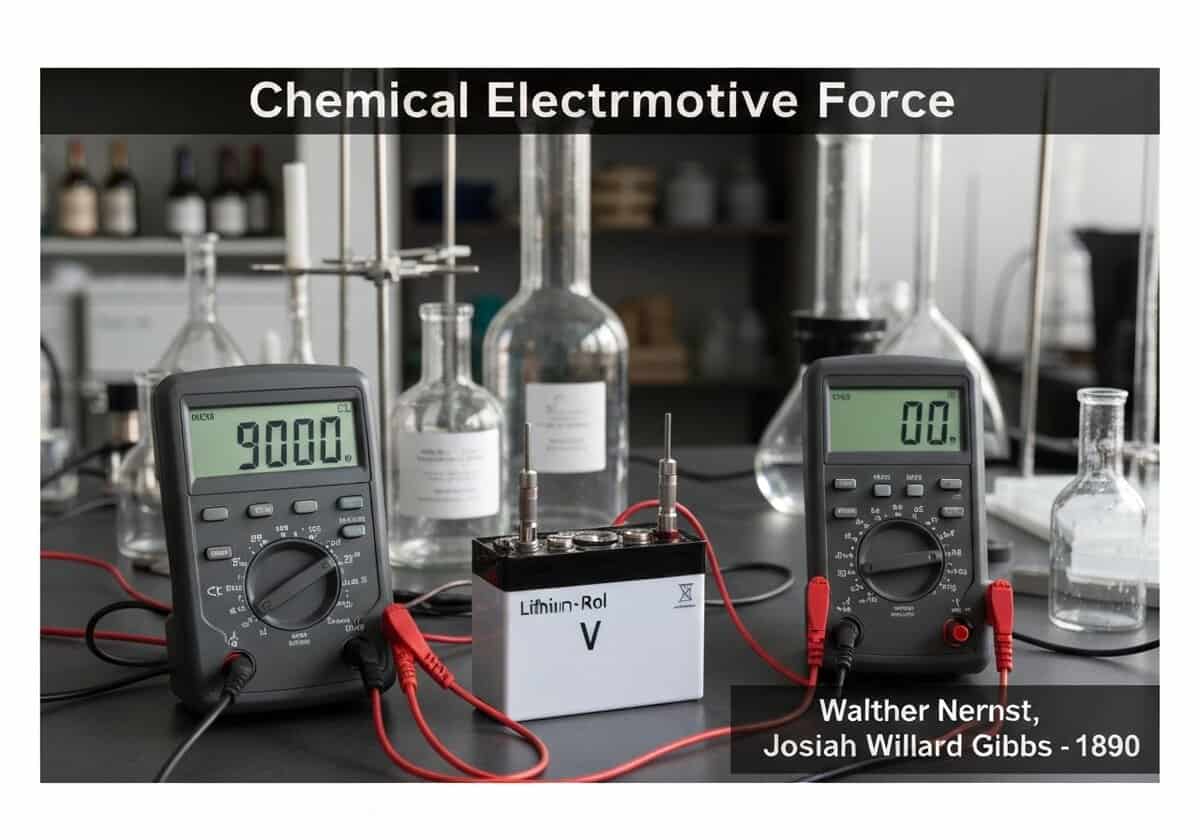
化学起電力

1890
  • Walther Nernst
  • Josiah Willard Gibbs
Lithium-ion battery testing in electrochemistry laboratory.

(画像はイメージです)

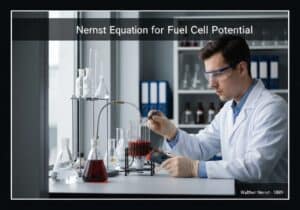
In electrochemical cells like batteries and fuel cells, EMF is generated by chemical reactions. The separation of charge is driven by oxidation and reduction reactions occurring at two different electrodes. The maximum EMF of a cell is related to the change in Gibbs free energy ([latex]Delta G[/latex]) of the reaction by [latex]mathcal{E} = -frac{Delta G}{nF}[/latex], where [latex]n[/latex] is moles of electrons and [latex]F[/latex] is the Faraday constant.


The electromotive force in a chemical source arises from the potential energy difference of electrons in different chemical species. In a galvanic cell, two dissimilar metals (electrodes) are placed in an electrolyte, creating two half-cells. At one electrode (the anode), an oxidation reaction occurs, releasing electrons. At the other electrode (the cathode), a reduction reaction occurs, consuming electrons. This creates an electrical potential difference between the electrodes. The chemical reactions effectively act as a “charge pump,” doing work on the electrons to move them from a lower potential energy state to a higher one, thus establishing the EMF.

The theoretical maximum EMF is determined by the thermodynamics of the reaction, specifically the change in Gibbs free energy ([latex]\Delta G[/latex]), which represents the maximum non-expansion work that can be extracted from a thermodynamically closed system. The Nernst equation further refines this by relating the EMF to the standard electrode potential and the concentrations (or activities) of the reactants and products, showing how the cell’s voltage changes as the reaction proceeds and concentrations vary. This thermodynamic basis is fundamental to designing batteries with specific voltage outputs and energy densities, and for understanding processes like electrolysis, where an external EMF is used to drive a non-spontaneous chemical reaction.

UNESCO Nomenclature: 2203
– Electro-chemistry

タイプ

化学プロセス

混乱

革命的

使用法

広く普及している

前駆物質

  • Luigi Galvani’s experiments with frog legs
  • Alessandro Volta’s invention of the voltaic pile
  • Michael Faraday’s laws of electrolysis
  • Josiah Willard Gibbs’s development of chemical thermodynamics

アプリケーション

  • batteries (alkaline, lithium-ion, lead-acid)
  • 燃料電池
  • electrolysis
  • corrosion prevention (cathodic protection)
  • 電気めっき

特許:

NA

潜在的なイノベーションのアイデア

ボットによるトラフィック(現在1日あたり4万件以上)を排除するため、このコンテンツはコミュニティメンバー限定となっています。
> ログイン < または > 登録 < (100%無料)でこれにアクセスできます。他のすべての制限付きコンテンツとツールも同様です。

Related to: electrochemistry, battery, galvanic cell, Gibbs free energy, Nernst equation, electrode, electrolyte, redox reaction.

歴史的背景

化学起電力

1885
1887
1889
1890
1890
1895
1895
1884
1887
1888
1889
1890
1890
1895
1895

(日付が不明または関連性がない場合、例えば「流体力学」などでは、その注目すべき出現時期の概算値が提示されます。)

関連する発明、革新、および技術原理

フルサイズの画像とダウンロードは、登録会員のみが100%無料で利用できます。