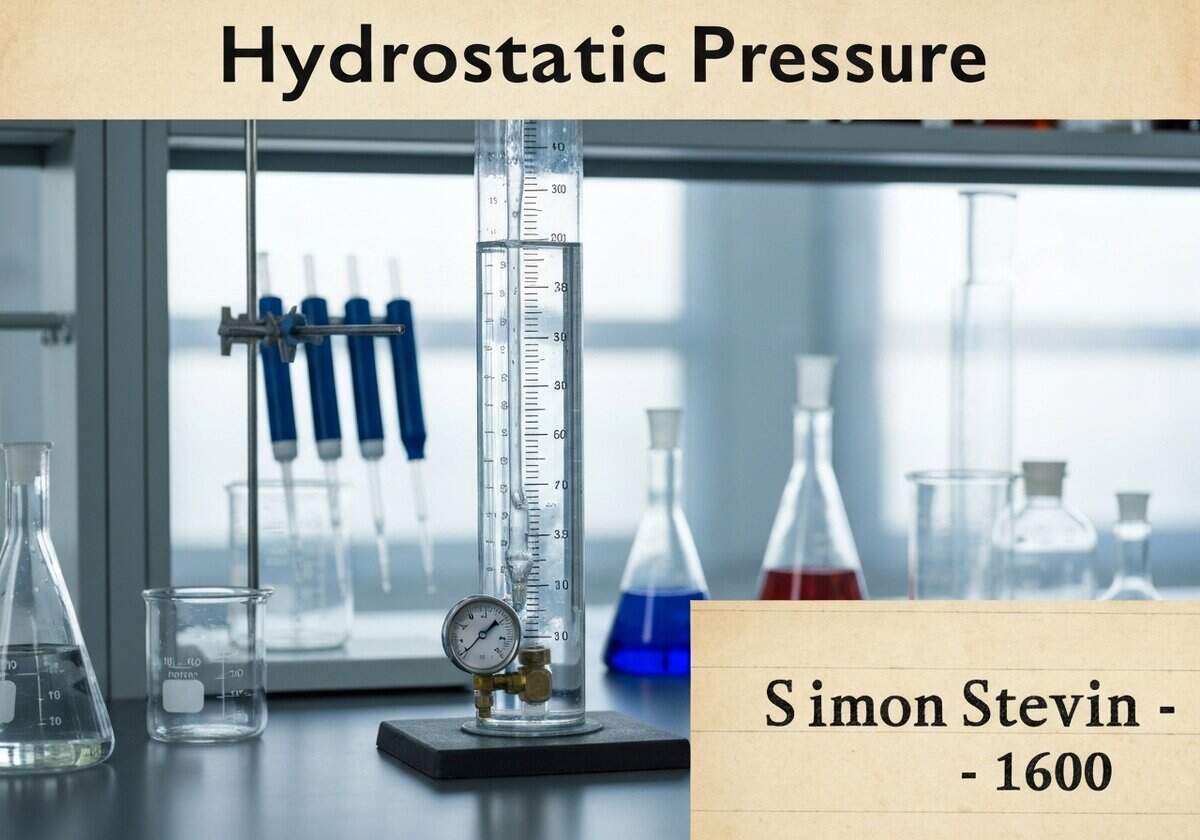
정수압 압력 압력은 유체가 평형 상태에 있을 때 유체 내 특정 지점에서 중력에 의해 작용하는 압력입니다. 유체의 무게가 증가함에 따라 위에서 아래로 작용하는 힘이 커지기 때문에 표면에서 측정한 깊이에 비례하여 압력이 증가합니다. 공식은 [latex]p = rho gh[/latex]이며, 여기서 [latex]rho[/latex]는 유체의 밀도입니다.
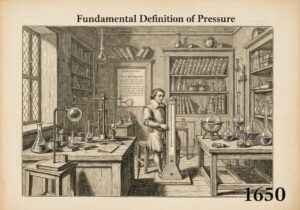

(설명을 위한 생성된 이미지입니다)
정수압 압력 압력은 유체가 평형 상태에 있을 때 유체 내 특정 지점에서 중력에 의해 작용하는 압력입니다. 유체의 무게가 증가함에 따라 위에서 아래로 작용하는 힘이 커지기 때문에 표면에서 측정한 깊이에 비례하여 압력이 증가합니다. 공식은 [latex]p = rho gh[/latex]이며, 여기서 [latex]rho[/latex]는 유체의 밀도입니다.

The principles of hydrostatic pressure were explored by Simon Stevin in the late 16th century, who demonstrated the hydrostatic paradox—that the pressure at the bottom of a container depends only on the height of the fluid, not the shape of the container or the total weight of the fluid. This concept was a significant advance from Archimedes’ earlier work on buoyancy. The formula [latex]p = \rho g h[/latex] quantifies this relationship, where [latex]p[/latex] is the hydrostatic pressure (gauge pressure, not including atmospheric pressure at the surface), [latex]\rho[/latex] is the fluid density, [latex]g[/latex] is the acceleration due to gravity, and [latex]h[/latex] is the height of the fluid column above the point of measurement. This linear relationship means that for every 10 meters of depth in water, the pressure increases by approximately one atmosphere. This has profound implications for deep-sea exploration, where submersibles must be engineered to withstand crushing forces. The same principle governs atmospheric pressure, although the calculation is more complex because air is a compressible gas, and its density ([latex]\rho[/latex]) is not constant with altitude. Hydrostatic equilibrium is a key concept in 천체물리학, describing the balance between gravity pulling inward and a pressure gradient pushing outward that keeps stars and planets stable.
정수압
(날짜를 알 수 없거나 관련이 없는 경우, 예를 들어 "유체역학"의 경우, 주목할 만한 등장 시기를 대략적으로 추정하여 제공합니다.)

고화질 이미지 및 다운로드는 등록된 회원에게만 100% 무료로 제공됩니다.
> 로그인 <