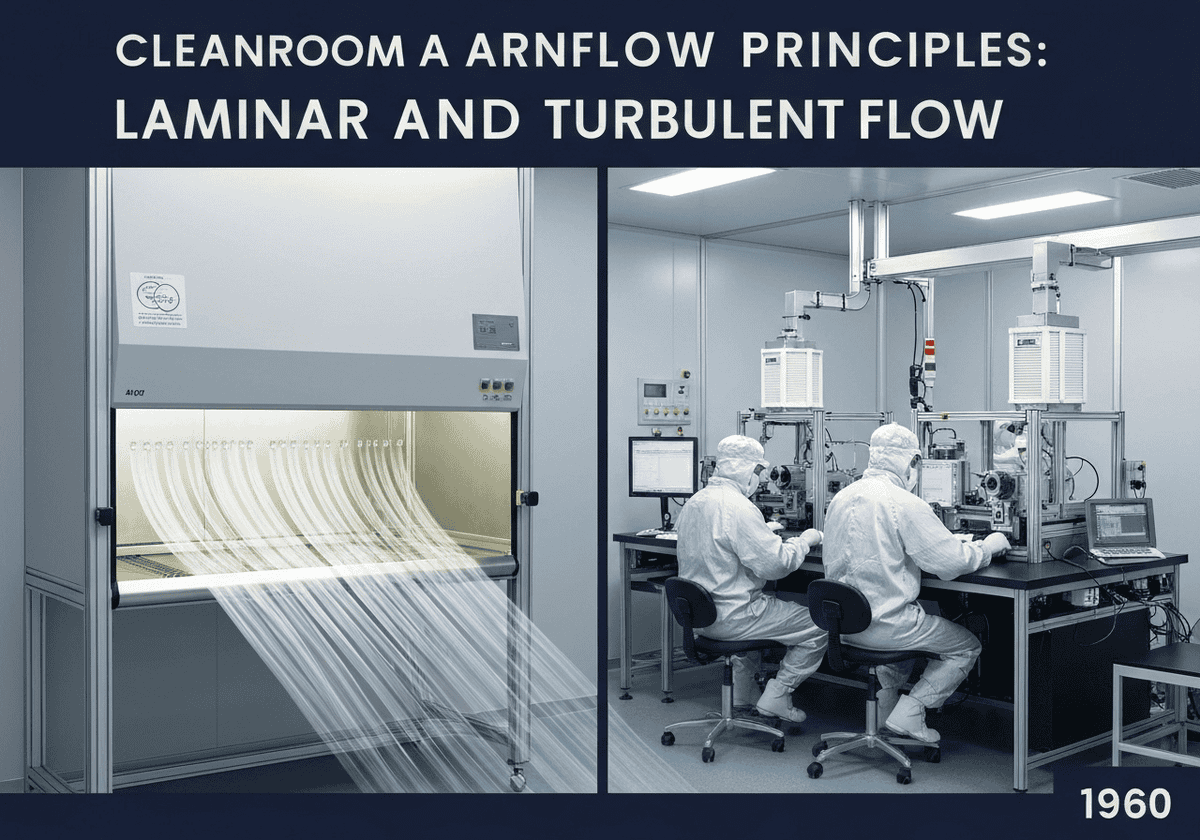
クリーンルームでは、汚染を制御するために主に2つの気流原理が用いられます。乱流(または非一方向流)は混合気流を利用し、比較的低レベルのクリーンルーム(ISO 6~9)に適しています。層流(または一方向流)は平行かつ一定速度の気流を用いて粒子を環境から除去し、ISO 1~5などの高純度用途に不可欠であり、相互汚染を防ぎ、粒子を迅速に除去します。

(画像はイメージです)
クリーンルームでは、汚染を制御するために主に2つの気流原理が用いられます。乱流(または非一方向流)は混合気流を利用し、比較的低レベルのクリーンルーム(ISO 6~9)に適しています。層流(または一方向流)は平行かつ一定速度の気流を用いて粒子を環境から除去し、ISO 1~5などの高純度用途に不可欠であり、相互汚染を防ぎ、粒子を迅速に除去します。

The choice between turbulent and laminar airflow is a fundamental design decision in cleanroom engineering, driven by the required cleanliness level and cost constraints. Turbulent flow rooms, the more conventional design, supply HEPA-filtered air from ceiling-mounted diffusers. The air enters the room, mixes with the existing air, and removes contaminants as it exits through low-level exhausts. While effective for many applications, the random air currents can create eddies where particles may linger or settle.
In contrast, laminar flow, also known as unidirectional flow, creates a predictable, uniform movement of air. In a vertical laminar flow room, the entire ceiling is composed of HEPA or ULPA filters, and the air travels straight down to a perforated raised floor, acting like a massive, slow-moving piston that pushes particles out. This design provides the highest level of air cleanliness by minimizing the time a particle can remain airborne and preventing lateral movement of contaminants. Horizontal laminar flow systems are also used, where air moves from a filtered wall to an exhaust wall. While significantly more expensive to build and operate due to the large filter area and high air-change rates, laminar flow is non-negotiable for processes like microchip fabrication where a single sub-micron particle can destroy a device.
ボットによるトラフィック(現在1日あたり4万件以上)を排除するため、このコンテンツはコミュニティメンバー限定となっています。
> ログイン < または > 登録 < (100%無料)でこれにアクセスできます。他のすべての制限付きコンテンツとツールも同様です。
クリーンルームの気流原理:層流と乱流
(日付が不明または関連性がない場合、例えば「流体力学」などでは、その注目すべき出現時期の概算値が提示されます。)

フルサイズの画像とダウンロードは、登録会員のみが100%無料で利用できます。
> ログイン <