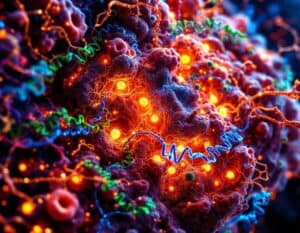
分子肿瘤学研究驱动癌症发生、发展和耐药性的遗传、表观遗传和生化改变。该领域整合了高通量测序、分子诊断和靶向治疗,以阐明致癌通路、抑癌基因失活和肿瘤微环境相互作用。分子谱分析、生物标志物发现和精准医学的进步重新定义了癌症的分类和治疗策略。以下汇编了最新的同行评审出版物和专利创新成果,反映了癌基因、信号转导、癌症干细胞、免疫调节和分子成像技术等领域的前沿研究,这些技术对于转化肿瘤学和临床应用至关重要。
这是我们最新精选的分子肿瘤学方面的全球英文出版物和专利,这些出版物和专利来自众多科学在线期刊,分类并侧重于癌基因、肿瘤抑制因子、信号转导通路、癌症基因组学、癌症表观遗传学、分子生物标志物、癌症靶向治疗、癌细胞信号转导、DNA 突变、肿瘤学中的 microRNA、癌症干细胞、细胞凋亡调控、肿瘤微环境、癌症免疫疗法、基因表达谱、染色体畸变、分子诊断、癌症蛋白质组学、致癌途径、癌症转移、致癌分子机制、肿瘤异质性、癌症表观基因组学、致癌病毒、分子靶向药物、癌症转录组学、DNA 修复机制、癌症药物基因组学和癌症分子病理学。.
A perspective on gene expression and regional brain sensitivity
Published on 2026-07-08 by @MIT
Abstract: AbstractNon-invasive transcranial ultrasound stimulation (TUS) enables deep brain therapeutic exploration at unprecedented scale. However, its optimal use is limited by the uncertainty surrounding ultrasound sensitivity across brain regions and cell types. This uncertainty often forces selection of sub-optimal parameter–target treatment paradigms guided solely by precedent, rather than an unbiased search of the larger combinatorial space. In principle, human brain-wide gene expression data cou[...]
Our summary: This perspective discusses the use of gene expression data to enhance transcranial ultrasound stimulation (TUS) parameter selection. It highlights the identification of regional gene expression clusters that may respond similarly to TUS. The findings emphasize the importance of optimizing stimulation parameters based on molecular profiles across different brain regions.
gene expression, transcranial ultrasound stimulation, brain regions, neuromodulation
Publication
Heterobifunctional compounds for the degradation of kras protein
Patent published on the 2026-07-02 in WO under Ref WO2026139448 by MERCK PATENT GMBH [DE] (Anderson Corey Don [us], Cheng Xinpeng [us])
Abstract: The invention provides compounds that degrade the Kirsten rat sarcoma viral oncogene homolog (KRAS) protein including mutant forms via the ubiquitination of the KRAS protein and subsequent proteasomal degradation. The compounds are useful for the treatment of various cancers.[...]
Our summary: The invention focuses on heterobifunctional compounds that target and degrade the KRAS protein, including its mutant forms. These compounds facilitate ubiquitination of KRAS, leading to its proteasomal degradation. They hold potential for treating various types of cancer.
Heterobifunctional compounds, KRAS protein, ubiquitination, proteasomal degradation
Patent
Chimeric antigen receptor fc-engineered granulocyte-monocyte progenitors for enhanced cancer immunotherapy
Patent published on the 2026-06-25 in WO under Ref WO2026136621 by UNIV SOUTHERN CALIFORNIA [US] (Majeti Ravindra [us], Ying Qi-long [us], Yue Shi [us])
Abstract: Provided herein are chimeric antigen receptors, comprising an extracellular domain capable of binding to an antigen, an Fc region, a flexible linker, a transmembrane domain, and may further comprise at least one intracellular domain that is designed to increase the anti-tumor activities of granulocytes, macrophages, and dendritic cells by increasing their phagocytosis and/or proinflammatory cytokines secretion and/or antigen presentation. Provided herein are vectors and nucleic acid molecules en[...]
Our summary: This content discusses the development of chimeric antigen receptors with Fc-engineering to enhance the anti-tumor activities of granulocyte-monocyte progenitors. It details methods for genetically engineering these progenitors to express the receptors and their potential differentiation into macrophages or granulocytes. The ultimate goal is to utilize these engineered cells in immunotherapy for cancer treatment.
chimeric antigen receptor, granulocyte-monocyte progenitors, cancer immunotherapy, Fc-engineering
Patent
Multifunctional molecules comprising soluble tcr fragments and uses thereof
Patent published on the 2026-06-18 in WO under Ref WO2026125496 by ENGIMMUNE THERAPEUTICS AG [CH] (Wehrle Sarah [ch], Lalevee SÉbastien [ch], Yang Qinmei [ch], Vazquez-lombardi Rodrigo [ch], Ehling Roy [ch], Crook Kenneth [ch], Kucharczyk Jakub [ch])
Abstract: The present invention is in the field of immunotherapy, in particular cancer immunotherapy and relates to multifunctional molecules comprising at least a soluble TCR fragment, a CD3 agonist, a CD2 agonist and optionally, an antibody Fc region. Furthermore, the invention relates to methods of making the multifunctional molecule according to the invention, as well as therapeutic uses thereof.[...]
Our summary: The invention describes multifunctional molecules that include soluble TCR fragments and CD3/CD2 agonists. These molecules are designed for applications in cancer immunotherapy. Methods for their production and therapeutic uses are also outlined.
multifunctional molecules, soluble TCR fragments, cancer immunotherapy, CD3 agonist
Patent
Lineage-loci engineered cell therapy and related methods of producing and using same
Patent published on the 2026-06-11 in WO under Ref WO2026123001 by UMOJA BIOPHARMA INC [US] (O'hara Samantha [us], Romanov Artem [us], Koning Ryan [us], Vereide David T [us], Yingst Ashley M [us], Jarrell Dillon [us])
Abstract: Provided herein are genetically engineered cells containing a payload in a lineage specific locus and related methods and uses thereof in cell therapy. In some embodiments, the cells are genetically engineered with a CAR, such that expression of the CAR is delayed until the cell is differentiated to a lineage. In some embodiments, the genetically modified cells can be selected for using a selection cassette. Also provided are cell compositions containing the engineered cells, and related methods[...]
Our summary: This content discusses lineage-loci engineered cell therapy and methods for producing genetically engineered cells. It highlights the use of CARs that are expressed upon cell differentiation. Additionally, it covers cell compositions, selection methods, and applications in cancer immunotherapy.
cell therapy, genetically engineered cells, CAR, lineage-specific locus
Patent
Tumor antigens for ovarian cancer and uses thereof
Patent published on the 2026-05-28 in WO under Ref WO2026107594 by UNIV DE MONTREAL [CA] (Perreault Claude [ca], Thibault Pierre [ca], Hardy Marie-pierre [ca], Vincent Krystel [ca])
Abstract: Ovarian cancer, notably high-grade serous ovarian cancer (HGSC), the principal cause of death from gynecological malignancies in the world, has not significantly benefited from recent progress in cancer immunotherapy. While HGSC infiltration by lymphocytes correlates with superior survival, the nature of antigens that can elicit anti-HGSC immune responses is still largely unknown. Novel tumor antigens shared by a large proportion of ovarian tumor cells are described herein. Several of the tumor [...]
Our summary: Novel tumor antigens for high-grade serous ovarian cancer are identified, derived from aberrantly expressed genomic sequences. These antigens are not present in normal tissues and may elicit immune responses. The study discusses their potential use in treatments, including nucleic acids, compositions, cells, and vaccines.
tumor antigens, ovarian cancer, immunotherapy, vaccines
Patent
A fluid processing device for processing droplets
Patent published on the 2026-05-06 in EP under Ref EP4737004 by IMEC VZW [BE] (Yurt Abdulkadir [be], Set Ying Ting [be], Moloudi Reza [be], Vandevelde Bart [be])
Abstract: [0001] The present invention relates to a fluid processing device for processing droplets. The device comprises a plate-like structure comprising a plurality of functional pixels. Each functional pixel is adapted to perform multiple operations on a droplet located on the pixel. Specifically, each pixel can selectively carry out at least two of the following processing operations: manipulating the droplet (e.g., its position), applying heat to the droplet, and subjecting the droplet to a magnetic[...]
Our summary: The invention is a fluid processing device designed for droplet manipulation. It features a plate-like structure with functional pixels that can perform multiple operations on droplets. This device integrates various microfluidic functions into a compact platform for applications in biochemical analysis and drug discovery.
microfluidics, droplet manipulation, functional pixels, biochemical analysis
Patent
Glioblastoma-Derived Extracellular Vesicles Modulate γδ T Lymphocytes Through a MIC-Dependent Mechanism
Published on 2026-02-03 by Micaela Rosato, Paula Saibene Vlez, Alejandra Infante Cruz, Matas A. Pibuel, Federico Fuentes, Mnica Vermeulen, Juan Iturrizaga, Pablo E. Espil, Silvia Berner, Gabriela V. Salamone, Carolina C. Jancic @MDPI
Abstract: Glioblastoma (GBM) is the most aggressive and common primary brain tumor, with a median survival of less than a year after diagnosis. γδ T lymphocytes are immune cells that can migrate to tumors and induce malignant cells’ apoptosis. Our previous in silico studies showed that higher γδ T-cell infiltration in GBM correlates with better patient survival, and in vitro experiments showed that GMB supernatants promote an antitumora[...]
Our summary: Glioblastoma-derived extracellular vesicles (EVs) modulate gamma delta T lymphocytes through a MIC-dependent mechanism. Increased CD69 expression, cytotoxicity, and cytokine production in T cells were observed following EV interaction. These findings offer insights for targeted immunotherapy development in glioblastoma patients.
Extracellular vesicles, Glioblastoma, Gamma delta T lymphocytes, Immunotherapy
Publication