Product Design, Manufacturing & Innovation Resources
Lar » Design de produto » Design Ecológico » Avaliação do Ciclo de Vida (ACV) no Design de Produtos, especificamente

Avaliação do Ciclo de Vida (ACV) no Design de Produtos, especificamente

Avaliação do Ciclo de Vida

À medida que as indústrias e os designers lutam contra as crescentes pressões regulatórias e a demanda do consumidor por sustentabilidade, a integração de Avaliação do ciclo de vida (ACV) em design de produto Os processos emergem como uma oportunidade significativa para melhorar o desempenho ambiental, mantendo a vantagem competitiva em setores de alto volume, como automotivo, eletrônico, construção e embalagens.

Este artigo fornece uma estrutura, principais ferramentas, bancos de dados, bem como 10 áreas específicas de projeto, para engenheiros que buscam aplicar o Avaliação do Ciclo de Vida in product design. It will cover fundamental principles outlined in ISO 14040/14044 standards, advanced Life Cycle Inventory (LCI) data collection methodologies, and in-depth Avaliação do impacto do ciclo de vida Metodologias de Avaliação do Ciclo de Vida (ACV) aplicadas ao projeto de produtos.

Principais conclusões

Avaliação do ciclo de vida
Vida útil assessment in product design
  • 4 fases da ACV: definição de objetivos, inventário, avaliação de impacto e interpretação.
  • Utilize métodos precisos de coleta de dados para uma modelagem de Inventário do Ciclo de Vida (ICV) acurada.
  • Selecione as metodologias de ACV apropriadas.
  • Analise os resultados da Avaliação do Ciclo de Vida (ACV) utilizando métricas estabelecidas.
  • Integre a Avaliação do Ciclo de Vida (ACV) aos processos de design para aumentar a sustentabilidade do produto.
  • Incorporar economia circular princípios para abordar o futuro desafios de design.

Princípios da Avaliação do Ciclo de Vida

A Avaliação do Ciclo de Vida (ACV) é um processo sistemático para avaliar os impactos ambientais associados a todas as etapas da vida útil de um produto, desde a extração da matéria-prima até a produção, o uso e o descarte.

Essa abordagem abrangente proporciona uma visão holística da pegada ambiental do produto, permitindo que projetistas e engenheiros identifiquem áreas para melhoria. A Avaliação do Ciclo de Vida (ACV) é crucial para o desenvolvimento sustentável de produtos, pois quantifica os potenciais impactos ambientais de forma mensurável.

As normas ISO 14040 e ISO 14044 padrões Fornecem uma estrutura para a realização da Avaliação do Ciclo de Vida (ACV), garantindo consistência e confiabilidade nas avaliações. Essas normas descrevem os princípios e requisitos para estudos de ACV, incluindo a definição do objetivo e escopo, a realização de análises de inventário, a avaliação de impactos e a interpretação dos resultados. A adesão a essas normas aumenta a credibilidade dos resultados da ACV e facilita a sua aplicação. comunicação entre as partes interessadas.

A Avaliação do Ciclo de Vida (ACV) é dividida em quatro fases distintas: definição de objetivos e escopo, análise de inventário, avaliação de impacto e interpretação, detalhadas a seguir:

1. Definição de Objetivo e Escopo

Esta fase inicial e fundamental estabelece a direção para toda a avaliação. Envolve definir claramente o propósito do estudo, a aplicação pretendida e o público-alvo dos resultados, bem como se as conclusões serão utilizadas para afirmações comparativas divulgadas ao público.

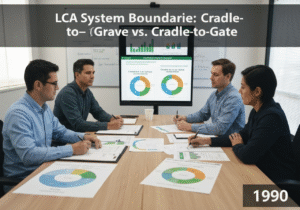
Os principais elementos estabelecidos nesta etapa incluem a unidade funcional, que fornece uma medida quantificável da função do produto e uma referência para comparação, e os limites do sistema, que determinam quais estágios e processos do ciclo de vida estão incluídos na análise (por exemplo, do berço ao portão ou do berço ao túmulo).

Definir cuidadosamente o objetivo e o escopo é crucial, pois isso orienta todas as fases subsequentes e garante a consistência e a relevância dos resultados finais.

Dual modeling approach
A utilização de uma abordagem de modelagem dupla na avaliação do ciclo de vida aprimora a compreensão do impacto ambiental de um produto, integrando perspectivas tanto atribucionais quanto consequenciais.

Dica: Empregue uma abordagem de modelagem dupla para robustez, definindo desde o início um escopo tanto atribucional quanto consequencial. Embora a maioria das ACVs (Avaliações do Ciclo de Vida) adote por padrão um modelo atribucional (quais impactos são atribuídos ao ciclo de vida do produto), defining a parallel consequential model (what systemic changes result from the product’s existence) provides deeper insights. Para produtos que visam influenciar a dinâmica do mercado ou moldar políticas públicas, é crucial apresentar resultados sob múltiplas perspectivas. Dessa forma, é possível obter uma compreensão mais profunda do impacto ambiental do produto e distinguir a pegada ecológica média do produto de seus efeitos marginais no sistema como um todo.

2. Inventário do Ciclo de Vida (ICV)

A segunda fase é a análise do Inventário do Ciclo de Vida (ICV), que consiste principalmente na coleta de dados. Envolve a identificação e quantificação de todas as entradas e saídas ambientais relevantes para o sistema do produto definido na primeira fase. Este inventário abrangente inclui o consumo de matérias-primas, energia e água, bem como as emissões para o ar, solo e água ao longo do ciclo de vida do produto. Os dados coletados são frequentemente organizados utilizando um modelo de fluxo para ilustrar as entradas e saídas de cada processo dentro dos limites do sistema. Esta fase é tipicamente a mais demorada de uma Avaliação do Ciclo de Vida (ACV) devido à complexidade de coletar dados precisos e abrangentes de diversas fontes.

Dica: implement a hybrid LCI approach to strategically fill data gaps. Instead of relying solely on process-based data or input-output tables, combine them. Use specific, primary data for key processes that are under your control or have high expected impacts (identified in the goal and scope phase). For less critical or upstream processes where primary data is unavailable, use environmentally extended input-output (EEIO) data. This hybrid método leverages the detail of process data where it matters most while ensuring the completeness of the system boundary, reducing the uncertainty that arises from relying on potentially mismatched proxy dados.
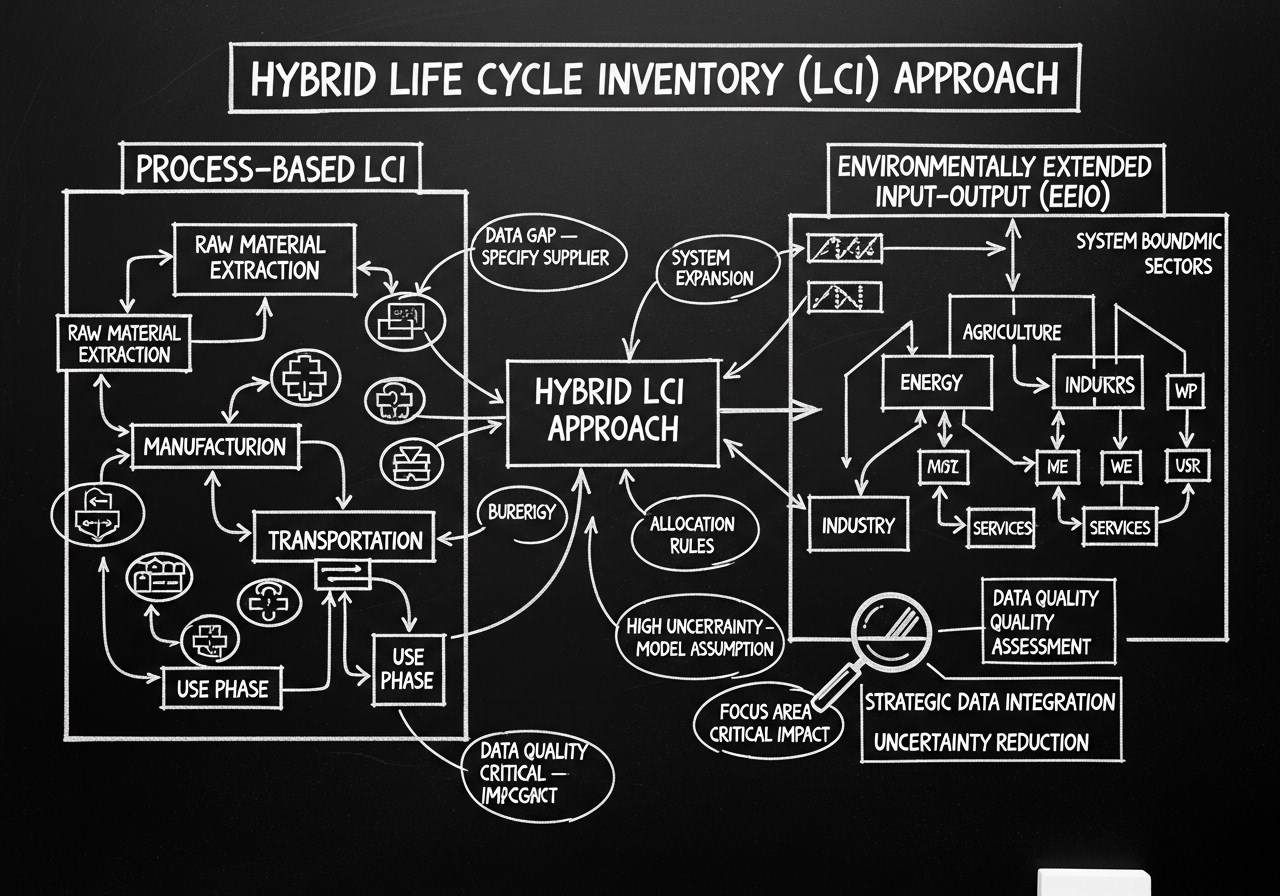
Hybrid lci approach
Abordagem híbrida de LCI para otimizar a precisão e a integridade dos dados no projeto e na engenharia de produtos.

Dica: Utilize modelagem estocástica para lidar com a variabilidade conhecida dos dados. Ao coletar dados primários ou secundários, em vez de usar valores pontuais (médias), caracterize os parâmetros-chave com distribuições de probabilidade (por exemplo, normal, lognormal, triangular). Por exemplo, distâncias de transporte, consumo de energia ou taxas de geração de resíduos frequentemente variam. Ao incorporar essas distribuições, você pode executar Monte Carlo simulações durante a fase de avaliação de impacto. Essa técnica propaga as incertezas de entrada por todo o modelo, produzindo resultados como distribuições em vez de pontuações únicas, o que proporciona uma visão mais realista e estatisticamente robusta dos potenciais impactos ambientais.

3. Avaliação do Impacto do Ciclo de Vida (ACV)

Na fase de Avaliação do Impacto do Ciclo de Vida (ACV), os dados coletados durante o Inventário do Ciclo de Vida (ICV) são traduzidos em potenciais impactos ambientais.

Isso é alcançado classificando-se inicialmente os resultados do Inventário do Ciclo de Vida (ICV) em categorias de impacto relevantes, como potencial de aquecimento global, acidificação e esgotamento de recursos. Após a classificação, uma etapa de caracterização quantifica a contribuição de cada entrada e saída para a categoria de impacto atribuída. Por exemplo, diferentes emissões de gases de efeito estufa são convertidas em uma unidade comum de equivalentes de CO2 para avaliar seu potencial de aquecimento global combinado. O objetivo da Avaliação do Impacto do Ciclo de Vida (ACV) é avaliar a significância ambiental dos fluxos identificados na fase de inventário.
Lcia methods
A utilização de múltiplos métodos de Avaliação do Ciclo de Vida (ACV) para análise comparativa aumenta a robustez das avaliações ambientais no projeto e inovação de produtos.

Dica: Realize a avaliação utilizando múltiplos métodos de ACV (Avaliação do Ciclo de Vida) cientificamente reconhecidos e compare os resultados. Não se baseie em um único método (por exemplo, ReCiPe ou TRACI), pois a escolha pode influenciar significativamente os resultados, especialmente para categorias relacionadas à toxicidade. Selecione dois ou três métodos distintos que tenham diferentes pressupostos de modelagem ou focos regionais (por exemplo, um orientado para o ponto médio, como o CML, e outro orientado para o ponto final, como o ReCiPe). Realizar uma análise comparativa dos resultados permite identificar conclusões consistentes entre diversas metodologias. Esse processo também revela quaisquer anomalias que possam surgir dos fatores de caracterização específicos associados a cada método.

Dica: Justifique sistematicamente o uso da normalização e da ponderação e apresente sempre os resultados com e sem essas etapas opcionais. A normalização (comparação dos impactos a uma referência, como o impacto anual total de uma região) e a ponderação (atribuição de importância às categorias de impacto) são escolhas baseadas em valores e podem ser controversas.

4. Interpretação do Ciclo de Vida

A fase final consiste na interpretação dos resultados do Inventário do Ciclo de Vida (ICV) e da Avaliação do Impacto do Ciclo de Vida (ACV). Isso envolve a análise das descobertas para tirar conclusões, identificar problemas ambientais significativos e fornecer recomendações que estejam alinhadas com o objetivo do estudo. Esta etapa inclui a avaliação da completude e consistência do estudo e a realização de testes de sensibilidade para avaliar a robustez dos resultados.

Em última análise, a interpretação deve traduzir as conclusões técnicas da avaliação em informações claras e práticas que possam orientar a tomada de decisões, como a identificação de oportunidades para melhorias ambientais no ciclo de vida de um produto.

Veja tambémAs 7 Fases Essenciais do Design do Ciclo de Vida do Produto
9658;

Dica: Realize uma análise sistemática de contribuição em múltiplos níveis para identificar os verdadeiros pontos críticos. Uma análise básica de contribuição identifica os estágios do ciclo de vida com os maiores impactos. Uma abordagem especializada aprofunda-se, dissecando esses pontos críticos. Para as categorias de impacto mais significativas, decomponha as contribuições não apenas por estágio do ciclo de vida, mas também por processo unitário e, em seguida, por fluxo elementar (por exemplo, emissões químicas específicas). Essa análise multinível fornece insights precisos e acionáveis, indo além de "a fabricação tem o maior impacto" para "a emissão da substância X durante o processo de pintura é o principal fator determinante da pontuação de ecotoxicidade".

Standardized Data Sources for LCA

As seen in the methodology above, a reliable standardized data source is necessary for conducting any credible Life Cycle Assessment. These databases provide the foundational Life Cycle Inventory (LCI) data necessary to model the environmental impacts of products, processes, and services. The reliability of an LCA study is directly linked to the quality and appropriateness of the data source selected.

Below is an inventory of some of the most widely used and respected standardized data sources in the field of LCA, with global and regional databases so as specialized and national databases:

 EcoinventGaBi DatabasesPEF DatabaseUSLCI DatabaseCarbon Minds
Primary FocusComprehensive, global LCI dataIndustry-focused, global LCI dataHarmonization and comparability within the EUU.S.-specific LCI dataChemicals and plásticos LCI data
Data TransparencyHigh (unit process level)
Moderate to 
High (aggregated and unit process)High (within PEF methodology)AltoHigh (consistent methodology)
Geographic CoverageGlobal, with strong European detailGlobal, with strong EU and U.S. detailPrimarily European UnionUnited States onlyGlobal, highly regionalized for chemicals
Sectoral CoverageVery broadBroad, with depth in industrial processesFollows specific Product Category RulesRange of common U.S. materials/processesSpecialized in chemicals and plastics
Update FrequencyAnnualAnnualOngoing developmentAs updated by NRELAnnual
Key StrengthTransparency, detail, and comprehensivenessStrong industry data and practical applicationComparability of results within the EUPublicly available, U.S.-specific dataHigh accuracy and detail for chemicals/plastics
Typical Use CasesAcademic research, complex global supply chains, detailed LCAsIndustrial product development, corporate sustainabilityEU-focused environmental claims, EPDsU.S.-based product assessments, public researchLCAs in the chemical and plastics industries
Producer

Ecoinvent Association

Commercial

Price: starts from ~€1,500 per year

Sphera

Commercial

Price: NA

European Commission, Joint Research Centre (JRC)

Open Access (with conditions)

Price: free of charge for PEF/OEF studies under approved category rules.

National Renewable Energy Laboratory (NREL)

Open Source / Public Domain

Price: free

 Carbon Minds

Commercial

Price: starts from ~€1,500 per year

The selection of a standardized data source for a Life Cycle Assessment is a critical step that should be guided by the specific goals and scope of the study. For broad, global assessments where transparency is paramount, Ecoinvent is often a top choice. For industry-specific applications, particularly in fabricação, GaBi provides valuable insights. When comparability within the EU is the primary driver, the PEF database is the most appropriate. For U.S.-centric studies, the USLCI offers a reliable and accessible option. Finally, for deep dives into the chemical and plastics sectors, the specialized data from Carbon Minds is unparalleled.

Understanding the strengths and weaknesses of each is a must for LCA practitioners to ensure their results are both accurate and credible.

Expert tip: to leverage their parameterization and uncertainty analysis features to create more dynamic and robust models. Instead of treating database values as fixed certainties, advanced users modify default datasets by linking key inputs—such as energy mix, transportation distances, or material efficiencies—to variables or formulas. This parameterization allows for rapid scenario analysis, where the impacts of potential supply chain modifications, technological improvements, or regional differences can be efficiently tested. Furthermore, by assigning probability distributions to these key parameters, practitioners can run Monte Carlo simulations to quantify the uncertainty in the final results. This elevates the LCA from a static report to a powerful decision-making tool, providing not only a baseline impact score but also a clear understanding of the confidence in the results and which variables have the most significant influence.

Other Free Sources

Beyond simply searching for established open-source LCA databases, method for uncovering alternative, high-quality data is to “data mine” the supplementary information sections of academic journals and the technical appendices of governmental or NGO reports: researchers conducting LCAs for niche materials or innovative tecnologias often publish their detailed Life Cycle Inventory (LCI) data as part of their methodology to ensure transparency and reproducibility.

Life cycle inventory
Detailed life cycle inventory data in academic publications enhances transparency and reproducibility in product design and innovation.

While not formatted as a ready-to-use database, these tables in articles from journals like the Journal of Industrial Ecologia or The International Journal of Life Cycle Assessment, and in reports from bodies like the IPCC or national environmental agencies, provide transparent, peer-reviewed raw data for specific processes. By methodically searching publicação científica databases (e.g., Google Scholar, Scopus) and institutional repositories using keywords related to a specific process plus terms like “life cycle inventory,” “supplementary data,” or “mass balance,” ones create a custom, scientifically-defensible dataset for novel applications not yet covered by mainstream sources.

Key Metrics for LCA & LCIA Interpretation

The selection of specific metrics for an LCA study is determined during the goal and scope definition phase and should be comprehensive enough to avoid burden-shifting—where improving one environmental impact inadvertently worsens another.

The analysis of Life Cycle Assessment (LCA) results requires careful interpretation of metrics obtained from two primary phases seen above:

  • In the LCI phase, a thorough inventory is created that catalogs all inputs, such as resources and energy, alongside outputs, including emissions and waste, associated with a product system. This phase serves as a foundational framework for understanding the resource utilization and waste generation throughout the product’s life cycle.
  • Following this, the LCIA phase converts the raw data from the LCI into actionable environmental impact indicators. These indicators elucidate the effects of the product on the environment, enabling a detailed assessment of its ecological footprint

Key Metrics from the Life Cycle Inventory (LCI) Phase

Life cycle inventory
Life cycle inventory metrics quantify resource use and environmental impacts for product design and innovation.

These metrics are direct quantifications of the resources consumed and substances released throughout the product’s life cycle. They form the foundation for the subsequent impact assessment. Typically:

  • Cumulative energy demand: this metric quantifies the total primary energy extracted from the environment to produce, use, and dispose of a product. It includes all energy sources, such as fossil fuels, nuclear, and renewables, and is typically measured in megajoules (MJ) or kilowatt-hours (kWh).
  • Water consumption/water use: this metric measures the total volume of freshwater consumed throughout the life cycle. It helps in understanding the product’s impact on water resources, especially in water-scarce regions, and is usually expressed in liters (L) or cubic meters (m³).
  • Material and resource inputs: this involves a detailed inventory of all raw materials used, including minerals and fossil resources. This data is crucial for assessing resource depletion.
  • Waste generation: this metric quantifies the total amount of solid waste produced, categorized by type (e.g., hazardous, non-hazardous) and final disposal method (e.g., landfill, incineration).
  • Greenhouse gas (GHG) emissions: this is a direct inventory of all greenhouse gases released, such as carbon dioxide (CO₂), methane (CH₄), and nitrous oxide (N₂O). These raw emission numbers are the basis for calculating the global warming potential.

Key Metrics from the Life Cycle Impact Assessment (LCIA) Phase

Global warming potential
Assessment metrics for environmental impact in product design and innovation.

The LCIA phase uses characterization models to convert the LCI data into a set of environmental impact indicators. These are typically presented as “midpoint” indicators, which represent potential impacts at an intermediate stage in the cause-and-effect chain.

Below are some of the most common LCIA impact categories and their corresponding metrics. The selection of these or other metrics, is completely depending on product or process:

 DescriçãoCommon Unit
arming Potential (GWP)Measures the potential contribution to mudanças climáticas by quantifying the heat-trapping capacity of greenhouse gas emissions. The impact is typically assessed over a 100-year time horizon (GWP100).

kg CO₂ equivalent

(kg CO₂-eq)

Ozone Depletion Potential (ODP)Assesses the potential for emissions of certain chemicals to deplete the stratospheric ozone layer, which protects the Earth from harmful ultravioleta radiation.

kg CFC-11 equivalent

(kg CFC-11-eq)

Acidification Potential (AP)Measures the potential of emissions like sulfur dioxide (SO₂) and nitrogen oxides (NOx) to cause chuva ácida, which can harm ecosystems and buildings.

kg SO₂ equivalent

(kg SO₂-eq)

Eutrophication Potential (EP)Quantifies the potential of nutrient emissions (e.g., nitrogen, phosphorus) to cause an over-enrichment of aquatic and terrestrial ecosystems, leading to harmful algal blooms and oxygen depletion.kg Phosphate equivalent (kg PO₄³⁻-eq) or kg Nitrogen equivalent (kg N-eq)
Photochemical Ozone Formation Potential (POFP)Also known as “smog formation,” this metric assesses the potential of volatile organic compounds (VOCs) and nitrogen oxides to form ground-level ozone in the presence of sunlight, which can harm human health and vegetation.kg Ethene equivalent (kg C₂H₄-eq)
Human Toxicity Potential (HTP)Evaluates the potential harm to human health from toxic substances, often categorized into cancer and non-cancer effects.kg 1,4-dichlorobenzene equivalent (kg 1,4-DB-eq)
Ecotoxicity PotentialAssesses the potential harm of chemical emissions to aquatic (freshwater and marine) and terrestrial ecosystems.kg 1,4-dichlorobenzene equivalent (kg 1,4-DB-eq)
Resource DepletionMeasures the consumption of non-renewable resources, including abiotic resources (minerals, fossils) and fossil fuels.kg Antimony equivalent (kg Sb-eq) or MJ
Particulate Matter FormationIndicates the potential health impacts from the emission of fine particulate matter (e.g., PM2.5), which can cause respiratory problems.kg PM2.5 equivalent
Land UseExamines the environmental impacts associated with land occupation and transformation, including effects on biodiversidade e ecossistema services.(various units, such as km²·year)

Integrate LCA in Product Design

Product designers directly influence the environmental footprint of the products we use.

It is frequently said that “80% of the final product cost is decided at the design stage” … product’s environmental impact is likely similar, or even greater as it also influences the related manufacturing process.

Integrating Life Cycle Assessment (LCA) into the design process is not an isolated activity; it extends established engineering principles like the Análise de valor approach, Design for Manufacturing (DFM), and the Product Life Cycle management already found in modern design specifications.

Value Analysis optimizes a product’s function against its economic cost; LCA provides the framework to optimize that same function against its environmental cost. Where DFM focuses on efficiency from the factory floor onwards, LCA expands that scope to the entire system—from raw material extraction to final disposal. By integrating LCA, designers add a quantitative environmental dimension to familiar, systems-based design processes. Understanding its specific applications is needed to design products with lower environmental impacts.

Product value analysis
Veja tambémVisão geral da análise de valor do produto
9658;
Veja tambémAs 7 Fases Essenciais do Design do Ciclo de Vida do Produto
9658;

Here are our specific aspects of LCA for this integrated design approach:

1. Life Cycle Thinking

Electric vehicle battery design
Designing electric vehicle battery enclosures with a focus on lightweighting, crashworthiness, and second-life potential to enhance sustainability and efficiency.

This foundational approach compels designers to consider a product’s entire journey—from raw material extraction (“cradle”), through manufacturing and use, to its final disposal or recycling (“grave”). It shifts the focus from isolated stages, like manufacturing cost, to the total environmental burden.

Practice “Systemic Life Cycle Thinking” by mapping not just the product’s direct lifecycle but also its interactions with larger systems. Consider how your product’s design influences user behavior (e.g., energy consumption habits), reverse logistics infrastructure (e.g., ease of collection and transport for recycling), and potential cascading failures in interconnected product systems.

Automotive application: when designing an electric vehicle’s battery enclosure, a standard approach focuses on lightweighting for efficiency and ensuring crashworthiness. Applying Systemic Life Cycle Thinking, a design team also considers its “second life” potential. They design the enclosure with standardized, non-destructive fasteners and integrated sensors that monitor cell degradation. This design choice simplifies removal, testing, and recertification of the battery module for use in a stationary energy storage system for homes or businesses, thus extending its functional life and delaying the energy-intensive recycling process. The LCA model for this design would include a separate “second life” use phase, significantly reducing the overall cradle-to-grave resource depletion and climate change impacts allocated to the vehicle’s initial use.

2. Goal and Scope Definition

This initial phase is where designers, alongside LCA practitioners, define the study’s purpose and boundaries. It answers critical questions: are we comparing two materials (a “screening” LCA)? Or are we certifying the final product’s footprint for an external claim (a full “ISO-compliant” LCA)? The scope determines the level of detail required.

Dica: utilize a “consequential” LCA scope in early-stage design instead of the more common “attributional” scope. An attributional LCA describes the impacts of a static system, while a consequential LCA models how the market might change in response to your design decision. For example, it would model whether choosing a bioplastic would actually stimulate the cultivation of more feedstock crops, including the associated land-use change impacts. This provides a more realistic picture of the large-scale consequences of a design choice.

Laparoscopic surgical tool
Evaluating the environmental impact of reusable versus single-use laparoscopic surgical tools through a cradle-to-grave analysis.

Medical device industry example: a company would designing a new laparoscopic surgical tool. The goal is to determine if a reusable, sterilizable stainless steel version has a lower environmental impact than a single-use polymer version over 100 surgical procedures. The scope is defined as “cradle-to-grave.” The functional unit is “performing 100 laparoscopic procedures.” The scope for the reusable tool crucially includes the energy and water consumption for the hospital’s steam sterilization (autoclave) process between each use, the manufacturing of cleaning agents, and transportation for potential repairs. The single-use tool’s scope includes the polymer manufacturing, assembly, and post-use transportation and disposal, typically via incineration due to biohazard regulamentos. This detailed scope will reveal whether the impact of repeated sterilization outweighs the impact of producing 100 disposable devices.

3. Functional Unit

The functional unit is a precise measure of the function that a product system delivers. It provides a fair and equivalent basis for comparing different product designs.

Energy-efficient laptop
Defining functional units for fair comparison of laptop energy efficiency and vida útil in product design.

One must define a multi-dimensional functional unit that incorporates performance and durability over time, not just a simple measure of service.

For a product like flooring, instead of “covering 1 square meter for 20 years,” an expert functional unit might be “providing a walking surface for 1 square meter for 20 years with a specified resistance to 50,000 abrasion cycles and requiring no more than 40 hours of cleaning.” This prevents misleading comparisons where a less durable product appears superior simply because its initial production impact is lower.

Consumer electronics example: um designer is comparing two laptops. A basic functional unit would be “3 years of typical office use.” A more expert, multi-dimensional functional unit is: “Execution of 5,000 hours of standardized office tasks (word processing, web browsing, video conferencing) over a 4-year service life, including the energy to recharge the device 1,000 times.” This rigorous definition ensures that a more energy-efficient laptop that lasts longer is fairly compared against a less efficient model that might have a slightly lower manufacturing footprint but a much higher use-phase impact and shorter lifespan.

4. Life Cycle Inventory (LCI)

The LCI is the data collection phase. It involves cataloging every input (energy, raw materials, water) and output (air emissions, water discharges, solid waste) for every stage of the product’s life. It is the most data-intensive part of an LCA.

Parametric lci model
Integrate parametric lci models with design software for real-time inventory feedback on product design choices.

CAD  Dica: instead of relying solely on generic database entries, create a parametric LCI model linked to your design software. This means key inventory flows (like material mass, energy for a specific machining process, or transport distance) are linked to variables in your CAD or PLM (Ciclo de vida do produto Management) system. When a designer changes a part’s thickness or the manufacturing location, the LCI updates automatically, providing near real-time feedback on how design choices influence the product’s inventory data.

To create the LCI for a high-performance waterproof jacket, a designer shall go beyond a generic “nylon fabric” database entry. They build a specific inventory model. It includes: the electricity and feedstock for extruding the specific nylon-6,6 polymer; the water, dyes, and chemical mordants used in the specific jet-dyeing process for the chosen color; the electricity for the weaving and heat-setting machines; the precise mass and chemical composition of the DWR (Durable Water Repellent) revestimento applied; and the fuel used for shipping components from the textile mill in Taiwan to the assembly plant in Vietnam.

5. Hotspot Identification

Hotspots are the specific life cycle stages, processes, or materials that contribute the most to the overall environmental impact.

Out-of-autoclave
Exploring lower-energy curing alternatives for carbon fiber manufacturing.

A key value of LCA for designers is its ability to pinpoint these areas, allowing for targeted, effective improvements.

Real Life Tip: before committing significant design resources to mitigating an identified hotspot, perform a sensitivity analysis. This involves systematically changing the key LCI data points for that hotspot (e.g., varying the electricity grid mix, transport distance, or a specific emission factor by ±30%) to see if it remains the most significant impact driver under different conditions. This ensures you’re not focusing on a hotspot that is merely an artifact of uncertain data.

Aerospace example: an LCA is performed on a carbon-fiber composite aircraft winglet. The initial analysis identifies the “use phase” (due to the winglet’s weight-saving fuel efficiency benefit over its 30-year life) as having the largest negative (i.e., beneficial) pegada de carbono. However,

the analysis also identifies a manufacturing hotspot: the energy-intensive, high-pressure curing process in an autoclave oven, which consumes enormous amounts of electricity (but one time/part). The design team, therefore, eventually focuses not on the carbon fiber material itself, but on exploring alternative “out-of-autoclave” curing resins that can be processed at lower temperatures.

6. Regionalyzed Impact Assessment (LCIA)

As reviewed above, the LCIA phase translates the long list of inventory data (e.g., kilograms of CO2, grams of lead, cubic meters of water) into a smaller, more understandable set of potential environmental impacts. These are categorized into areas like Global Warming Potential, Water Scarcity, and Human Toxicity.

One shall go beyond using a single, globally averaged LCIA method. Select regionalized impact assessment methods that reflect the actual location of your product’s life cycle stages.

For example, when assessing water use, use a method like AWARE, which differentiates between extracting a cubic meter of water in a water-scarce region like Spain versus a water-rich region like Sweden. This provides a more accurate and meaningful assessment of the true environmental local consequences.

Bio-based pla
Sustainable yogurt cup design utilizing bio-based pla from regional agricultural resources.

Food Packaging principle example: a company would designing a

yogurt cup made from a new bio-based PLA (Polylactic Acid) plastic. The feedstock corn is grown in the American Midwest, the PLA is polymerized in Germany, and the product is sold and disposed of in France. The LCIA shall use a regionalized method. For the “agricultural phase,” it applies a water scarcity model specific to the Midwest’s Ogallala Aquifer. For the “end-of-life” phase, it models the impacts based on the high rate of industrial composting infrastructure available in France, rather than a generic global landfill scenario. This could reveal a potentially significant water scarcity issue that a globally-averaged LCIA method would have missed.

7. Material Selection and Dematerialization

LCA provides the empirical data to compare material choices based on their full life cycle impacts. This supports selecting materials with a lower footprint and “dematerialization”—the strategy of reducing the total amount of material used to deliver the same function.

Dica: design shall integrate LCA databases with material selection software that uses Ashby charts (diagrams plotting material properties). By adding an axis for an environmental impact indicator (like embodied CO2 per kg or water use per kg), designers can visually screen for materials that meet required engineering properties (e.g., stiffness, tensile strength) while simultaneously having the lowest environmental impact. This allows for multi-criteria optimization at the earliest stage of material selection.

Lca databases
Integrating lca databases with material selection software enhances sustainable material choice by visualizing environmental impacts alongside engineering properties.

Furniture application (potentially high volumes = high ecological impact): a designer is tasked with redesigning a classic office chair backrest made of solid injection-molded polypropylene. Using generative design software integrated with an LCA tool, they define the functional load-bearing constraints and introduce the following changes:

  • The software can algorithmically generate a new, lattice-like structure that uses 45% less material (dematerialization) while maintaining the required structural integrity.
  • The material is switched to recycled PET pellets sourced from post-consumer bottles.

The LCA confirms that the combination of dematerialization and material substitution reduces the backrest’s embodied carbon footprint by over 60%.

8. Design for End-of-Life (DfEoL)

This aspect focuses on intentionally designing a product for what happens after its useful life is over. LCA helps quantify the benefits of strategies like Design for Disassembly (DfD), Design for Recycling (DfR), or using biodegradable materials.

Important note: while we strongly advocate for end-of-life design, do not forget the value analysis key “do not improve what you can suppress at the root“; in other words do no improved gadgets, suppress them!

Model and compare multiple, realistic end-of-life (EoL) scenarios in your LCA instead of assuming a single outcome (e.g., 100% recycling). For a given product, model a scenario mix based on real-world regional data: for instance, 50% recycling, 30% incineration with energy recovery, and 20% landfill. Weighting these scenarios by the infrastructure available in your target markets gives a much more robust and defensible EoL impact result than an idealized, best-case scenario.

Note also that this analyse can be country dependent: wood for example is considered in some countries as non-recyclable, and therefore badly scored, as in other countries, it is OK with a logic that can be simplified as following “carbon from air went to wood, now comes back to air; nothing is added20.

Core module
Innovative espresso machine design integrates key components into a modular system for improved recyclability and efficiency.

Home appliance principle example: when designing a new coffee machine, the engineers consolidate the heating element, bombear, and electronic controller into a single “core module.” This module is attached to the chassis with three standard screws and a single quick-connect wiring harness, instead of being dispersed and glued in place. The EoL scenario for the new design assumes a 70% probability of the “core module” being easily removed by recyclers, allowing for the targeted recovery of valuable copper and precious metals.

This “Design for Disassembly” approach shows a significant calculated reduction in the “resource depletion” impact category compared to the old model, where these components were shredded along with the low-value plastic housing.

For advanced levels: previous example is for illustration purpose; experienced field designer would take the scenario that in most organized countries, for such activity, recyclers would not unscrew every single screw, but use pneumatic guns to brake-apart fast plastics and separate parts. The optimal design is to have obvious breakable points in the plastic that brakes only when desired. But the screw design would be good for maintenance and prolonging product-life, so avoiding glue in any case!

9. Comparative Analysis and Trade-offs

LCA is rarely about finding a single “perfect” product but is instead a tool for understanding the complex environmental trade-offs between different design choices. A material might be better for climate change but worse for water toxicity.

Lca comparative analysis
Comparative life cycle assessment of recycled steel versus glulam beams highlights trade-offs in environmental impacts.

Dica: to visualize and communicate trade-offs to non-experts, avoid single-score results (which combine all impacts into one number). Instead, use a “spider diagram” (or radar chart). Each axis represents a different environmental impact category (e.g., carbon footprint, water use, ecotoxicity). Plotting the normalized results for two or more product designs on the diagram creates a shape for each. This provides an immediate visual representation of which design performs better in which category, facilitating a more nuanced and transparent decision-making process about which trade-offs are acceptable.

10. Communication and Substantiating Green Claims

In a market wary of “greenwashing,” a robust LCA provides the credible, third-party verifiable science to back up environmental marketing claims (e.g., “30% lower carbon footprint”). It is the foundation for formal certifications like Environmental Product Declarations (EPDs).

Running shoe
Innovative running shoe design integrates sustainable materials and rigorous lifecycle assessment to achieve a lower carbon footprint.

Instead of just communicating the final, positive results, use the LCA to transparently communicate the product’s main “hotspot” as well. For example: “This product has a 30% lower carbon footprint than its predecessor, primarily due to a new recycled material. We’re now working on its main remaining impact: the energy consumed during its use phase.”

This builds consumer trust through radical transparency and demonstrates an ongoing commitment to improvement, which is often more credible than a simple claim of perfection.

Conclusão

The pressing challenge of significantly reducing greenhouse gas emissions, as highlighted by the United Nations Environment Programme, establishes a compelling case for the adoption of Life Cycle Assessment (LCA) in product design.

Looking ahead, the future of LCA lies in its potential to adapt and evolve alongside emerging technologies and circular economy principles. As industries increasingly prioritize sustainability, the integration of LCA practices into product design will likely expand beyond traditional sectors, influencing areas such as healthcare, textiles, and food systems. This raises an essential question: how will organizations leverage LCA to anticipate and mitigate future environmental challenges while simultaneously driving innovation? As we stand at the intersection of technology and sustainability, the imperative remains clear: to transform insights gained from LCA into actionable strategies reduce environmental footprints but also has a sustainable economic future.

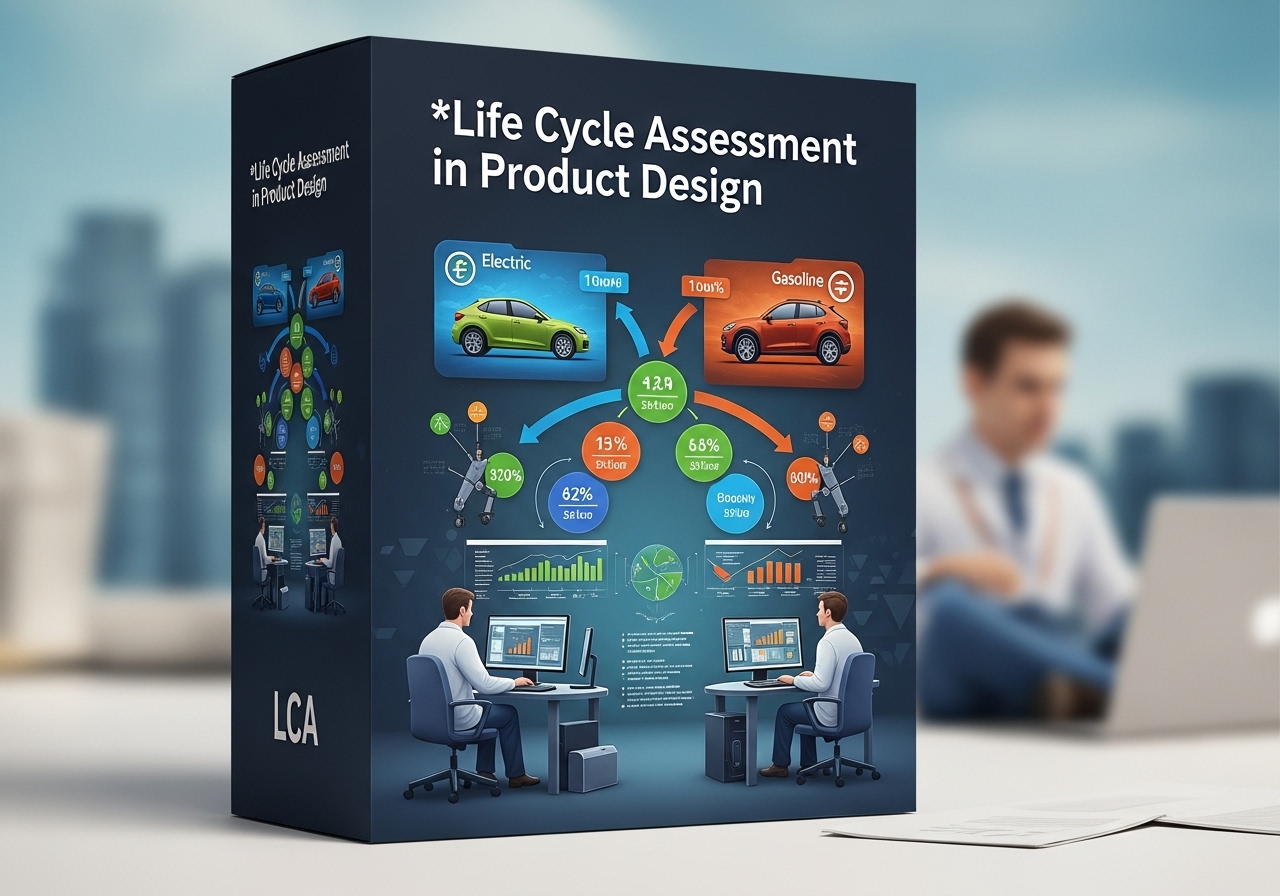
Electric vehicle life cycles
Comparative analysis of life cycles for electric versus gasoline vehicles and sustainable practices in electronics and construction.

Frequently Asked Questions

What is Life Cycle Assessment (LCA) in product design?

Life Cycle Assessment (LCA) is a systematic process for evaluating the environmental impacts associated with all stages of a product’s life cycle, from raw material extraction to disposal. It follows the ISO 14040/14044 standards, which define the framework and methodology for conducting LCA.

What are the 4 phases of LCA?

The phases of LCA include goal and scope definition, inventory analysis, impact assessment, and interpretation. Each phase contributes to a comprehensive understanding of the environmental impacts throughout the product’s life cycle.

What methodologies are used in Life Cycle Impact Assessment (LCIA)?

LCIA methodologies include Eco-indicator 99, ReCiPe, and CML. The selection of an appropriate methodology depends on the specific goals of the assessment and the types of impacts relevant to the product.

How can LCA results be interpreted for decision-making?

Interpreting LCA results involves analyzing key metrics such as carbon footprint, energy use, and resource depletion. Frameworks for integrating findings into strategic decision-making include sensitivity analysis and scenario modeling.

What role does LCA play in assessing sustainable vehicle design?

LCA evaluates the lifecycle impacts of vehicles, comparing electric and gasoline-powered options, including considerations for battery production and disposal. This assessment informs sustainable design choices in the automotive industry.

How does LCA facilitate sustainable design in the electronics sector?

In the electronics sector, LCA helps evaluate the environmental footprint of materials and end-of-life options such as recycling and remanufacturing. This analysis supports the design of more sustainable electronic devices.


Tópicos relacionados

  • Life Cycle Thinking in Product Development: understanding the holistic approach to evaluating environmental impacts throughout a product’s life cycle.
  • Functional Unit Definition: establishing a quantifiable measure to compare environmental impacts of different products or systems.
  • Quality Assessment of LCI Data: evaluating the reliability and completeness of life cycle inventory data for robust analysis.
  • Impact Categories in LCIA: identifying specific environmental impacts such as global warming potential, resource depletion, and human toxicity.
  • Uncertainty Analysis in LCA: assessing the variability in data and models to understand the reliability of the results.
  • Scenario Analysis in LCA: evaluating different future scenarios to understand potential impacts of design choices under varying conditions.
  • Life Cycle Costing (LCC): integrating economic analysis with LCA to evaluate the total cost implications over a product’s life span.
  • Social Life Cycle Assessment (S-LCA): assessing the social impacts of a product throughout its life cycle, complementing traditional environmental LCA.

External Links on Life Cycle Assessment in Product Design

(Passe o cursor sobre o link para ver nossa descrição do conteúdo)

Glossário de termos utilizados

Computer Aided Design (CAD): Um aplicativo de software usado para criar, modificar, analisar e otimizar projetos em diversas áreas, como engenharia, arquitetura e manufatura, permitindo desenhos e modelos precisos por meio de ferramentas e técnicas digitais.

Contract Manufacturer (CM): Uma empresa que produz bens para outra, geralmente seguindo especificações de design e qualidade específicas. Esse tipo de acordo permite que a empresa contratante se concentre em suas competências essenciais, como marketing e desenvolvimento de produtos, enquanto terceiriza os processos de fabricação.

Design for Disassembly (DfD): Uma abordagem de design que facilita a separação de componentes e materiais ao final do ciclo de vida de um produto, promovendo a reciclagem, a reutilização e a gestão eficiente de resíduos. Ela enfatiza a modularidade e a acessibilidade para aumentar a sustentabilidade e reduzir o impacto ambiental.

Design for Manufacturing (DfM): Um conjunto de princípios que visam simplificar e otimizar o projeto de produtos para melhorar a capacidade de fabricação, reduzir os custos de produção e aprimorar a qualidade, considerando os processos de fabricação, os materiais e as técnicas de montagem durante a fase de projeto.

Design for Reliability (DfR): Uma abordagem sistemática para o desenvolvimento de produtos que enfatiza a confiabilidade em todo o processo de projeto, incorporando técnicas para identificar e mitigar possíveis modos de falha, garantindo desempenho consistente e longevidade em ambientes operacionais.

International Organization for Standardization (ISO): a non-governmental international body that develops and publishes standards to ensure quality, safety, efficiency, and interoperability across various industries and sectors, facilitating global trade and cooperation. Established in 1947, it comprises national standardization organizations from member countries.

Life Cycle Assessment (LCA): Uma análise sistemática dos impactos ambientais associados a todas as etapas do ciclo de vida de um produto, desde a extração da matéria-prima até a produção, o uso e o descarte, com o objetivo de identificar oportunidades de melhoria e subsidiar a tomada de decisões.

Life Cycle Impact Assessment (LCIA): Um método para avaliar os impactos ambientais associados a todas as etapas do ciclo de vida de um produto, desde a extração da matéria-prima até a produção, o uso e o descarte, com foco no consumo de recursos, nas emissões e nos potenciais efeitos ecológicos.

Positron Emission Tomography (PET): Uma técnica de imagem médica que detecta raios gama emitidos pela aniquilação de pósitrons, usada para visualizar processos metabólicos em tecidos, frequentemente empregando radiotraçadores para avaliar condições como câncer, distúrbios neurológicos e doenças cardiovasculares.

Product Lifecycle Management (PLM): a systematic approach to managing a product's lifecycle from inception, through engineering design and manufacturing, to service and disposal, integrating people, processes, data, and technology to improve product quality, reduce time to market, and enhance collaboration across stakeholders.

Public Domain: Um status legal que indica que as obras estão livres de restrições de direitos autorais, permitindo que qualquer pessoa as use, modifique e distribua sem permissão ou pagamento. Esse status pode surgir da expiração dos direitos autorais, da dedicatória explícita do criador ou da falta de elegibilidade para direitos autorais.

Volatile Organic Compound (VOC): organic chemicals that have a high vapor pressure at room temperature, leading to significant evaporation and potential air pollution. They are commonly found in paints, solvents, and fuels, contributing to smog formation and adverse health effects.

Tópicos abordados: Avaliação do Ciclo de Vida, Design de Produto, Desempenho Ambiental, Sustentabilidade, Inventário do Ciclo de Vida, Avaliação do Impacto do Ciclo de Vida, ISO 14040, ISO 14044, Definição de Objetivos, Análise de Inventário, Avaliação de Impacto, Interpretação, Economia Circular, Métodos de Coleta de Dados, Modelo Atribucional, Modelo Consequencial, Abordagem Híbrida de Inventário do Ciclo de Vida e Modelagem Estocástica.

Contexto histórico

1986
1987
1989
1990
1990
1990
1990
1986
1986
1987-03
1990
1990
1990
1990
1990

(Caso a data seja desconhecida ou irrelevante, por exemplo, "mecânica dos fluidos", é fornecida uma estimativa aproximada de seu surgimento notável)

Imagens em tamanho real e downloads estão disponíveis apenas, 100% gratuitos, para membros registrados.