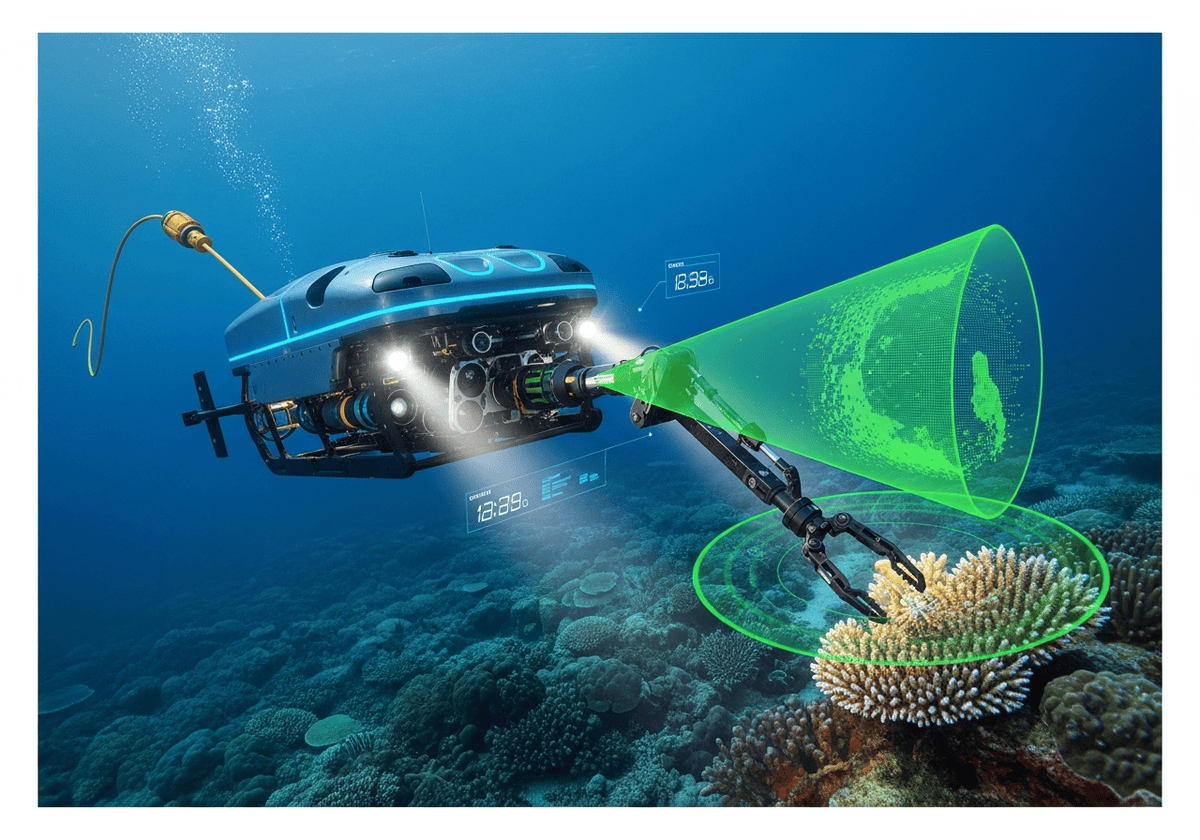

Remotely Operated Underwater Vehicles (ROUVs) and Remotely Operated Vehicles (ROVs) integrate advanced thruster control, tether management, underwater navigation, and sensor fusion to perform precise operations in subsea environments. Critical components include pressure-resistant housings, manipulator systems, sonar imaging, and real-time telemetry enabling inspection, maintenance, and data acquisition at variable depths and complex terrains. Research advances focus on autonomy algorithms, hydrodynamic optimization, power management, and comunicação protocols to enhance operational endurance and maneuverability. This collection compiles the latest peer-reviewed publications and patents detailing innovations in vehicle design, control architectures, mission planning, and payload integration driving subsea robótica capacidades.
Esta é a nossa mais recente seleção de publicações e patentes mundiais em inglês sobre Veículos Subaquáticos Operados Remotamente (ROUV) e Veículos Operados Remotamente (ROV), provenientes de diversos periódicos científicos online, classificadas e focadas em controle de propulsores, navegação subaquática, gerenciamento de cabos, sistema de sonar, manipulador ROV, comunicação subaquática, autonomia ROV, invólucro pressurizado, carga útil ROV, hidrodinâmica, planejamento de missão ROV, imageamento subaquático, veículo subaquático, sistema de controle ROV, gerenciamento de energia ROV, classificação de profundidade ROV, flutuabilidade ROV, propulsor ROV, sonar ROV, transmissão de vídeo ROV, Veículo Subaquático Operado Remotamente, Veículo Operado Remotamente, posicionamento ROV, desvio de obstáculos ROV, aquisição de dados ROV e inspeção ROV.
Underwater enclosure
Patent published on the 2026-06-10 in EP under Ref EP4755784 by INESC TEC INSTITUTO DE ENGENHARIA DE SIST E COMPUTADORES TECNOLOGIA E CIENCIA [PT] (De Oliveira Martins Alfredo Manuel [pt], Soares De Almeida JosÉ Miguel [pt], Valente De Almeida Carlos Eduardo [pt], Pereira Silva Eduardo Alexandre [pt])
Abstract: The present document discloses an underwater enclosure for holding a pressurised fluid for a variable buoyancy system, comprising: a watertight external shell for withstanding external underwater pressure; an airtight internal shell defining an internal chamber for holding the pressurised fluid and arranged for withstanding pressurised fluid pressure; wherein the internal and external shells are arranged in a spaced arrangement defining an intermediate volume between the internal and external sh[...]
Our summary: The document describes an underwater enclosure designed for a variable buoyancy system. It features a watertight external shell and an airtight internal shell to contain pressurized fluid. Additionally, it outlines the integration of this enclosure within an autonomous underwater vehicle.
underwater enclosure, buoyancy system, pressurized fluid, autonomous vehicle
Patent
Analytical response functions for a compressible thin fluid layer with odd viscosity *
Published on 2026-06-09 by Abdallah Daddi-Moussa-Ider, Yuto Hosaka and Shigeyuki Komura @IOP SCIENCE
Abstract: Fluids composed of chiral active components can exhibit odd viscosity, a property that breaks time-reversal and parity symmetries. We investigate the hydrodynamic response to monopole and dipole singularities in a compressible thin fluid layer with odd viscosity, supported by a conventional lubrication layer. Using the two-dimensional Green’s function in Fourier space, we derive analytical solutions for the flow and pressure fields. These solutions provide a detailed description of the hydrody[...]
Our summary: This study explores the hydrodynamic response of a compressible thin fluid layer with odd viscosity. Analytical solutions for flow and pressure fields are derived using the two-dimensional Green’s function in Fourier space. The findings enhance understanding of particle dynamics and collective behavior in chiral microfluidic systems.
odd viscosity, compressible fluids, hydrodynamic response, Green s function
Publication
Rotary propeller featuring enhanced slot effect through staggered blade configurations
Patent published on the 2026-06-04 in US under Ref US20260153096 by DOWNARD JACOB DORIAN [US] (Downard Jeffrey Brian [us], Downard Abigail Rebecca [us], Downard Jacob Dorian [us])
Abstract: The present invention provides a propeller assembly having staggered pairs of blades arranged to enhance hydrodynamic and aerodynamic efficiency across marine, aerial, energy, and industrial applications. Each propeller incorporates pairs of forward and aft blades configured with controlled rake, skew, and pitch to generate a coherent slot effect, particularly in the outer third of the blade span where linear velocity and thrust are greatest. By aligning the forward blade with the aft blade, the[...]
Our summary: The invention presents a rotary propeller with staggered blade configurations to enhance efficiency. It features controlled rake, skew, and pitch to improve thrust and reduce turbulence. Applications span marine, aerial, and industrial sectors, integrating conventional design parameters for superior performance.
propeller design, staggered blades, hydrodynamic efficiency, thrust optimization
Patent
vortices, bubbles and odd diffusion
Published on 2026-05-29 by Umberto Marini Bettolo Marconi, Alessandro Petrini, Raphael Maire and Lorenzo Caprini @IOP SCIENCE
Abstract: Starting from a microscopic multiparticle Langevin equation, we obtain a hydrodynamic description in terms of density and momentum fields for chiral active particles interacting via standard repulsive and nonlocal odd forces. These odd interactions are reciprocal but non-conservative: they are non-potential forces, as they act perpendicular to the vector joining any pair of particles. As a result, the torques that two particles exert on one another are non-reciprocal. The ensuing macroscopic con[...]
Our summary: This study develops a hydrodynamic model for chiral active particles under non-conservative odd forces. It predicts phenomena such as odd diffusivity, bubble-like structures, and vortices. The findings align with numerical simulations and suggest experimental validation in granular and microbial systems.
chiral active particles, odd viscosity, non-conservative forces, hydrodynamic description
Publication
Device for hydrodynamic testing of connections in the hollow organs of humans and animals
Patent published on the 2026-05-20 in UA under Ref UA163066U by E O PATON ELECTRIC WELDING INST OF THE NATIONAL ACADEMY OF SCIENCES OF UKRAINE [UA] (Chvertko Nataliia Anatoliivna [ua], Dubko Andrii Hryhorovych [ua], Romanenko Oleksandr Volodymyrovych [ua], Nikitin Viktor Oleksiiovych [ua])
Abstract: Device for hydrodynamic testing of connections in the hollow organs of humans and animals consists of a fluid pressure sensor, a data acquisition unit, a T-fitting, connecting tubes and a medical needle, and a flow pump, which is designed to deliver an unlimited supply of fluid to the test area.[...]
Our summary: The device tests connections in hollow organs using hydrodynamic principles. It includes a fluid pressure sensor and a data acquisition unit. A flow pump supplies fluid to the test area for accurate measurements.
hydrodynamic testing, fluid pressure sensor, data acquisition, medical device
Patent
Method for activating lime slurry
Patent published on the 2026-05-20 in UA under Ref UA130822 by INST OF ENGINEERING THERMOPHYSICS OF THE NATIONAL ACADEMY OF SCIENCES OF UKRAINE [UA] (Obodovych Oleksandr Mykolaiovych [ua], Rezakova Tetiana Anatoliivna [ua], Cherniavskyi Kostiantyn Yevhenovych [ua], Sheiko Tamila Volodymyrivna [ua], Stepanova Olesia Yevheniivna [ua])
Abstract: Invention relates to food industry, specifically sugar industry. Method for activating lime slurry, quenching burnt limestone with water and hydrodynamic cavitation activation of lime slurry in rotary pulsation device with discrete-pulse energy input and a pressure pulsation amplitude of 370-380 kPa in recirculation mode over 4-5 cycles. Technical result: increased activity of lime slurry by converting under-burned, over-burned, and encapsulated lime into an active state, which significantly red[...]
Our summary: The method activates lime slurry for the sugar industry by quenching burnt limestone with water. It utilizes hydrodynamic cavitation in a rotary pulsation device with specific pressure conditions. This process enhances lime activity, reducing limestone consumption in sugar purification.
lime slurry activation, hydrodynamic cavitation, sugar industry, rotary pulsation device
Patent
Systems, methods, and apparatus for a tank inspection robot and tether management system
Patent published on the 2026-05-14 in AU under Ref AU2024355055 by SQUARE ROBOT INC (Vaganay Jerome, Jarvis Ross)
Abstract: Systems, methods and apparatus for a tank inspection vehicle and a tether management system (TMS) are disclosed. The tank inspection vehicle is connected to the TMS via a negatively buoyant tether. The TMS is also connected to a power source external to a tank via a power and communications cable. The TMS selectively connects the vehicle to the power source via the tether and the power and communications cable. The TMS may include a frame, a float, a reel, a reel mechanism, a float switch, one o[...]
Our summary: The document describes a tank inspection vehicle connected to a tether management system (TMS) via a negatively buoyant tether. The TMS provides power and communication to the vehicle while managing the tether s length. It includes various components such as a frame, float, reel, sensors, and a control unit for operation in submerged environments.
tank inspection, tether management system, negatively buoyant tether, power source
Patent
Hydroelectric power plant
Patent published on the 2026-05-13 in UA under Ref UA162973U by KRYVOSHEI OKSANA VIKTORIVNA [UA] (Kryvoshei Viktor Yakovych [ua], Kryvoshei Liubov Oleksiivna [ua], Kryvoshei Oksana Viktorivna [ua])
Abstract: Hydroelectric power plant contains hydrodynamic blades and an electric energy generator, wherein a transmission is installed between the hydrodynamic blades and the generator, designed to regulate the generator rotation frequency depending on the power.[...]
Our summary: A hydroelectric power plant converts kinetic energy from water into electrical energy. It includes hydrodynamic blades that drive an electric generator. A transmission system regulates the generator s rotation frequency based on power output.
Hydroelectric, generator, hydrodynamic, transmission
Patent