Product Design, Manufacturing & Innovation Resources
» 製品デザイン » 価値分析 » 製品価値分析の概要

製品価値分析の概要

Product Value Analysis

製品価値 analysis (VA) plays in enhancing operational efficiency across various industries, not only including physical product development but also software development, and service sectors. As companies face increasing プレッシャー to deliver high-quality products at competitive prices, understanding the principles and methodologies of product 価値分析 エンジニアがプロセスと成果を最適化するために不可欠となる。

この記事は、製品価値分析の包括的な概要を提供することを目的としており、その中核となる原則と重要性を詳しく説明しています。 製造 さらに、バリューアナリシスの手法のうち、機能分析システム技法(FAST)とAPTE手法の2つを詳しく説明し、バリューアナリシスとバリューエンジニアリングの違いを明確にします。

主なポイント

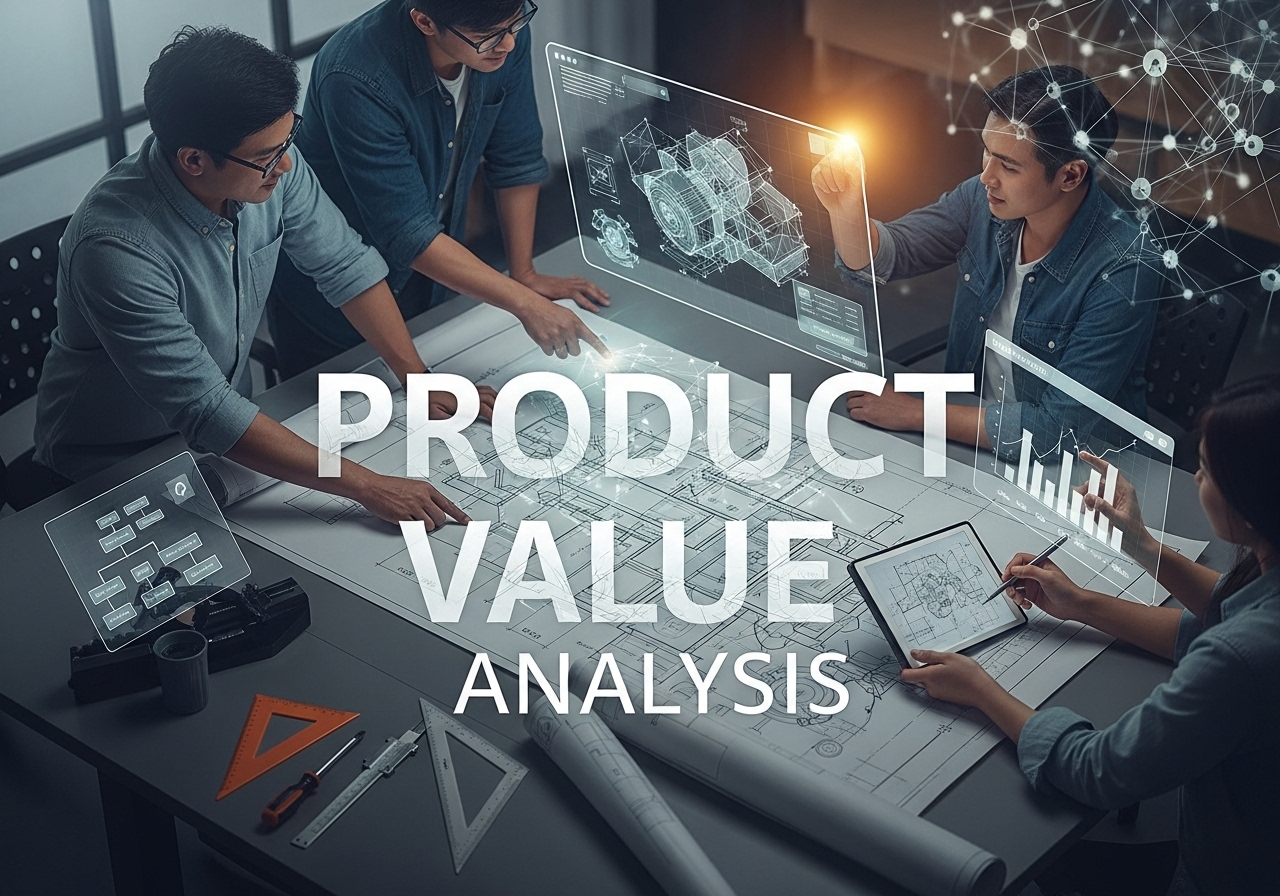
Engineering office
現代のエンジニアリングオフィスにおける、協働的な製品価値分析。
  • 価値分析は、コストに対する製品の機能性を向上させる。
  • この価値方程式は、機能性とコストを効果的にバランスさせている。
  • FAST手法は製品開発の効率性を向上させます。
  • 価値分析は、適用範囲において価値工学とは異なる。
  • コスト削減戦略は、まず設計と調達の段階から組み込まれる。

定義と基本原則

価値分析

価値分析とは、製品の機能と関連コストを分析することで、製品の価値を高めることを目的とした体系的なアプローチです。この手法は、品質を損なうことなくコストを最小限に抑えつつ、製品の機能性を向上させることを目指します。
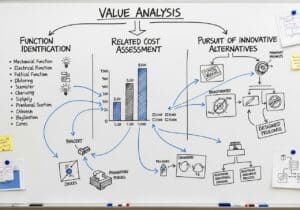
価値分析
価値分析は、革新的な設計案を通して、機能とコストを最適化することに焦点を当てています。

背景: 価値分析の起源は第二次世界大戦に遡り、ゼネラル・エレクトリック社のエンジニア、ローレンス・マイルズが資材不足に対処するためにこの概念を開発した。 導かれた 製造業におけるコスト削減と効率向上を目的とした、正式な方法論へ。

価値分析の主要原則には以下が含まれる。

  1. 機能識別
  2. 関連コスト評価
  3. そして、革新的な代替案の追求。

The methodology operates under the premise that every product or service must fulfill a specific function. By breaking down these functions and examining associated costs, organizations can identify opportunities for cost savings and improvement. This structured approach encourages creative problem-solving and collaboration among cross-functional チーム.

チームワーク
依頼内容:多様なエンジニアチームを描いた超リアルな写真を作成する。

価値分析を支援する手法はいくつかあり、機能分析、ブレインストーミング、費用対効果分析などが挙げられる。これらの手法を用いることで、チームは知見を収集し、重要な機能を特定し、価値を高める代替案を検討することができる。

製品価値分析は製造業にとどまらず、さまざまな産業にまで拡大した。

  • ソフトウェア development, it aids in prioritizing features relative to their costs, ensuring that resources are allocated efficiently.
  • サービス業においては、価値分析によって業務プロセスを効率化し、顧客満足度を向上させ、運用コストを削減することができる。

ヒント: 価値分析のメリットを最大限に引き出すには、異なる部門から多様なメンバーで構成されるチームを編成することが重要です。このような協働は革新的な思考を促進し、より効果的な解決策へと導きます。

機能

Function
製品やサービスの主な目的を特定することは、 製品デザイン and innovation.

機能を定義するとは、製品やサービスの主な目的を特定することです。機能には、自動車の輸送能力のような有形のものもあれば、快適さを提供するといった無形のものもあります。

重要な注意事項: 具体的な方法論や国によっては、製品のパラメータや仕様の一部が機能としてみなされない場合があります。議論の的となる典型的な例は以下のとおりです。

  • 遵守 基準
  • 「安全に」そして「安く」

これらは重要かつ必須の仕様ではありますが、製品の主な用途や目的ではありません。 価値の面では、 直接 ユーザーにとっての価値(これがVA以外の専門家との間で頻繁に議論される理由です)。車が運転できない場合、基準を満たしているという理由だけで車を購入する人はいません。

いくつかの方法論では、以下のように区別されます。

  • 主な機能(複数持つことも可能)(時速70マイル以下の道路で、5人をA地点からB地点まで200マイル輸送する)
  • 二次的な機能(四方から車に乗り降りできること、荷物を置くスペースがあること、キャンピングカーを牽引できることなど)。
  • 制約事項(基準を満たす、安全である、身長2mの人に対応できるなど)。これらの制約事項は機能そのものではありませんが、譲歩できない評価を受ける場合があります。

The Value Equation: Function vs. Cost

Product value analysis
Flowchart illustrating the interplay of function and cost in product value analysis.

Although very simple, the value equation is fundamental in product value analysis: value can be defined as the ratio of a product’s function to its cost, expressed mathematically as:

\(V = \frac{F}{C}\), where V represents value, F denotes (user) function, and C signifies cost.

This balance between function is at the core of achieving optimal value. This involves making trade-offs where necessary, such as enhancing a product’s features while minimizing expense.

ヒント: utilize benchmarking against industry standards to gauge function and cost effectively. This practice can reveal areas for improvement and inform strategic decisions in product development.

Functional Analysis Methodologies

Several functional analysis methodologies have been developed singe the 50s. We will explore two of them below. They both not only aid in function analysis but also serves as a robust フレームワーク for brainstorming potential improvements.

ヒント: when applying FAST or APTE below, ensure that all team members understand the definitions of functions to avoid miscommunication and misalignment in objectives. Regularly revisiting the FAST or APTE diagrams can also help teams stay aligned as the project evolves.

機能分析システム技法(FAST)

Engineers collaborating
Collaborative engineering team analyzing innovative design strategies in a modern workspace.

Function Analysis System Technique (FAST) is a structured approach used in product value analysis to identify and improve the functions of a product while minimizing costs. Developed by Lawrence D. Miles in the 1960s, FAST focuses on understanding the relationship between a product’s functions and costs to enhance value.

This methodology streamlines the process of function identification, ensuring that each function contributes meaningfully to the end-user experience.

The key components of FAST include a clear definition of functions, a graphical representation of these functions, and an emphasis on the relationships between different functions. The steps of the FAST methodology are as follows:

  1. List Functions: identify and list all functions of the product, system, or process being analyzed. Each function should be described using an active verb and a measurable noun.
  2. Categorize Functions: detail and prioritize the identified functions. Differentiate between the main functions, secondary functions, and any constrained functions.
  3. Construct the FAST Diagram: develop a graphical representation of the logical relationships between functions. This is executed from left to right.
  4. Expand Functions with “How” and “Why” Logic:
    – To build the diagram to the right (the “How” path), ask of a function, “How is this achieved?”. The answer, framed as an active verb and measurable noun, is placed to the right.
    – To validate the logic, move from right to left (the “Why” path) and ask of a function, “Why is this undertaken?”. If the logical connection is weak, it indicates a need to re-order, or identify missing or redundant functions.
  5. Identify Concurrent Functions: for any given function, ask, “When this function is performed, what other functions must be done or are caused by it?”. This helps to identify functions that occur at the same time or as a direct result of another function. The higher-order functions, which describe what is being accomplished, are placed towards the left of the diagram, while lower-order functions, describing how they are accomplished, are on the right.

Iterative Techniques like function breakdown and the use of “how-why” questioning enable teams to delve deeper into the rationale behind each function.

The APTE Methodology

The APTE methodology (a French MoSCoW は、 for “Application aux Techniques d’Entreprise“, translating to “Application to Business Techniques“) was developed from the principles of value analysis pioneered by Lawrence D. Miles in 1947. It was created by Gilbert Barbey in 1964 and later formalized by Bertrand de la Bretesche in his book “La méthode APTE : Analyse de la valeur, analyse fonctionnelle'#8220;。

Similarly to the FAST described above, this methodology was designed to provide a systematic approach for the design and improvement of products, processes, and services by focusing on functional analysis at the early stages of development to optimize quality and reduce costs. Although widely taught in engineering and business schools in France, usages in other countries have been less common.

The APTE methodology is grounded in the core principle of value analysis, asserting that a product or process should be designed to “do what you need at the lowest cost” and “forms follow function”. It systematically dissects a subject of study—be it a product, service, or process—into its essential functions to distinguish between:

  • functions: these are the functions that directly satisfy the fundamental need identified in the “Bête à cornes” diagram. They represent the primary reasons for the product’s existence.
  • constraints: what is eventually superfluous, not necessary the user’s demand. These are the functions that the product must perform to adapt to its environment, 規則, or other limitations. They are often imposed by the context in which the product operates.
"beast diagram" (apte methodology) of a wood bow
“beast diagram” (apte methodology) of a wood bow

The fundamental needs can be distinguished with the help of a “Bête à cornes” (Horned Beast) diagram representing all needs and specs of a product being developed:

the product being at the center,

  • the (real) functions link the user to something else, thus providing a service to the user or permitting to do or get something else.
  • constraints only link something external to the product only, thus benefiting or imposing to the product only. If the product would be different (other technology, other way of solving the need …), that constraint could disappear.

This functional approach is central, ensuring that every element of the design is directly linked to meeting a specific user need and not a technical solution. The methodology operates on the idea that by focusing on functions rather than the existing solution, a team can innovate more freely and avoid preconceived ideas, leading to an optimal balance between quality and cost.

Apte methodology
The apte methodology enhances product design by integrating systemic analysis, qualitative assessments, and economic evaluations within a collaborative framework.

Furthermore, the APTE methodology integrates a systemic, qualitative, and economic approach in a participatory and interdisciplinary framework. It is systemic because it analyzes the product’s interactions with all elements of its environment and lifecycle. The qualitative aspect involves a diagnosis to identify gaps between the desired quality and the current quality, while the economic diagnosis measures the gap between the necessary cost to fulfill a function and the actual cost of the current solution.

This dual focus on both performance and cost-efficiency drives the search for the “bare minimum” solution—one that precisely fulfills all required functions at the lowest possible expense, thereby maximizing value, very close to the more recent MVP approach (see below for details on MVP).

Minimum viable product
関連項目最小実行可能製品(MVP):プロのヒント
►


Comparison with Value Engineering

Value engineering is defined as a systematic 方法 aimed at improving the value of a product or service by analyzing its functions and costs. As described above, in the 1940s to address shortages in materials while maintaining product functionality. It focuses on maximizing function while minimizing costs, making it a complementary approach to product value analysis.

Both product value analysis and value engineering share the goal of optimizing value, yet they differ in their approaches:

  • value analysis emphasizes understanding and enhancing value through function analysis,
  • while value engineering targets cost reduction without sacrificing essential functions.

A notable distinction is that value analysis is often employed in the early stages of product development, whereas value engineering is typically applied during the design and production phases to refine existing products.

Choosing between these methodologies depends on the specific project requirements. Value analysis is preferable in the initial design phase to ensure optimal functionality and value creation. In contrast, value engineering is more suitable for established products where cost savings are needed without compromising their intended use.

側面価値分析Value Engineering
集中Function enhancementCost reduction
Application StageEarly design phaseProduction phase
客観的Maximize valueMinimize costs
方法論Function analysisCost analysis
Collaborative workspace
Collaborative innovation in a high-tech manufacturing workspace.

ヒント: regularly review and update value analysis practices to adapt to changing market conditions and technological advancements. Continuous improvement ensures sustained benefits and competitiveness.

結論

Value analysis methodologies
Value analysis methodologies enhance product design by focusing on core user needs, which in turn opens up a broader spectrum of innovative solutions.

By focusing on both cutting costs and improving features, companies can succeed in more and more competitive markets and provide better value to the final users.

Looking ahead, the principles of product value analysis hold untapped potential across various industries beyond those traditionally associated with lean manufacturing and design. As sectors such as healthcare and renewable energy increasingly prioritize efficiency and customer-centric solutions, the methodologies discussed here can be adapted to meet their unique challenges.

A continuous evolution in how the market perceives value, and how industries implement it.

Frequently Asked Questions

What is value analysis and what are its core principles?

Value analysis is a systematic method to improve the value of products, services, or processes by assessing their functions relative to their costs. Core principles include function identification, cost analysis, and the pursuit of alternatives to enhance value without compromising quality.

What is the value equation?

The value equation is defined as Function divided by Cost, illustrating the relationship between the utility of a product or service and its associated costs. Understanding this equation helps organizations balance functionality with expenditure to achieve optimal value.

What is the Function Analysis System Technique (FAST)?

FAST is a visual tool used to analyze functions in a product or service, focusing on the relationships between functions and their costs. Its application in product development aids in identifying unnecessary costs and improving overall value through function optimization.

How does value analysis compare to value engineering?

Value analysis and value engineering are both methodologies aimed at improving value, but they differ in focus; value analysis is often applied to existing products, while value engineering is typically used in the design phase. Both approaches can complement each other in achieving cost-effective solutions.

What cost reduction strategies can be derived from value analysis?

Cost reduction strategies from value analysis include identifying non-value-added activities, optimizing material usage, and redesigning processes for efficiency. These strategies can be applied across various sectors, including manufacturing, procurement, and service industries.

How is value analysis applied in product development and design?

In product development and design, value analysis is used to evaluate functions and costs to enhance product value while minimizing expenses. This approach aids in creating innovative solutions that meet customer needs effectively and efficiently.
 

関連トピック

  • ライフサイクル cost analysis: evaluating the total cost of ownership over the entire life span of a product to inform decision-making.
  • Customer value assessment: evaluating customer perceptions and needs to align product functions with market demands.
  • Risk analysis in value assessment: identifying potential risks associated with cost reduction strategies to ensure viability.
  • Value metrics development: establishing quantifiable measures to assess value in product features and functions.
  • Change management in value analysis: addressing the organizational impact of implementing value analysis findings and recommendations.
  • Design for manufacturability: integrating value analysis during the design phase to simplify manufacturing processes and reduce costs.
  • Value stream mapping: visualizing product flows and processes to identify waste and enhance value delivery.
  • Continuous improvement strategies: implementing ongoing refinements to processes based on value analysis outcomes.
  • Technology assessment: evaluating technological options to enhance product value and functionality.

External Links on Value Analysis

(リンクにカーソルを合わせると、コンテンツの説明が表示されます)

用語集

Function Analysis System Technique (FAST): システムの機能を分析し改善するために用いられる手法であり、機能間の関係を視覚的にマッピングし、それらの相互依存関係を特定し、優先順位を付けることで、目標達成における効率性と有効性を向上させる。

Minimum Viable Product (MVP): 初期ユーザーのニーズを満たし、今後の開発のためのフィードバックを収集するために必要な基本機能のみを搭載した製品の基本バージョン。最小限のリソースと時間投資で顧客ニーズに関する仮説を検証することを目的としている。

User experience (UX): the overall satisfaction and perception of a user when interacting with a product, system, or service, encompassing usability, accessibility, design, and emotional response throughout the entire interaction process.

Value Engineering (VE): プロジェクトの機能分析、コスト削減、パフォーマンス向上を通じて、品質や信頼性を損なうことなくプロジェクトの価値を高めるための体系的な手法。費用対効果の高い代替案を特定し、実行するために、学際的なチームワークが不可欠である。

Value Stream Mapping (VSM): プロセスにおける材料と情報の流れを分析・最適化し、付加価値のある活動と付加価値のない活動を特定することで、効率性を向上させ、無駄を削減するために使用される視覚的なツール。

取り上げるトピック: 製品価値分析、コスト削減、機能性、顧客満足度、業務効率、製造、製品開発、ソフトウェア開発、サービス部門、価値方程式、機能分析システム技法(FAST)、バリューエンジニアリング、情報収集、創造的評価、費用対効果評価、革新的な代替案、およびクロスファンクショナルチーム。

歴史的背景

1950
1955
1956
1960
1960
1960
1960
1950
1950
1955
1958
1960
1960
1960
1960

(日付が不明または関連性がない場合、例えば「流体力学」などでは、その注目すべき出現時期の概算値が提示されます。)

フルサイズの画像とダウンロードは、登録会員のみが100%無料で利用できます。