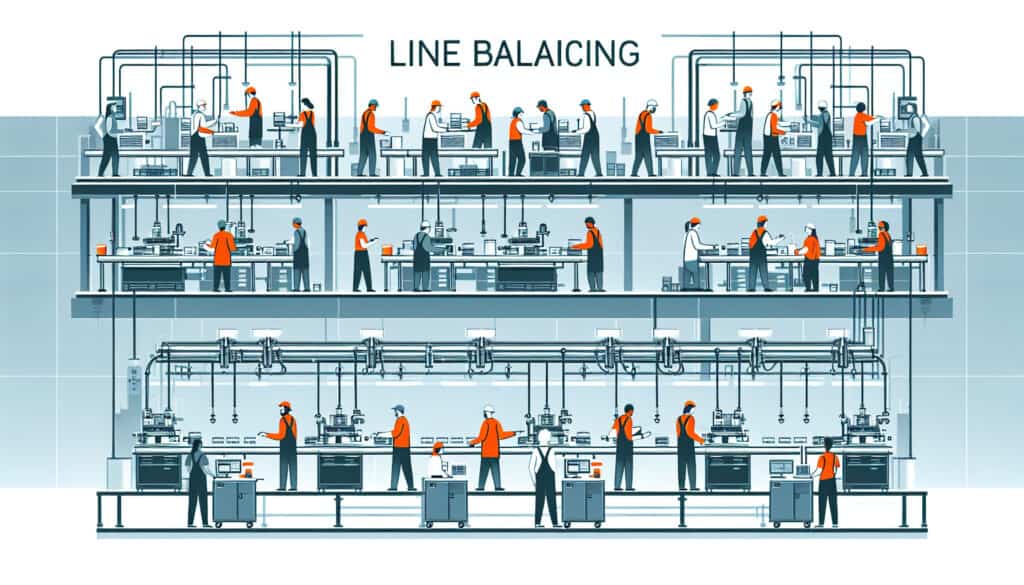
To optimize the allocation of tasks to workstations on an assembly line.
使用方法:
The process of assigning tasks to workstations on an assembly line in a way that minimizes the idle time of workers and machines. The goal is to create a smooth and efficient production flow.
長所
Improves efficiency and productivity; Reduces bottlenecks and idle time.
短所
Can be a complex and time-consuming process; May require specialized software and expertise.
カテゴリー:
リーンシックスシグマ, 製造業
最適な用途:
Optimizing the efficiency of an assembly line to improve productivity and reduce costs.
Line balancing is widely utilized in various manufacturing sectors such as automotive, electronics, and consumer goods, where assembly lines are prevalent. This methodology is particularly beneficial during the design and improvement phases of production processes, where understanding the flow of tasks across multiple workstations is crucial. Participants typically include production managers, process engineers, and assembly line workers, who collaborate to identify the most effective distribution of tasks based on cycle times and resource availability. Tools such as simulation software, workflow analysis, and time studies are frequently employed to visualize and assess the current state of production lines, enabling teams to experiment with configurations that eliminate bottlenecks and reduce worker fatigue. For instance, the automotive industry applies line balancing to maintain a constant flow of vehicle assembly while minimizing the downtime associated with machine maintenance or part shortages. Additionally, the practice is important in lean manufacturing initiatives, where the focus is on maximizing value while minimizing waste, thereby driving not only operational efficiency but also improvements in product quality. By continuously monitoring performance metrics and gathering feedback, organizations can iteratively refine their assembly processes, facilitating a culture of ongoing improvement that responds to changing market demands and technological advancements.
この方法論の主なステップ
Determine the cycle time for the assembly line based on production requirements.
List all tasks required for the production process and their respective time durations.
Calculate the theoretical minimum number of workstations needed by dividing the total task time by the cycle time.
Create a precedence diagram that illustrates task dependencies.
Assign tasks to workstations while considering task dependencies and the maximum cycle time.
Evaluate the balance efficiency using the formula: (total task time / (number of workstations x cycle time)) x 100.
Adjust task assignments if the balance efficiency is below desired levels to minimize idle time.
Perform a simulation or trial run to validate the new workstation assignments.
Implement feedback loops for continuous improvement based on real-world performance data.
プロのヒント
Conduct simultaneous engineering sessions with cross-functional teams to identify inefficient bottlenecks and enhance task integration across workstations.
Implement the Theory of Constraints to pinpoint process limitations, ensuring that workload distribution aligns with the slowest workstation.
Utilize advanced simulation tools to model various line configurations, assessing potential improvements before physical implementation.